

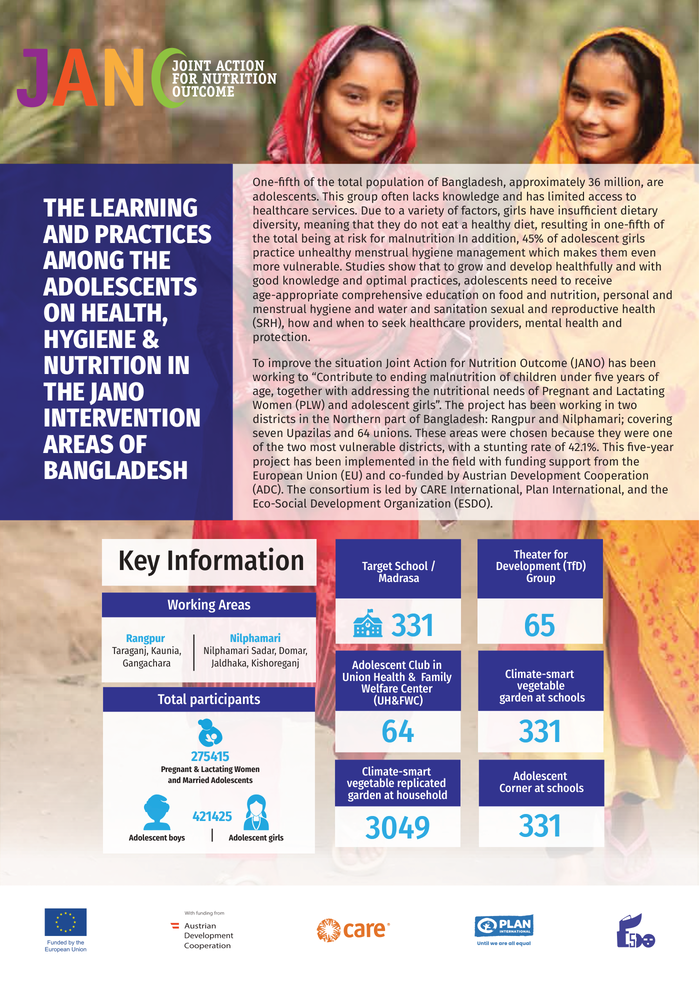
One-fifth of Bangladesh’s total population, approximately 36 million people, are teenagers. This group often lacks knowledge and has limited access to health services. Due to various factors, girls do not eat a diverse and healthy diet, which puts one-fifth of them at risk of malnutrition. Moreover, 45 percent of teenage girls have unhealthy menstrual hygiene practices, making them even more vulnerable. Research shows that to grow up healthy and acquire the right knowledge and optimal habits, teenagers need to receive comprehensive, age-appropriate education on food and nutrition, personal and menstrual hygiene, water and sanitation, sexual and reproductive health (SRH), how and when to seek health care providers, and mental health and protection.
To improve the situation, Joint Action for Nutrition Outcomes (JANO) has been working to “contribute to eliminating malnutrition in children under five years of age while addressing the nutritional needs of pregnant and lactating women (PLW) and adolescent girls”. The project covers seven upazilas and 64 union districts in two districts in northern Bangladesh, Rangpur and Nilphamari. These areas were chosen because they were among the two most vulnerable districts, with a stunting rate of 42.1%. The five-year project is implemented on the ground with funding from the European Union (EU) and co-financed by Austrian Development Cooperation (ADC). The consortium is led by CARE International, Plan International and the Ecosocial Development Organization (ESDO).
