

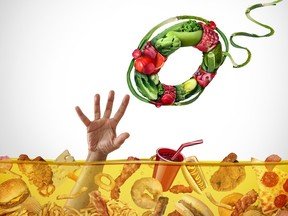
The idea that food and health are intimately related is not new: the Greeks recognized this in the 2nd century.
Article Contents
“Go vegetarian!” That was the advice Swami Satchidananda gave to a young Dean Ornish when he asked about improving his health. In 1972, Ornish was stricken with mononucleosis and then depression, forcing him to drop out of Rice University. While at home, he met the Swami, who was teaching meditation to his sister. This piqued Ornish’s interest, and a discussion ensued, resulting in the advice to not only embrace vegetarianism, but also to explore yoga and meditation. Ornish did as he was advised, and soon recovered to continue his studies, this time at Baylor College of Medicine.
Ad 2

Article Contents
Seeing his patients suffering from heart disease, Ornish began to wonder if the program that had solved his problem might work for others. He recruited a small group of patients who were willing to try his treatment and taught them about diet, exercise, and yoga. Within weeks, their condition improved, their chest pains lessened, and their cholesterol went down. This was a seminal moment in Ornish’s life and a defining moment in his career. He dedicated himself to researching whether diet and other lifestyle changes could prevent and even reverse heart disease.
Of course, the idea that food and health are intimately related is not new. As far back as the 2nd century AD, the Greek physician Galen described the relationship between food and health in his book On the Power of Food. The connection between diet and heart disease is also not new. In 1908, Russian physician Alexander Ignatovsky published a paper showing that rabbits who ate full-fat milk, eggs, and meat had clogged arteries with fat and cholesterol buildup. Then, in 1913, another Russian, Nikolai Anichkov, showed that feeding cholesterol to rabbits caused atherosclerosis, or hardening of the arteries due to the buildup of fatty deposits called “plaque.” The question of whether dietary fat and cholesterol also affect human arteries was not raised until the 1940s.
Ad 3
Article Contents
Lester Morrison graduated from McGill University, earned his medical degree from Temple University in Philadelphia, and worked as a physician in Los Angeles. Reading about Anichkov’s experiments piqued his interest in heart disease, and it was further fueled by noting that heart disease was recorded to decrease during wartime when food supplies were critical, and increase during peacetime when food was plentiful. As he had many heart disease patients in his clinic, Morrison decided to conduct an experiment. In 1946, he put 86 men and 14 women who had suffered heart attacks on a low-cholesterol, low-fat diet, while an equal number of control patients were asked to continue their normal diet.
Although this was a properly randomized trial, not double-blind, it was the first experimental study of the relationship between diet and heart disease in humans. After three years, the test group had lost weight and blood cholesterol, reduced angina symptoms, and increased exercise tolerance. More importantly, 30% of the control subjects had died, compared with only 14% of the test group. Morrison followed both groups for an additional five years, and the mortality rates were 44% in the test group and 76% in the control group. The study was deemed too small and the methodology questionable, and it received little attention from the medical community.
Ad 4
Article Contents
Meanwhile, researchers followed up Anichkoff’s rabbit feeding study. John Gofman at the University of California centrifuged serum from cholesterol-fed rabbits and identified two types of cholesterol, both attached to proteins and transported through the blood. One type floated to the top of the serum samples and was named low-density lipoprotein cholesterol (LDL), while the other was deposited at the bottom and was named high-density lipoprotein cholesterol (HDL). These two types of cholesterol were also found in human blood samples, and Gofman showed that men who had heart attacks had high LDL and low HDL. Then, in 1952, Lawrence Kinsel published a study in the American Journal of Clinical Nutrition showing that LDL could be reduced by consuming plant foods and avoiding animal fats.
At this point, the story took an interesting turn. It was thanks to Nathan Pritikin, who was neither a doctor nor a nutritionist. Pritikin had made his fortune as an entrepreneur, but in 1955, at the age of 40, he was devastated when a routine electrocardiogram revealed that he had heart disease. The view at the time was that the only way to cure it was to avoid both physical and mental stress. Pritikin decided to “do his own research,” a common recommendation from self-proclaimed nutrition gurus today. He found Morrison’s small study and, living nearby, made an appointment. A blood test revealed that he had high cholesterol, and Morrison encouraged him to try a low-fat diet. Pritikin accepted, adopted a strict vegetarian diet, and began an exercise program, ignoring the advice to avoid exercise. His blood cholesterol dropped dramatically, and he was convinced he was overcoming heart disease. He then underwent a cardiac stress test by running eight miles on a treadmill, which confirmed that his heart function was indeed normal.
Ad 5
Article Contents
Enthralled by the results, Pritikin became an evangelist for his diet and exercise regime and began funding medical research. He educated himself extensively, gave talks about his experiences, and eventually attracted national attention after publishing his book, Pritikin’s Diet and Exercise Program, in 1979. Pritikin was invited to speak at medical conferences, and although some criticized his diet as too extreme, he gained a solid reputation in the medical community. Pritikin ended up touting the effectiveness of his program posthumously. In 1985, in the final stages of leukemia, he committed suicide. An autopsy, as required by law, showed little to no arteriosclerosis. Furthermore, the pumping function of his heart was completely intact during his lifetime. However, a proper randomized trial proving that diet and exercise could reverse heart disease had yet to be done.
That’s just the kind of trial Ornish ended up running. Just a year after Pritikin’s death, 48 patients with coronary artery disease were randomized to an experimental group that received a strict vegetarian diet, an exercise program, and stress-management training that included yoga and meditation. After five years, the 28 patients who followed the program had fewer heart attacks and reduced blockages in their coronary arteries. Though the study was small, it demonstrated that lifestyle factors may play an important role in reversing heart disease, at least in some cases.
Ornish always credited Swami Satchidananda with inspiring his work, even writing the foreword to his healthy vegetarian cookbook. Vegetarianism and yoga worked for him, and he remained healthy until his death at age 88. Unfortunately, it seems he was interested in more than just vegetarianism. His reputation has been tarnished by allegations that he used his spiritual authority to coerce women into sexual relationships.
joe.schwarcz@mcgill.ca
Joe Schwartz is Director of the Office of Science and Society at McGill University (mcgill.ca/oss). He hosts the Dr. Joe Show every Sunday from 3:00-4:00 pm on CJAD Radio 800 AM.
Editor’s recommendation
-

Correct Chemistry: Following the Trail of Chemtrail Nonsense
-

Right Chemistry: Facial Creams and Lotions Deliver Hope in a Bottle


Ad 6
Article Contents
Article Contents
