

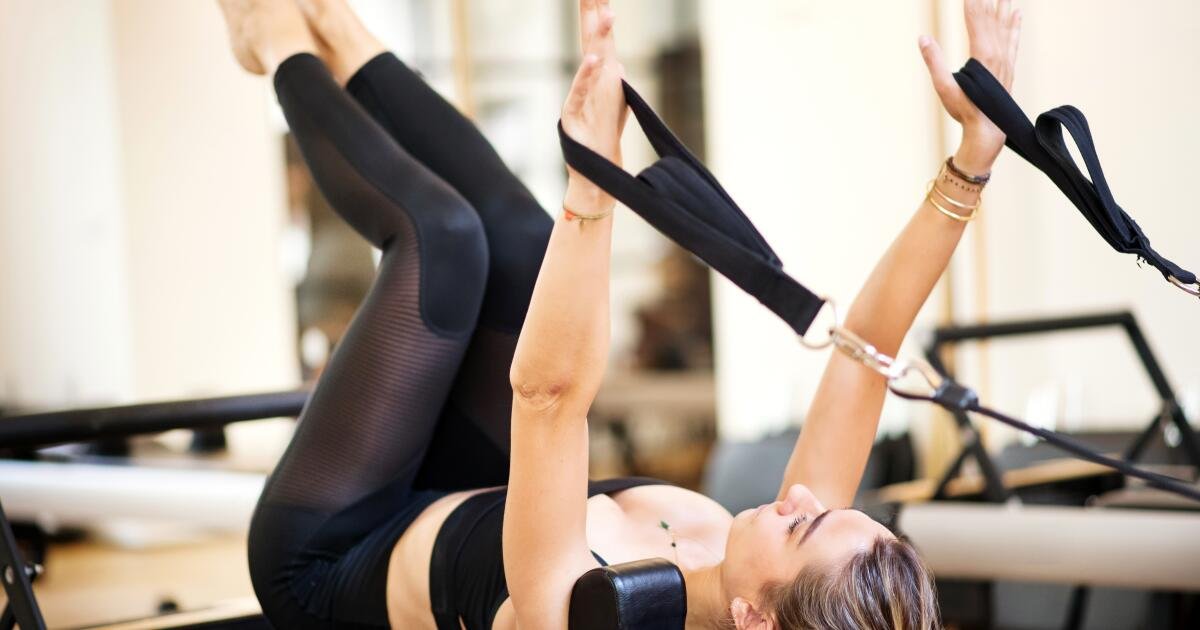
About a year and a half ago, I realized that if I didn’t start exercising again, I would slip into late middle age with a sloppy, flabby figure.
I’ve been a runner my whole life. For more than 30 years, my training partner and I have run regularly along the coast from Venice to Santa Monica. Through rain or shine, through pregnancies, parenting, PTA meetings, marital disputes, and everything else that Zorba the Greek once described as “utter ruin,” we ran, we talked, and we became each other’s best therapists.
Then, shortly before the COVID-19 pandemic, my partner discovered a trendy new way to exercise: The running life we knew was basically over, and I effectively became a pickleball widow.
In 2020, the pandemic forced us all to stay indoors and I pretty much stopped running.
Around the same time, my left knee started to hurt and swell. I was convinced it was because my energetic golden retriever had bumped into my leg. But the doctor said it was arthritis. (Me? At such a young age?)
She referred me to physical therapy, whose office never answered my calls.
Desperate (and overweight), I decided to give Pilates a try. Why? Because all the women walking in to my local Pilates studio had the bodies I dreamed of. And my knees were hurting like crazy.
My first 45-minute Pilates class was a disaster. As the instructor called out the various poses (dancing bear, French twist, reverse kneeling crunch), I felt lost. I sat on the Megaformer machine, out of breath and feeling defeated.
“Why don’t you take a few private lessons until you get the hang of it?” was the studio owner’s suggestion after I complained that there were no lessons available for beginners like me.
Over the next year, I spent enough money on private lessons to buy a used car – so much, in fact, that I was relieved when I heard my beloved instructor was moving to Amsterdam.
With some trepidation, I started taking group lessons again, but this time it was different: I knew (mostly) what to do and I could (mostly) keep up.
“Booty, booty, booty,” yells Denae D’Auria, the class instructor, as we get on all fours and do donkey kicks with a bungee cord attached to one leg for added resistance.
“Pelvic floor stability isn’t talked about enough,” says D’Auria, who expands on the core concepts of Pilates with her more intense Lagree training.
“I love watching that trembling,” she says, as our muscles tremble after a lumberyard full of squats, lunges, and planks. “Remember to slow down and breathe. The secret is tension time.”
I first encountered a Pilates machine about 25 years ago in the home of Vidal Sassoon, the famous hairdresser featured in The Times. It seemed unconventional, but he was in great shape for a 71-year-old man.
Although Pilates classes are primarily attended by women, the exercise was used to treat wounded and disabled soldiers soon after it was developed by Joseph Pilates, a German bodybuilder and gymnast who was interned on the Isle of Man by the British Army during World War I. Pilates improvised the first version of his famous machine by attaching bed springs to the headboard and footboard of a bed to create resistance.
He called his exercise system “Control-G” and it focused on breathing, the postural muscles of the back, and the abdominal muscles that we think of as our “core.”
For decades, Pilates was “an obscure form of exercise with a small but enthusiastic following among dancers, singers, circus performers, and actors,” according to the authors of the 2011 book “Pilates Anatomy,” but it exploded in popularity in the mid-to-late 1990s, with celebrities like Madonna and Uma Thurman touting its benefits.
“Suddenly, it began appearing in Hollywood movies, TV commercials, cartoons, sitcoms, and late-night TV,” write Rael Isacowitz and Karen Clippinger, “and became synonymous with going to Starbucks and drinking a low-fat triple-shot soy latte (without the whipped cream!).”
The Pilates Foundation estimates that about 12 million people worldwide practice the exercise, a small fraction of the estimated 300 million people who practice yoga.
“Scientific studies support a number of impressive health benefits of Pilates,” The New York Times reported in 2022. “Studies show that Pilates Muscle endurance and flexibilityreduce Chronic pain Mitigate Anxiety and depression.”
Pilates was firmly established in pop culture in April when “Saturday Night Live” featured a sketch on the subject, poking fun at the love-hate relationship that exists among Pilates practitioners.
“Pilates,” says a deep-voiced narrator, “from the creators of Saw X and Alo’s Marketing Director comes a chilling new take on girl horror.”
For those, like me, who came of age during the craziness of high-intensity aerobics; Thanks for the sciatica, Jane Fonda! — The low-impact nature of Pilates is appealing.
I usually take 45-minute classes four times a week, and while I wouldn’t claim to resemble the lithe young women around me (most of whom I’m young enough to be their mother), I have developed a toned core beneath my bulging belly.
Oh, and that awful knee pain? It’s been gone for months now.
