

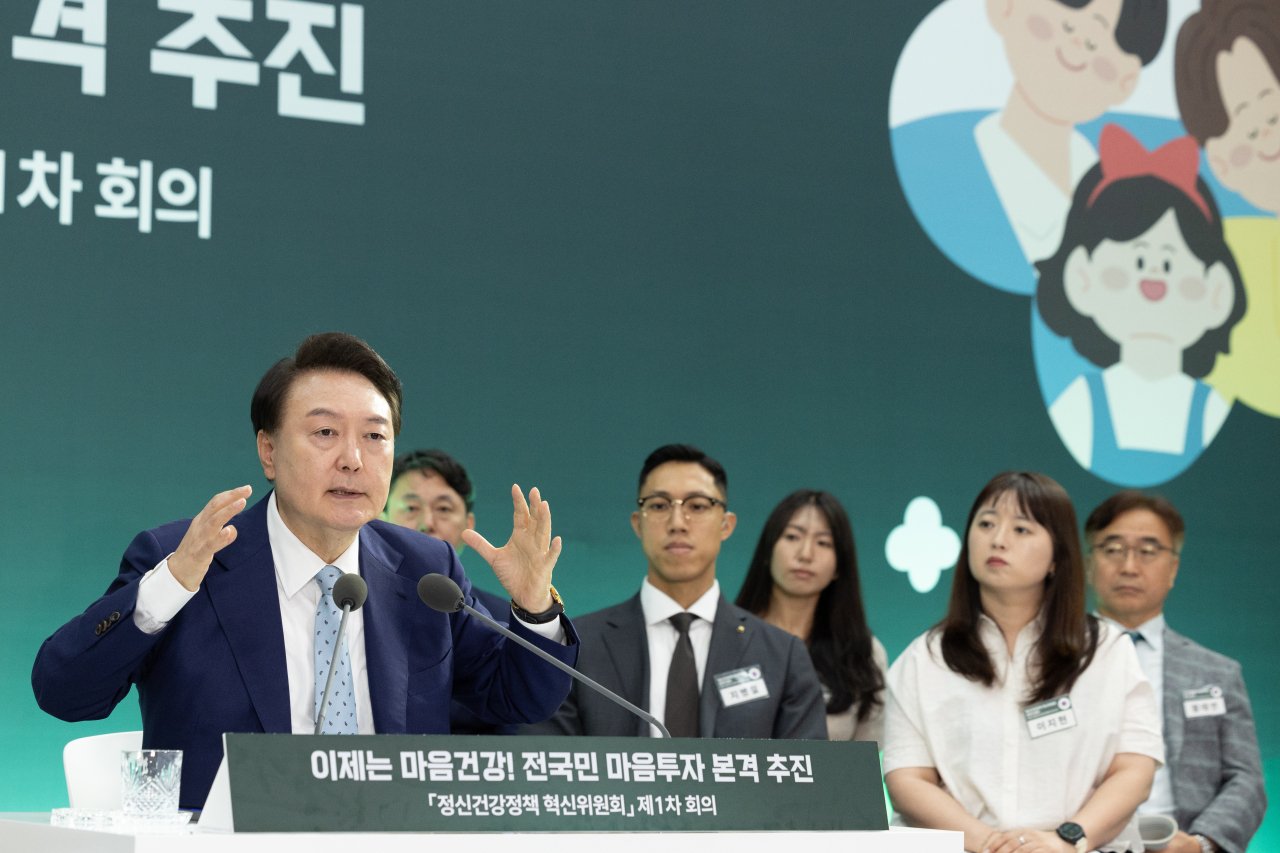
President Yoon Seok-yeol on Wednesday vowed to overhaul the country’s mental health policy as he presided over the first meeting of a presidential committee aimed at expanding state support and changing public perception of mental illness.
The government will start investing expanded national funds in mental health measures for the public starting next year. The national aid package is estimated to cost about 300 billion won ($215.7 million) next year alone, according to a senior presidential official who spoke on condition of anonymity, and a draft budget has yet to be drawn up.
Citing a World Bank analysis, President Yoon said at a meeting of a newly inaugurated presidential committee in Seoul that social stigma against people with mental illnesses is the biggest obstacle to treatment and that fostering understanding that people with mental illnesses can receive treatment and do not pose a threat to others will be a national priority until the end of his term in 2027.
This comes after a presidential commission launched on Wednesday outlined a timeframe for the implementation of policies on the prevention, treatment and recovery of mental illnesses.
President Yoon said that at least one million South Koreans will have access to mental health counseling services from July, with his goal being to reach that figure by the end of his five-year term in 2027.
All applicants for the service will undergo eight counseling sessions, which the state will cover in part or in full depending on the applicant’s income level, Yoon’s office said.
Yoon’s office estimates that the number of people using counseling services will reach at least 80,000 by the end of this year, and predicts that as the country’s mental health care infrastructure expands, the number of people with access to counseling services will gradually increase, reaching 500,000 by 2027.
Yoon said the counselling services are aimed at preventing mental health problems caused by a highly competitive society.
Starting next January, young people will also be able to receive state-sponsored mental health checkups once every two years. Currently, under South Korean regulations, young people between the ages of 20 and 34 can only receive mental health checkups through the National Health Insurance Service more than once every 10 years.
Additionally, South Korea plans to add another center to its national suicide prevention hotline and hire more crisis counselors next year.
“Many people are suffering from depression and anxiety due to excessive competition in society,” Yoon said. “Early detection of mental illness is important to prevent depression and anxiety from developing into mental illness.”
In addition, the number of psychiatric emergency care centers will triple to 32 by 2028, and the number of hospital beds at these centers will also increase.
As a result, the number of frontline mental health care workers is set to increase by 50% to 306 by the end of the year.
More mental rehabilitation facilities will be built across the country as well as 50 new homes being provided for people with mental health care needs.
These are among 39 policy goals laid out on Wednesday by the committee, which will meet at least twice a year, according to President Yoon’s office.
South Korea has had the highest suicide rate among 38 countries surveyed by the Organization for Economic Cooperation and Development (OECD) for nearly two decades. South Korea’s suicide rate in 2022 was 25.2 deaths per 100,000 people, more than double the OECD average. South Korea’s life satisfaction was ranked 35th out of 38 countries from 2020 to 2022.
Seoul hopes that the new plan will halve the country’s suicide rate by 2030.
