

Ani
Has been updated: June 25, 2024 22:25 IST
New Delhi [India]India, June 25 (ANI): The Central Council for Research in Ayurvedic Sciences (CCRAS), an apex autonomous body under the Ministry of Ayurveda, has signed two MoUs with Shri Krishna Ayurved University, Kurukshetra and Davar, a leading Ayurvedic company in India, to further its pioneering efforts to align traditional medicine research with global standards and priorities, the Ministry of Ayurveda said on Tuesday.
CCRAS has also launched a newly updated website.
This first-of-its-kind council brought together representatives from various branches of Indian traditional medicine (TM) including policy makers, academics, researchers, patients and industry players. Its objective, according to the release, is to identify and prioritise key areas of research across various traditional medicine systems such as Ayurveda, Siddha, Unani and Homeopathy.
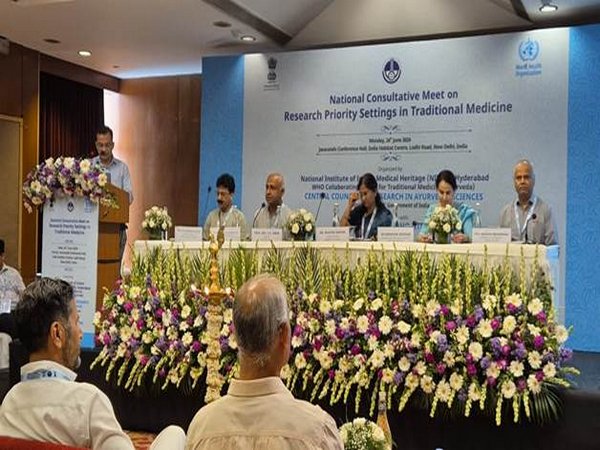
These announcements were made during a one-day National Consultation on “Setting Research Priorities in Traditional Medicine”, organised in collaboration with WHO-SEARO (World Health Organisation Regional Office for South East Asia) Office and WHO-GTMC (World Health Organisation Global Centre for Traditional Medicine) at the India Habitat Centre, New Delhi on 24 June 2024.
Speaking on the occasion, Vaidya, Additional Secretary, Ministry of Ayush Rajesh Kotecha said, “The objective is to ensure effective utilisation of funds and address critical needs in traditional medicine, including medicinal plant research, quality, safety and efficacy studies, pre-clinical validation, rational use of traditional medicines, monitoring of clinical trials, medical anthropology and digitisation of ancient medical texts, thereby supporting its global acceptance and integration.”
“We wanted to create a research roadmap for the next 10 years and lay the foundation for a 10-year research strategy in traditional medicine, aligned with WHO guidelines. These two MoUs with Dabar University and Sri Krishna Ayush University are a sound start in this direction,” CCRAS Executive Director Prof Vaidya Ravinarayan Acharya said in a statement.
Highlighting the importance of the MoU, Prof. Kartal Singh Dhiman, Vice Chancellor, Sri Krishna Ayush University, Kurukshetra, Haryana, said that within the scope of the MoU, both the parties will consider fostering avenues of academic and research collaboration that will provide opportunities for exchange of ideas among researchers and scientists through workshops, seminars and doctoral programmes of scientists from CCRAS.
Setting research priorities is a critical endeavor that guides resource allocation, shapes the scientific agenda and influences the direction of innovation and discovery. Setting research priorities for traditional medicine has become a necessity now as the same is driven by increasing demand and global accessibility and acceptability of the system. The identified areas will form a roadmap for traditional medicine policies at regional or global levels, the release stated.
Approximately 150 stakeholders participated including representatives from the Ministry of Health, NITI Aayog, Chairpersons of various Indian Research Councils in Traditional Medicine and Homeopathy, Vice Chancellors of various reputed universities, Directors of National Institutes under the Ministry of Health, ICMR-NITM, CSIR, RIS-FITM, JNU New Delhi, WHO-SEARO, WHO-GTMC, policy makers, representatives of pharmacy sector and media personnel.
A roundtable discussion by expert working groups crystallized the prioritization exercise, followed by a plenary session with the way forward. Prioritization will promote preservation and documentation of traditional knowledge, safeguarding cultural heritage and biodiversity associated with medicinal plants and indigenous remedies, Dr GP Prasad, Deputy Director (Head) of National Institute of Medical Heritage (NIIMH), India, which was recently designated as a WHO Collaborating Centre for Traditional Medicines in India and co-organizer of the event, said in a release. (ANI)
