

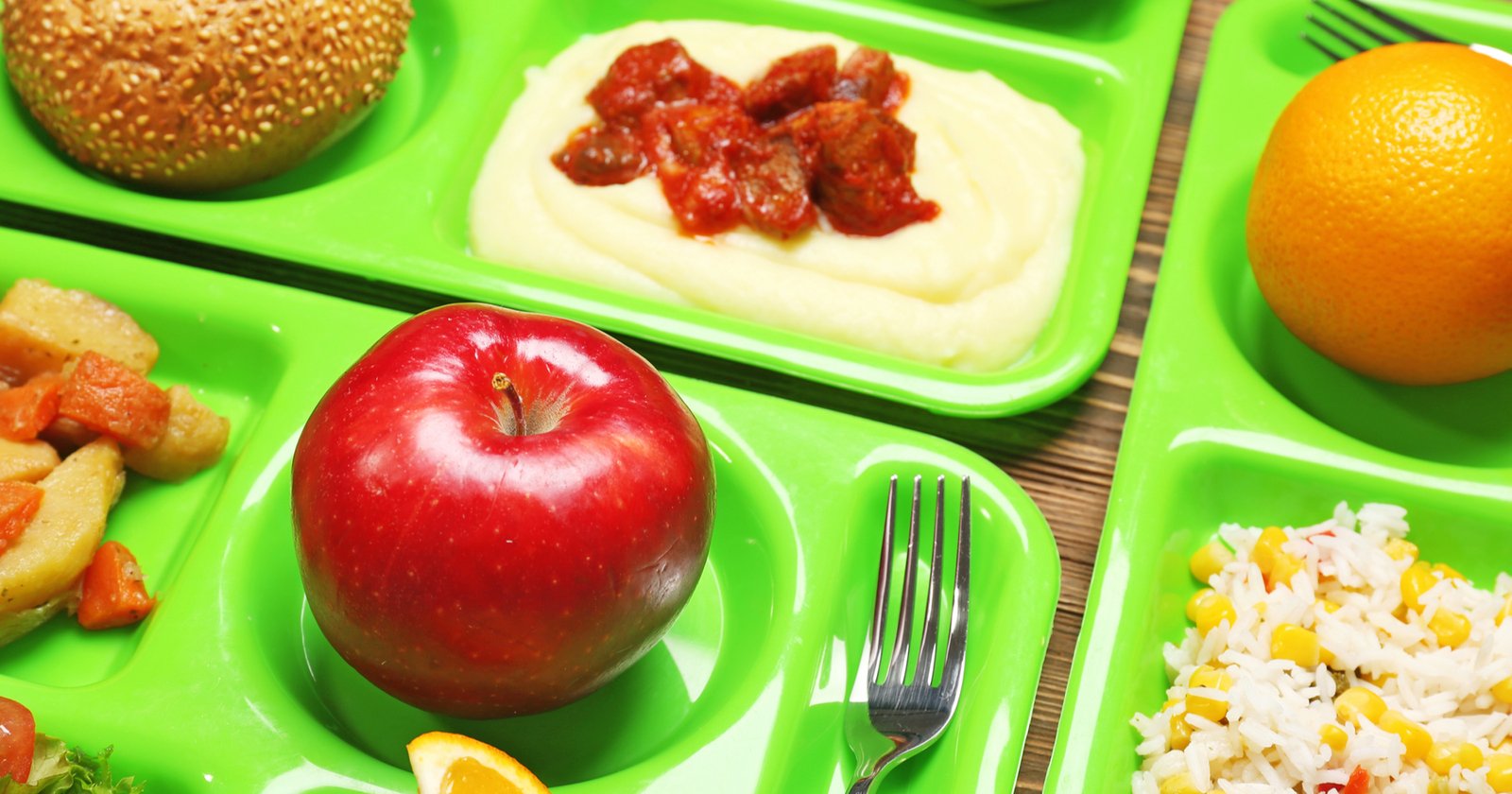

Participation and federal spending on child nutrition programs, including the National School Lunch Program, declined during fiscal year 2023, according to the report. Photo: Shutterstock
Federal spending on child nutrition programs and meal participation are declining when comparing fiscal year 2023 to fiscal year 2022, according to a new report from the U.S. Department of Agriculture (USDA) Economic Research Service.
In FY 2023, 8.8 million meals were provided through the National School Lunch Program (NSLP), School Breakfast Program (SBP), Child and Adult Care Meals Program (CACFP) and Summer Food Service Program (SFSP).
The total number of lunches served through the NSLP will total 2.4 billion meals in FY 2023, a decrease of 8.8% compared to FY 2022. The total number of breakfasts served through the SBP also decreased when comparing the two years: 2.4 billion breakfasts served through the program in FY 2023, a decrease of 8.8%.
Additionally, federal spending for both the NSLP and the SBP decreased in FY 2023 compared to FY 2022. A total of $17.2 billion was spent through the NSLP in FY 2023, a 25.2% decrease from FY 2022. Federal spending for the SBP was $5.2 billion in FY 2023, a 19.8% decrease from FY 2022.
The report noted that the two-year decline in federal spending for both programs may be due in part to the expiration of a series of child nutrition waivers issued by the Department of Agriculture. The waivers allowed school nutrition programs to provide meals to all students at no cost and receive a higher SFSP federal meal reimbursement rate for each meal served. The waivers were in effect until June 2022. Additionally, the Keep Kids Fed Act, passed shortly after the waivers expired, temporarily increased federal meal reimbursement rates by 40 cents for each lunch served and 10 cents for each breakfast served until June 2023.
School nutrition experts have warned in recent years that federal funding rates are too low to cover the costs of producing school meals. In its 2024 policy statement, the School Nutrition Association urged Congress to raise federal funding rates by 40 cents per lunch meal and 15 cents per breakfast meal.
Like the NSBP and SBP, federal expenditures and participation in the SFSP in FY23 were both down compared to FY2022. In FY23, 2.2 million meals were provided in July, a month when participation in the SFSP typically peaks, down 20.3% compared to July in FY22. Through FY23, federal expenditures for the program were $546.6 million, down 8.9% compared to FY22.
The CACP, which provides after-school meals to students, also saw a decrease in the number of meals served when comparing FY23 to FY22, but expenditures remained the same. In FY23, 1.7 million meals were served through the program, down 8.9% from FY22. FY23 expenditures were $3.9 billion, roughly the same as FY22 expenditures.
In the summer of 2022, school nutritionists were again able to take advantage of waivers issued by the USDA to set up dining venues and expand the number of areas where meals could be served in non-congregate settings, which may be the reason for the higher turnout in 2022 compared to 2023.
This is not the only report to find that USDA waivers have affected school nutrition programs. A report from the Food Research and Action Center indicates the expiration of waivers likely led to a decline in school lunch participation in the nation’s largest school districts.
