

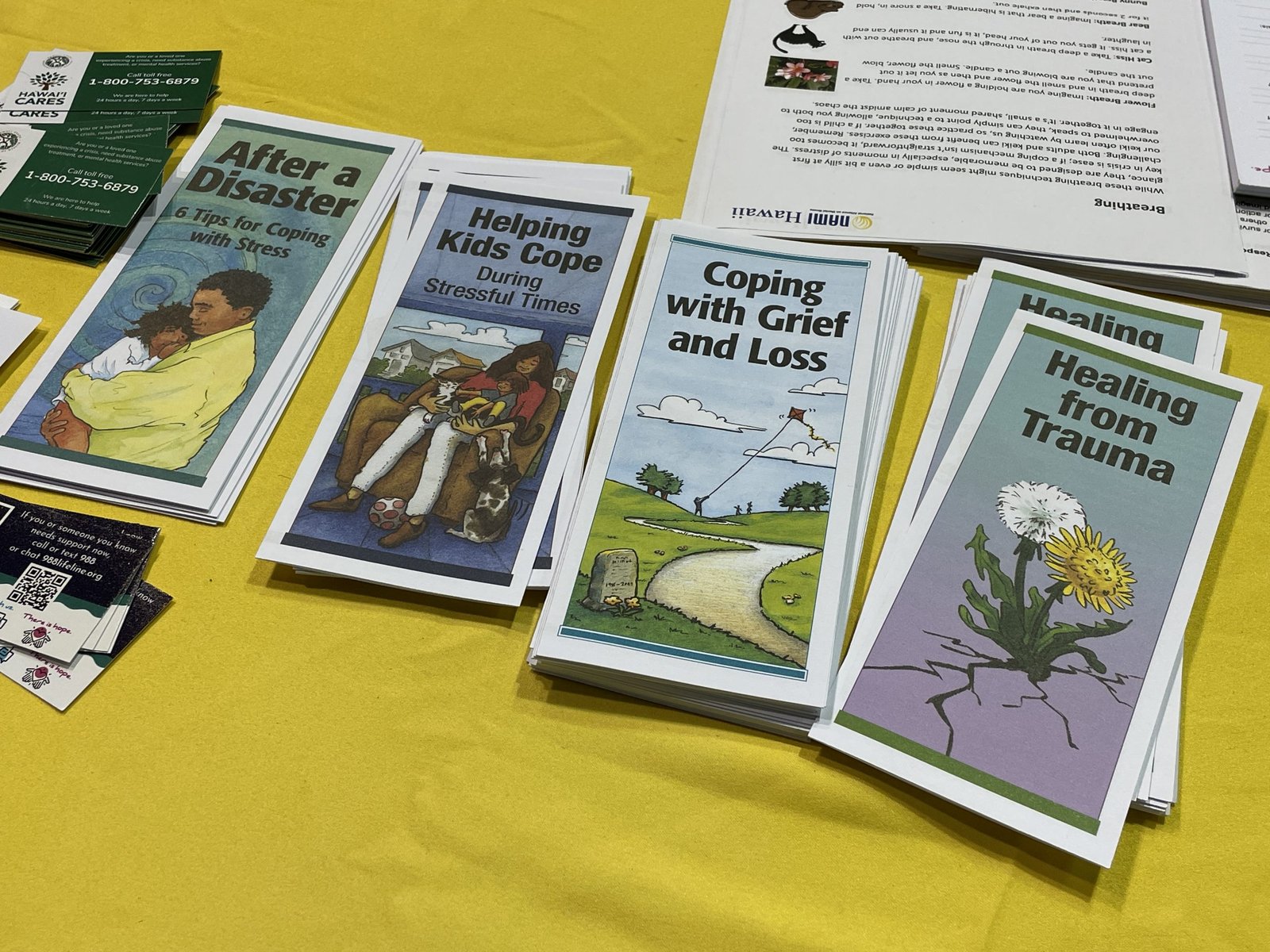
A Lahaina woman seeking psychological help has been through five different mental health care providers since wildfires devastated her community last August.
Her experience is not uncommon.
Lisa Grove, interim director of the Maui United Way, said many of Maui’s fire survivors who suffer from anxiety, depression and symptoms of post-traumatic stress disorder are receiving care from a constantly rotating roster of counselors who are sent to Maui for short periods from other states to quell the mental health crisis after the disaster.
This isn’t just a matter of continuity of care: When a Lahaina woman finished her final therapy session with one of these flying-in counselors, the counselor bombarded her with vacation advice: “Where’s a good beach? Where should we go for a meal?”


There have also been complaints of health care workers asking Maui fire survivors, “Are you sure you want to live here?” Many affected by the fires have roots on Maui for generations and have nowhere else to go. Grove said other health care workers have told Maui patients, “You’re living in paradise, so that can’t be a problem,” or mispronounced Kihei multiple times during treatment sessions.
Therapists on the front lines of the mental health crisis sparked by last summer’s deadly wildfires on Maui say they can’t keep up with the steady demand for their services. Social workers, counselors and psychologists have been flown in to fill a gap in the local workforce. But now, some fire survivors are refusing to be treated by outsiders, citing cultural differences.
The problem, clinicians say, is that there simply aren’t enough local providers to meet the demand.

At least one soon-to-be-published study finds that demand for mental health care on Maui is higher now than it was at the end of the COVID-19 pandemic, according to results from a community mental health survey sponsored by the Hawaii Rural Health Association and funded by the U.S. Centers for Disease Control and Prevention and the Hawaii State Department of Health.
The report, due to be released within the next few weeks, found that the number of people on Maui reporting a worsening mental health condition is up significantly from two years ago.
Grove, who read the report, said the data showed mental health conditions were worse among those directly affected by the fires.
“On the mental health front, all the data is showing us that it’s worse than we thought,” Grove said, “and we’re trying to help funders and communities understand that this may just be the beginning.”
On an island with far fewer resources to deal with the psychological effects of the Aug. 8 fire, one way to move forward is to get short-term assistance from other states.
This approach to shoring up a fragile system has created a revolving door and exhaustion for fire survivors who must build and rebuild trust and relationships with multiple different mental health providers in a short period of time, and creates friction as providers unfamiliar with the island’s unique social and cultural norms unintentionally cause frustration and discomfort to those in crisis.

For example, some evacuated fire survivors say disaster relief volunteers encouraged them to move off-island in search of better housing and lower living costs. Diane Peters Nguyen, former CEO of the Hawaiian Red Cross, said she was fired by the organization in early May after calling for reforms and asking the group to stop encouraging Maui wildfire victims to move to other islands or states.
“Cultural competency is really important,” Grove said. “The fire was traumatic, and then the next step in the process is really re-traumatizing, and even more traumatic for some people, especially when they’re trying to get help from people who they feel don’t understand them.”
It’s now common for Maui fire survivors — both adults and children — to not receive mental health care if they can’t connect with local providers, said Tina Boteillo, a Maui marriage and family therapist who has worked with nonprofits and state and county governments to coordinate psychological support and treatment for fire survivors.
““We have children in our facilities who tell the doctors about their traumatic experiences and the doctors say, ‘Oh, thank you so much for telling me. My contract ends on Friday so I’m going back to the mainland,'” Boteillo said.
“The problem is, we were devastated by COVID,” she explained. “A lot of professionals left the island and aren’t coming back because now they can get telemedicine in cheaper places. And now we have a lot of people who say they want to come back, but they can’t afford to come back because housing costs are high and inflation is so bad.”
Despite the shortage of clinicians, there are some new local resources.
The state Department of Adult Mental Health opened two certified behavioral health clinics in Lahaina and Kahului to meet the surge in demand for mental health care after the fires, and Dr. Courtenay Matz, AMHD’s acting administrator, said staffing at the clinics is OK for now.
The new clinic accepts patients of all ages and has no eligibility requirements, a departure from the agency that has historically positioned itself as a state care provider for uninsured or underinsured adults diagnosed with severe, chronic mental illnesses. People suffering from symptoms of grief, guilt, anxiety or depression can receive care from the Maui agency even if they don’t have a formal diagnosis.
“Finding a provider can be hard sometimes,” Matz said, “so this gives people another option.”
The health department said it was unclear how many people received services at the new clinic, citing issues with its data systems.
State health officials this year also launched the Maui Warm Line (also known as Malu i ka Ulu), a local call center offering support and resources to people affected by the Maui fires. It complements Hawaii Cares, which is designed to provide rapid assistance to callers experiencing mental health emergencies or suicidal thoughts.

Still, labor shortages are a problem: University of Hawaii professor Kelly Withey, who conducts an annual statewide health workforce survey, said Maui needs to increase the number of adult psychiatrists by 59 percent and the number of child and adolescent psychiatrists by 77 percent.
There are other challenges: some people affected by the fires may not be able to seek mental health care due to stigma, especially among certain ethnic groups, and some may not realize they need mental health care or have a clear understanding of how it can help them get through the psychological effects of the wildfires.
“We’re not doing a good job of explaining to people, ‘Hey, what’s going to happen when you get help from a neutral professional to figure things out? What are you going to get out of counseling?'” Grove said.
The new initiative, launched in April with a $1 million donation to Maui United Way, aims to address the needs of children affected by the Aug. 8 wildfires by deploying teams of mental health counselors to meet with young people in their hometowns.

Funded by the Sentry Insurance Foundation, Mālama Na Keiki is a year-long program that will send counseling teams to visit hotels where many of the fire victims are still living, as well as meet young people on the streets, on beaches and at the Boys & Girls Club of Maui.
The program aims to reach approximately 200 youth per month and provide at least six counseling sessions to youth participants per year.
In Lahaina Public Schools, teachers and staff receive training in areas such as psychological first aid, childhood traumatic grief and self-care, according to the Department of Education website. But Mālama na Keiki Program efforts also include reaching out to students who aren’t attending school regularly or who don’t seek out the resources available at school.
“We know that while we have counselors at the schools, a lot of kids don’t necessarily go to them,” said Makana Rosete, community impact coordinator for Maui United Way. “What makes this program different is that we get to know where the kids are and where they like to be, not the other way around.”
The program also targets children who live on the coast and those experiencing homelessness.
Grove said one of the stereotypes the program aims to dispel is the idea that children are born resilient.
“Kids can be resilient if they have a toolbox, if they learn coping strategies, if they have family support,” Grove says, “but it’s not natural for our children to know how to navigate the most traumatic events of their lives.”
This week, Maui United Way announced an additional $650,000 in Ohana Mental Health Grants that will support projects at seven local nonprofits: Boys & Girls Clubs of Maui, Imua Family Services, Maui Arts & Cultural Center, Nohona Health, Pacific Birth Collective and The Spirit Horse Ranch.
Civil Beat’s Maui County coverage is supported in part by a grant from the Nuestro Futuro Foundation.
Civil Beat’s community health coverage is supported by the Cooke Foundation, Atherton Family Foundation, and Papa Ola Lokahi.

