

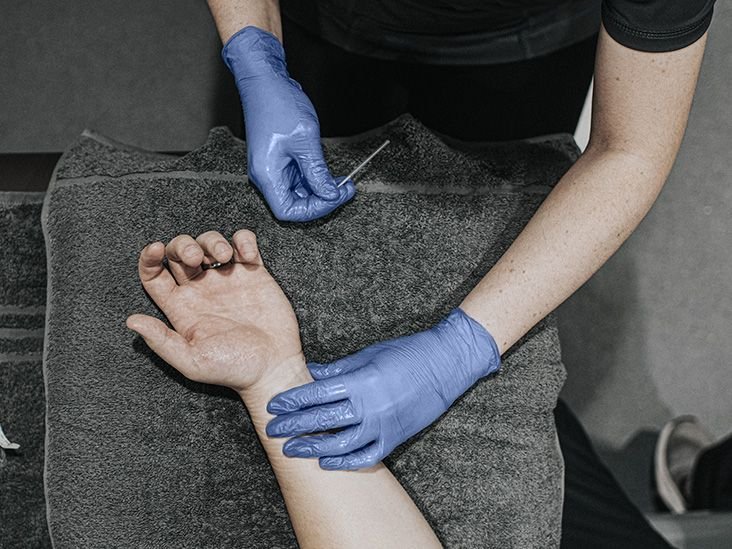
Acupuncture for ADHD may be an effective treatment, but research is still ongoing into how acupuncture can help with symptoms of attention-deficit hyperactivity disorder (ADHD).
Acupuncture is a therapeutic technique derived from Traditional Chinese Medicine (TCM) that involves applying small needles or pressure to specific points on a person’s body.
In this article, we discuss whether acupuncture is an effective treatment for ADHD symptoms, whether it works for children with ADHD, and what Chinese medicine has to say about ADHD. We also discuss common methods of acupuncture for ADHD, its safety, and acupuncture pressure points for ADHD.
Acupuncture is used to treat a variety of conditions.
ADHD
Doctors usually diagnose ADHD during childhood, but it often persists into adulthood. According to the American Psychiatric Association (APA), about 8.4% of children and 2.5% of adults in the United States have ADHD.
There is currently no cure for ADHD, but there are some treatments available.
Additionally, several scientific journals have investigated whether acupuncture is effective in treating ADHD. They have found that acupuncture may be effective in treating ADHD symptoms. However, scientists still don’t know for sure if and how effective acupuncture is.
According to the National Center for Complementary and Integrative Health (NCCIH):
Research into the effectiveness of acupuncture for ADHD is ongoing. A 2023 overview states that acupuncture may improve ADHD symptoms, but larger studies with better quality data and methods are needed to draw more definitive conclusions.
Acupuncture may be effective for children with ADHD,
a
Acupuncture points are specific points on a person’s body where a practitioner inserts needles. Acupuncturists choose specific points to insert needles at depending on the symptoms and parts of the body they wish to treat.
There does not appear to be a standard acupuncture point for ADHD. However, the above
- DU20 (Baihui)
- SP6 (Sanyinjiao)
- EM1 or additional points (Sishencong)
- EM2 or additional points (Yintang)
- LV3 (Taichou)
- DU24 (Shengting)
- HT7 (Shinmon)
- PC6 (Naikaku)
- KI3 (Taishi)
- LI4 (Hegu)
be
TCM does not consider ADHD a disease, but rather a manifestation of an “imbalance of the mind and spirit.” ADHD symptoms are attributed to the following factors:
- Excess heat or wind in a person’s head
- Stagnation of Liver Qi
- Possible complications from dampness. This can arise from problems with the spleen or kidneys.
TCM treatment aims to restore balance to a person’s vital energy in order to treat conditions such as ADHD.
According to the 2023 review mentioned above, practitioners widely use acupuncture to reduce symptoms in people with ADHD.
There appears to be no reliable data on how widespread this treatment for ADHD is in the United States.
According to NCCIH, experts
Localized side effects
Below are answers to some frequently asked questions about acupuncture and ADHD.
What is the most effective treatment for ADHD?
Healthcare professionals usually help treat ADHD with medication and therapy, and a combination of the two is often the best treatment option.
Can ADHD be inherited from the mother or father?
scientist
Acupuncture, a treatment in which a practitioner inserts small needles into specific points on a person’s body, may help with ADHD symptoms.
There is no conclusive scientific evidence yet to prove that this is an effective treatment for ADHD, but scientists continue to research it as a way to improve ADHD symptoms.
Experts generally consider acupuncture to be a safe treatment when given by a qualified, experienced practitioner, and many people use acupuncture to treat a variety of conditions.
