

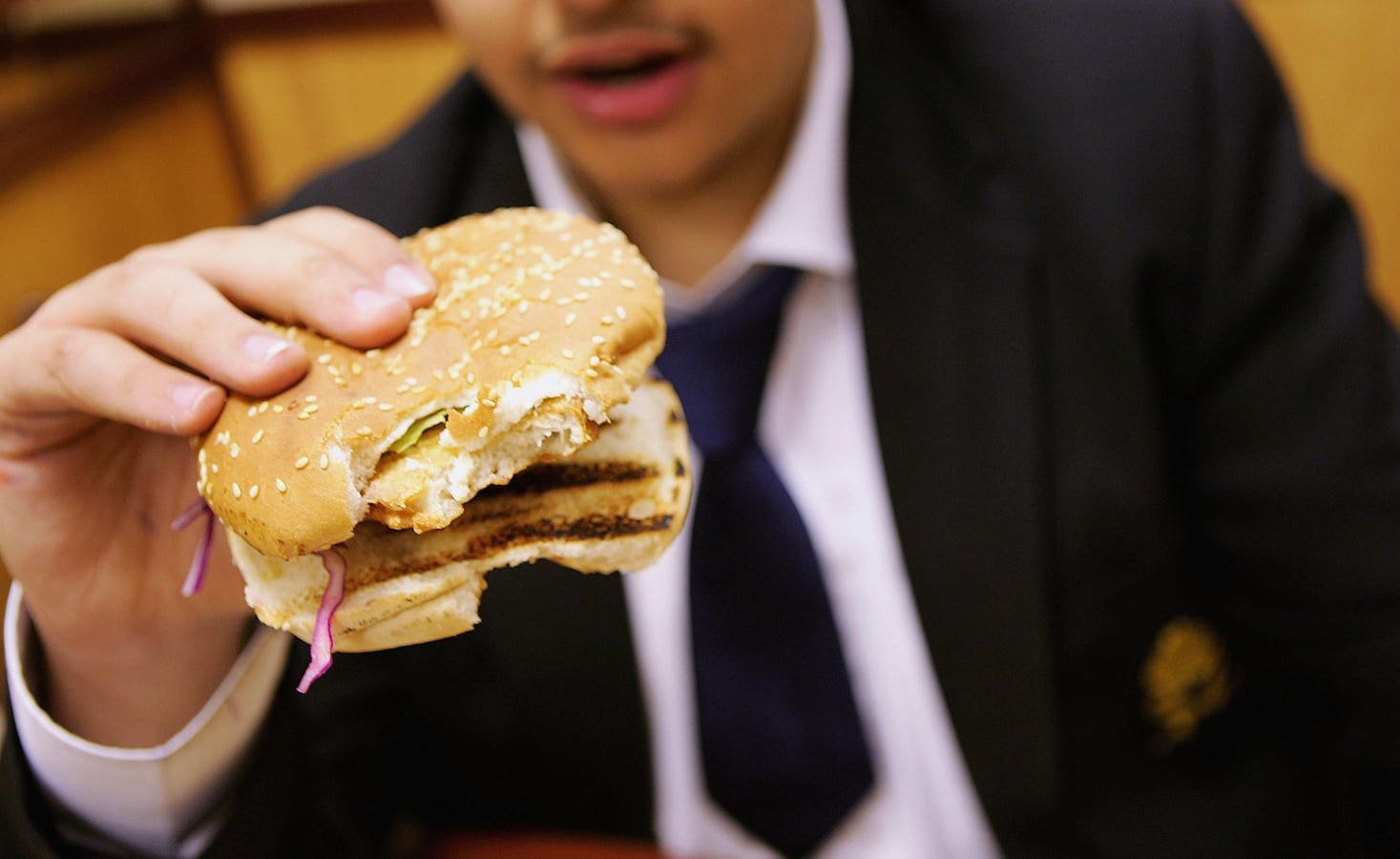
In this photo illustration, students eat burgers in London, England.
The average height of five-year-olds in England has fallen over the past 11 years, while rates of obesity and type 2 diabetes have increased, according to the charity’s report.
The Food Foundation claims that a diet high in calories but low in nutrients is worsening the health of young people, which it attributes to food insecurity caused by poverty, unhealthy environments that make it difficult to afford good food, and the “aggressive promotion of cheap junk food,” according to its statistics.
The report found that obesity in 10- to 11-year-olds has increased by nearly a third since 2006, while diagnoses of type 2 diabetes in people under 25 have increased by 22 percent in the past five years.
The report found that babies in England could live one less year of health than those born ten years ago.
The Food Foundation used government data to produce the report, which it claims paints an “alarming picture” of the current state of children’s health and reveals “the surging deterioration facing our children.”
“We previously thought of the combination of undernutrition and obesity as characteristic of low- and middle-income countries, but in the UK in 2024 it is happening,” Sir Michael Marmot, director of the Health Equality Institute at University College London, said in a statement.
Marmot, a director of the Food Foundation, has written two groundbreaking reviews into the health impact of growing inequalities in England.
The Food Foundation argues that the nation is at a “critical crossroads” for children’s health and that an opportunity to “assess our nation’s priorities” is at hand.
The general election on July 4 is widely expected to produce a Labour government. Opinion polls predict the Conservative Party, which has been in power for 14 years, will lose hundreds of seats. Some predict that the Liberal Democrats, a much smaller party, may overtake the Conservatives.
The Labour Party is considered to be centre-left, while the Conservative Party has traditionally been centre-right, but with the rise of smaller rival right-wing parties such as Nigel Farage’s UK Independence Party and now Reform UK, Labour has arguably moved further to the right. The Liberal Democrats are traditionally a centre-right party that promotes social liberal ideals.
Both the Liberal Democrats and Labour have promised to tackle inequality in some way if they come to power. The Conservative manifesto promises to tighten restrictions on advertising of unhealthy foods to children and to better research the effects of ultra-processed foods. The manifesto does not include the word “inequality” and “poverty” is mentioned only once, in the context of international development.
A summary of the health policy pledges of the three major parties can be found here.
Henry Dimbleby, who conducted the independent review of the National Food Strategy, said in response to the Food Foundation report: “The poor health outcomes for children revealed in this report are a shocking and deeply sad consequence of the failure of the UK’s food system. We need the next government to take decisive action to make healthy, sustainable food affordable, stop the rise of junk food and recognise that investing in children’s health is an investment in the country’s future.”
