

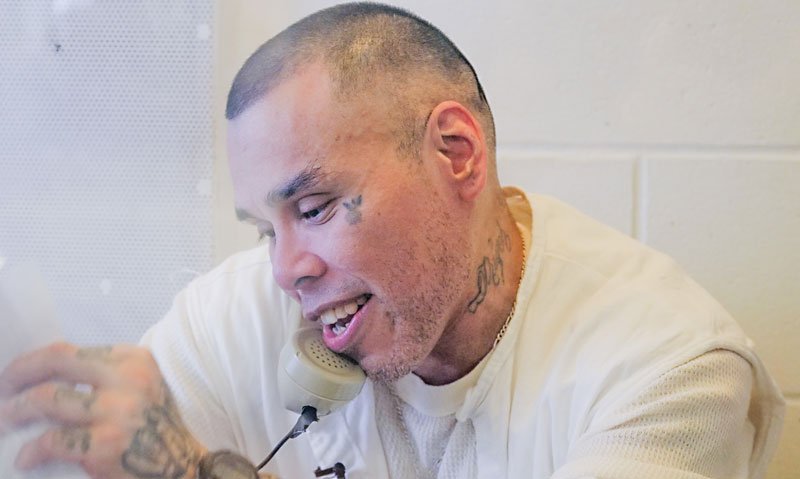

Ramiro Gonzalez said in a video clip asking the Texas Board of Pardons and Paroles for clemency. (Courtesy of Texas Defender Services)
In recent years, death row inmates have begun attaching videos to their clemency petitions to the Texas Board of Pardons and Paroles in an effort to commute their death sentences to life in prison. Earlier this month, Ramiro Gonzalez submitted a powerful video.
Gonzalez has already faced the death penalty once. In July 2022, he asked the Texas Board of Pardons and Paroles to postpone his execution to donate a kidney for the murder of Bridget Townsend in 2001. The board denied the request. However, the Texas Court of Criminal Appeals stayed the execution to consider whether false testimony submitted at Gonzalez’s trial prejudiced his sentence. The court found that it did not, and the execution was rescheduled for June 26. Now, Gonzalez has submitted a video to the BPP, requesting a commute to life imprisonment, talking about how he has changed and what he means to the death row community.
The video begins with Gonzalez talking about how his feelings of remorse for Townsend’s murder have evolved, and how he thinks about those he hurt through his violence every day, particularly Townsend’s mother. “Because of my stupidity, my actions, my actions, I took everything that mattered from her, and I can never get that back,” he says. “So to go through this level of regret, that complexity, is like the depth of the debt that I owe.”
Gonzales was raised by his grandparents on a ranch in the Texas Hill Country when his mother was only 17. Growing up, he was physically and sexually abused by various members of his family. Kate Porterfield, a psychologist who has studied Gonzales’s upbringing, said Gonzales’ mother and four sisters also suffered similar abuse during their childhoods.
“All of these young women grew up to attempt suicide, develop substance abuse issues, or have problems with violence,” Porterfield said, “so Ramiro, as a young boy, was placed in a home that had already created generations of trauma.”
“As a young boy, Ramiro was placed into a home that had already created generations of trauma.”
– Psychologist Kate Porterfield
Psychologists know that victims of sexual abuse often blame themselves for their suffering and become convinced they are worthless. They may develop substance abuse problems, give up school, or become violent. Gonzalez experienced all of this. As a teenager, he stopped going to school, took stimulants for weeks at a time, and considered suicide multiple times. The jury at his trial knew nothing of these sufferings before sentencing him to death.
Gonzalez became deeply religious after arriving on death row in 2006. He had already been counseling and comforting men for years when the Texas Department of Criminal Justice established a faith-based program aimed at rehabilitating death row inmates in 2021. Program leaders say Gonzalez is loved and respected by death row inmates and guards, and that he would make an excellent field chaplain for the program if the Board of Pardons and Paroles sees fit to commute his sentence.
A group of evangelical leaders also want Gonzalez’s life spared. “We ask that you grant clemency to Ramiro, who has made a remarkable change, so he can live his life in service to others,” they wrote to the Board of Pardons and Paroles earlier this month, noting that Gonzalez has a special ability to connect with others.
Regular readers of this coverage know that it’s highly unlikely the committee will vote to spare Gonzalez from the death penalty. Gonzalez seems to have acquired the mysterious serenity that comes to many death row inmates as their final moments approach. “The 13th chapter of the Book of Corinthians ends with faith, hope and love,” Gonzalez said. “‘And these three remain: faith, hope and love.’ I’m on death row, and I still have faith. I still have hope. And I can still love everyone around me.”
