

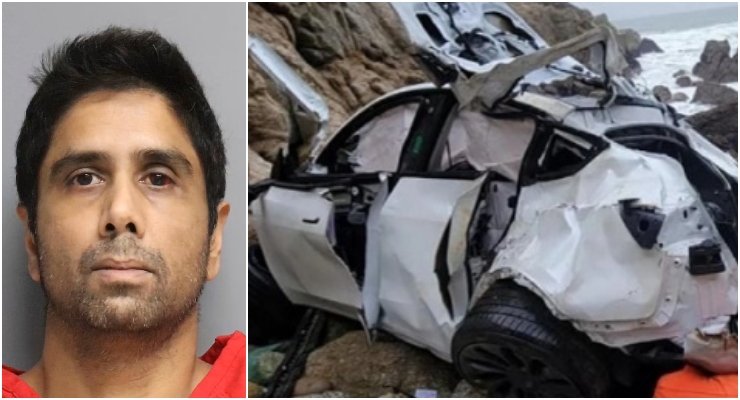
A Pasadena radiologist accused of intentionally driving his Tesla off a cliff with his family inside will avoid trial for now and instead enter a mental health diversion program, a judge ruled Thursday.
Dharmesh Patel, 43, is charged with three counts of attempted murder in the incident that occurred on Jan. 2, 2023, on Highway 1 in San Mateo County.
San Mateo County Superior Court Judge Susan Jakubowski found Patel “eligible and appropriate” to be considered for mental health diversion, a program established in 2018 to address mental illness in the criminal justice system.
The ruling means that all charges against Patel could be dismissed if he successfully completes a two-year treatment program overseen by Stanford University’s Forensic Psychiatry Fellowship.
Prosecutors had strongly opposed the diversion, arguing that Patel posed a danger to the public. Deputy District Attorney Dominic Davis said Patel suffered from schizoaffective disorder and delusions.
“He was terrified that his children would be sold into sex slavery. He carried the knife with him for three days,” Mr Davis said, describing Patel’s mental state before the accident.
Patel’s defense lawyers countered that her client suffered from severe depression, which the judge ultimately accepted as a proper diagnosis of her client’s mental illness.
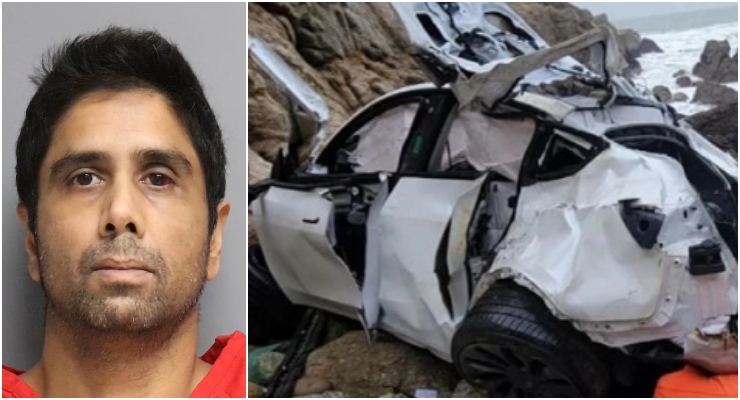
The accident occurred when Patel’s Tesla went off Highway 1 near Devil’s Slide and fell 330 feet onto a rocky shore north of Half Moon Bay.
Miraculously, Patel, his wife and their two children, who were aged 4 and 7 at the time, all survived the crash and were rescued by helicopter and airlifted to hospital.
Initially, Mr Patel claimed the accident was caused by a tyre problem, but his wife reportedly told emergency responders that Mr Patel had deliberately driven off the cliff.
Investigators later concluded that Tesla’s Autopilot feature did not cause the crash, and a psychologist testified that Patel’s actions appeared to be rooted in delusional fear.
Judge Jakubowski described Patel as a “genuinely kind and loving” person and said she would benefit from treatment at home rather than awaiting trial in prison.
“He wants to continue his psychiatric treatment,” Jakubowski said. “I believe the court realized the importance of him being forthright.”
Mr Patel’s wife testified in support of his release, saying, “We are not a family without him.” She vowed to seek help if needed and to report any signs of mental instability.
Under the terms of the diversion program, Patel will remain in jail for a few more weeks before being released to live with his parents in San Mateo County.
Before her release, Patel will have to undergo a “bridge period” of two to three weeks, including regular medical checkups to ensure a smooth transition from prison.
He is required to wear a GPS device, cannot leave the county except for medical treatment, and is under a protective order barring him from contacting his wife and children.
Patel is also prohibited from practising medicine while in the programme, and a hearing is scheduled for July 1 to discuss his possible release from prison to begin a treatment programme.
The case drew attention to California’s Mental Health Diversion Law, which aims to reduce incarceration rates for individuals with treatable mental illnesses who commit crimes.
If Patel successfully completes the two-year program, prosecutors must drop all charges against him, including three counts of attempted murder.
 Get the daily Pasadena Newspaper delivered to your mailbox for free.
10+ breaking Pasadena news stories delivered to you daily at 7am 7 days a week.
