

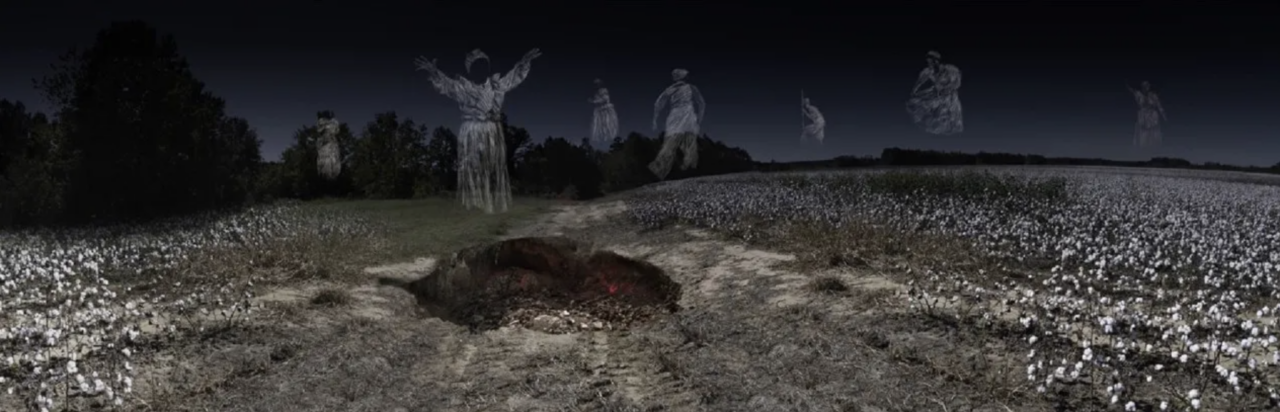

John E. Dowell’s hauntingly beautiful series, “Road to Freedom,” was born after he had a dream in which he heard a story of his late grandmother and her cotton fields. The dream was so intense that it prompted him to go in search of the cotton fields in person. Deep in the South, in the dead of night, Dowell envisioned the harrowing journey of his enslaved ancestors. Through his photographs, he explores their courage, wisdom, and pursuit of freedom in the dark. His photographs, now on display at the Charles H. Wright Museum of African American History in Detroit, evoke doorways, spirits, signs of nature, and faith.
You said the concept for your series came from a dream – can you expand on this? Did you wake up with a clear vision of what you wanted to create or did it come together over time?
“It took me a while to piece it together. When I first started dreaming, I wasn’t sure what I wanted. After consulting with my sister and brother, I decided it was about my grandmother’s cotton stories.”
In this insightful conversation with Brittany Webb, you talk about your connection to your ancestors, especially your grandmother. How difficult was it to trust and act on what you were being told?
“My grandmother was a very articulate, no-nonsense person. From there it became a matter of how to get the cotton, contacting the farmers or traveling to the farms.”

Can you talk a bit more about this idea of portals of hope and encouragement in nature?
Slaves? Did you read about this in a book or found it naturally in the wild? Also, in what form do you think these portals existed (light, burrows, etc.)?
“The idea for Portals came from my experiences with African-origin religions, Voodoo, Santeria and Gullah spiritual traditions. In all of these experiences, the individual
I communicated with my ancestors and received helpful guidance, strength, and the ability to survive. Photographing the cotton plants was always an emotional experience.
“I heard and saw things that only existed on a metaphysical level. When I went out to take pictures I heard singing, when I was looking at cotton fields I saw slaves picking cotton even though no one was there. On rare occasions I felt real pain, as if I had been hit.”

For this series, you shot cotton fields in the dark. What was this process like? Did you scout locations during the day and return at night with a more specific idea? Or was it a more organic process?
“It was both. I got ideas from my daytime explorations, and then when the sun went down, I just followed my senses. I imagined escape routes and ways of escape for groups and individuals. Part of it was my knowledge of the Underground Railroad and the escape routes I saw and felt when I was in the cotton fields. When I was there at night, I had the sensation of feeling the presence of my ancestors.”

Many of us live in cities, addicted to screens and disconnected from nature. Your work makes me think of the concept of “grounding” or “earthing”. Is this something you share? What do you think we can learn from nature? What role does nature play in your personal life?
“I’ve been searching for moments in nature that are very spiritual for me, and I’ve found places and moments in my work that give me that identity. For example, I shot in a banana plantation in Caracas, in a place where I felt like I was in the middle of an altar. Not in front of the altar, I was inside the altar. I had a similar experience in a cornfield in South Dakota, where I felt the presence of God. So for me, nature is a way to discover my own spirituality.”
“When I’m in nature and I get rid of all the distractions of the world, I really feel the presence of God. What’s interesting for me is that when I’m in the city, I feel a potential awareness of humanity in certain situations, such as parks and places of communication. What I really feel in the city is that I can get away from the screens and enjoy interacting with nature and people. So these connections that I experience both in the city and outside the city are not formed in spite of my addiction to screens or their influence, I just pass through them, they’re not really part of my life.”

Do you think there is a connection between connecting with nature and feeling connected to your ancestors?
“It depends on the individual’s experience and background. I recall experiences I had in church services, Gullah ceremonies, Santeria, Voodoo and other African immigrant religions where I felt connected to my ancestors. In these ceremonies, many people are possessed by ancestral spirits. For example, in Voodoo ceremonies you can have an experience with Shango or Ogun, and the same in Santeria and Candomblé. During the course of the ceremony, you can see people being possessed by the spirits of certain Orishas or Loa. As I said, I have experienced ancestral connection in nature, alone and witnessed others in rituals and group settings. So it’s all down to the individual.”

