

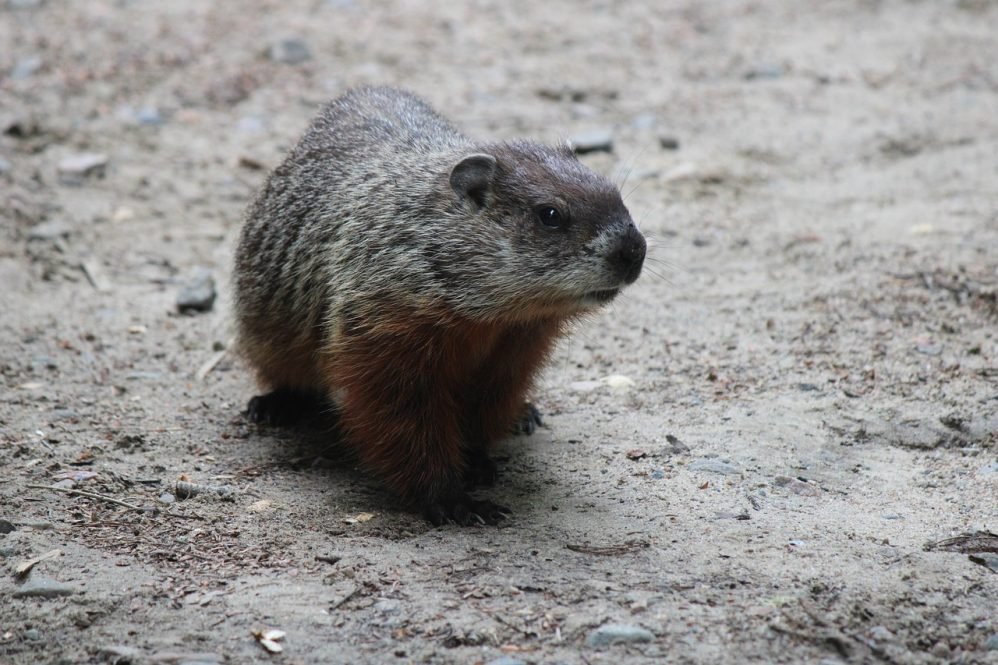
Animal Care Services (ACS) Program Manager James Brennan has published a paper providing guidance on best practices for rearing woodchucks in the laboratory.
If a woodchuck could cut down trees, how much wood could he cut?
The answer to this age-old question is, “not a big deal, as long as proper enrichment is provided,” according to an article published by James Brennan, program manager at the University of Connecticut’s Animal Care Services (ACS).
Woodchucks are best known for their annual weather forecasting role, but they are also used on rare occasions as laboratory animals – in particular, scientists use them to study Hepatitis B, because the virus they infect is very similar to that found in humans.
Unlike more common animal models such as mice and zebrafish, woodchucks are rarely used in laboratory research and therefore there is little information available on how to maintain woodchuck health in a laboratory environment.
Brennan published an article in Laboratory Animal Science Professional magazine sharing his knowledge on woodchuck health care.
“There’s very little information available on how to care for them, how to improve their environment, how to maintain them, really anything like that,” Brennan said, “so I thought it might be helpful to share what I have.”
Brennan completed the research that led to this publication while previously employed by a pharmaceutical company. Currently, no research is being conducted at the University of Connecticut using the woodchuck model.
With any type of enrichment, it is important to consider the species-specific behavior of the animals, and with that in mind, you can develop a good enrichment program. — James Brennan
Brennan studied the woodchucks’ natural behavior and created enclosures that allowed them to practice behaviors like foraging and digging.
“With any type of enrichment, it’s important to consider the species-specific behavior of the animal, and keeping that in mind will help you develop a good enrichment program,” says Brennan. “We used the same concepts when designing devices to assist in everyday research tasks. With the help of my father, Jim Brennan, we fabricated simple, everyday components. [a 4-inch diameter PVC length along with an HVAC blast gate] “To create a device that the animals can get into to reduce stress for both the animals and the users.”
There are no commercially available cages for woodchucks, so Brennan designed his own enclosure for the animals.
One way to improve the environment was to install a hutch within the enclosure so the woodchucks could dig holes.
“They don’t like being outside so they spent most of their time there,” Brennan said.
Brennan made sure the animals’ social needs were met, too, by providing visual contact between the woodchucks and giving them the option for physical contact with their same-sex cagemates.
Brennan also enriched the woodchucks’ diet by providing them with fresh fruits and vegetables.
“It turns out they weren’t really into the kinds of produce we thought they would like – garden vegetables like cucumbers, carrots and lettuce,” Brennan says. “They preferred more exotic fruits like pineapple and mango.”
Brennan also gave the woodchucks common playthings like bones and balls, but he said the woodchucks didn’t pay much attention to these.
Brennan said these enrichment interventions did not result in observed behaviors that often indicate distress in other lab animals, such as pacing, aggression toward other animals or humans, self-injury or vocalization.
“There was no behavior that indicated they were uncomfortable,” Brennan said.
Brennan says his work is motivated by compassion for the animals he works with.
“We provided a good environment for collecting good research data,” Brennan said, “and in my opinion, the animals experienced very little stress and lived happy lives while they were with us.”
