

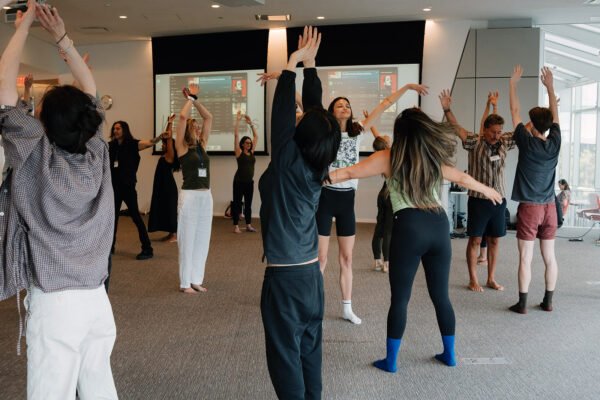
NEW YORK (RNS) — In a glass building overlooking the East River, a holistic wellness retreat kicked off a recent Saturday with hot tea, an opening keynote and meditation. After brunch, the afternoon continued with workshops on topics like “calming eating,” “body healing” and “intuitive art making.”
Everything was as expected, but instead of ending the opening meditation with “Namaste,” the leader ended it with “In Jesus’ name, Amen.”
Well Church NYC (often simply referred to as “The Well”) describes itself as “a church where wellness and spirituality meet in community.” The church, which meets on Sunday mornings out of a rented space at Scandinavian House on Park Avenue, also hosts wellness retreats, rooftop dinners, and pop-up meditations throughout the year around the city. While rooted in the Presbyterian tradition, Well Church NYC hosts events aimed at those seeking a broader spiritual exploration.
“The average New Yorker is not a Christian,” Pastor Aaron Bjelke said. “The average New Yorker may be driven by success and money, but ultimately they’re trying to find purpose in life. I thought if I was going to plant a church, it should be a church for the average New Yorker.”
Bjarke, 41, founded The Well in 2018, but first felt the spark for the idea in the early 2000s, as she watched the popularity of spin classes give way to quasi-spiritual self-care from brands like SoulCycle. Meanwhile, Buddhists like Sharon Salzberg were bringing meditation into the mainstream. In 2011, Bjarke began her own study of Christian meditation under the guidance of a spiritual director.
While working in public relations and still searching for his true purpose, Bjarke attended Redeemer Presbyterian Church, part of a network of churches founded by the late Tim Keller. He was inspired by Keller’s project to spread Christianity in New York’s secular missions by meeting in person with seekers in the city.

Bjelke was ordained in 2013 and became an assistant pastor at Redeemer Church. Worried about what his new congregants would think, he kept his views on health and Christianity secret for several years. Eventually, parishioners began to question whether his yoga and meditation practices were compatible with their faith, so he began sharing his spiritual practices with the community.
The Well isn’t the only place blending traditional faith with holistic health. With church membership declining and yoga studios more crowded than ever, some religious institutions are starting to emphasize the elements many seek in the wellness world: community, support, peace, stillness, breath, wisdom and song. The Well takes this a step further: There’s a 10-minute meditation after the sermon every Sunday. There’s an in-house health coach, in addition to a prayer team. The church’s app offers guided meditations.
The post-sermon meditation was invented after Bjarke noticed that people, including himself, had a hard time remembering the content of sermons. “The Protestant version of church worship is centered around the sermon,” Bjarke said. “Boom, boom, it’s over.” Adding a 10-minute meditation after the sermon allows people to “transfer what’s in your head to your heart.”
But The Well’s innovation goes beyond simply bringing modern wellness practices to the church. When Bjarke began researching what spiritual Christian communities looked like, he was struck by the long history of meditation in the church. The Desert Mothers and Fathers, early Christian hermits and monks who lived in Egypt, Palestine and Syria, combined prayer and meditation as far back as the third century.
“The church was Eastern before it was Western,” Bjarke says, “and I wanted to give a modern twist to the theologians and thinkers of the past. Instead of spending 30 days in the desert, I’d spend 30 minutes in a meditation studio.”
But whereas modern Western meditators go alone into themselves, Christians invite God in because “they need help seeing themselves,” Bjarke says. His technique is inclusive. “I might quote Buddha or Jesus, but I always quote Jesus,” he says. “Buddha has insight, Jesus has insight into his spiritual path. They all overlap, but they’re all different.”
The Rev. Matt Reeves, national coordinator of the World Community for Christian Meditation, said he was “thrilled” when he learned about The Well, noting that while some Christian churches incorporate Christian meditation and contemplative prayer, typically only a small portion of the congregation adopts the practice. The World Community for Christian Meditation, like The Well, is working to find ways to make these techniques a feature of the entire church.
“When people start meditating, the practice leads them to ask different questions about life,” he said. “It’s natural that they want to feel more connected to their body, and The Well seems like an embodied answer to the questions we (WCCM) are asking.”

Lina Raphael, author of “The Wellness Gospel: Gyms, Gurus, Groups, and the False Promises of Self-Care,” said that while the goal of commercially promoted exercise programs is to get participants to stay active, the main reason churches incorporate wellness activities is to connect members with each other and help them live healthier lives.
“Faiths have perfected their systems over centuries, so they are often more resistant to some of the issues we see in the wellness industry,” Raphael says. “They have a built-in community, a purpose, a meaning, and a guide.”
Bjarke was heartened that half of the 115 people who came to The Well retreat in early June were not church members, and nearly 90 percent of the retreat was funded by volunteers. He also said he makes sure newcomers “draw their own conclusions.” “My concern is, if we’re part of the same spiritual community, then let’s just walk together in some way, shape or form.”
David Saal, author of Seculosity, a 2019 book about the many alternative religions in modern society, warns: “Health spirituality can easily slip into ‘prosperity’ theology when we begin to equate physical health, and even mental health, with the sacred. What hope is there for those among us who are sick, paralyzed, debilitated, or dying, or who, no matter how hard we try, cannot recover?”
But Saar hesitated to pass judgment in a world where people are suffering more than ever before: “A new diet or exercise regimen alone is not enough to address pain. True integration could be a really great thing.”
Duke Divinity School pastor Daniel Castelo said churches like The Well could become more popular as people take more seriously what a holistic approach to caring for others looks like. “Christianity doesn’t have a consistent theme of self-care, apart from the word and concept of Sabbath,” Castelo said. “But in our culture where people are exhausted, stressed and burned out, this approach is logical and appealing, especially for people in urban areas.”
by
