

Mental Health First Aid USA June 17, 2024
Juneteenth marks an important anniversary of the abolition of slavery in the United States and serves as a reminder of hope and resilience, as well as the work that remains towards mental health equity in the Black community.
Kimberly Arnold, PhD, MPH, is a health equity activist, scholar, Mental Health First Aid Research Advisor, and Assistant Professor at the University of Pennsylvania. In Part 1 of Dr. Arnold’s blog, she discussed the importance of understanding the relationship between historical trauma and the physical and mental health of Black communities, highlighting the need to reduce stigma, promote equitable access to mental health resources and services, and celebrate the accomplishments of Black people throughout history.

This blog focuses on why community-engaged research is important for mental health equity in Black communities, Dr. Arnold’s work building mental health interventions in Black schools and churches, and her thoughts on the future of the field of community-engaged mental health research.
The road to community-participatory research
Dr. Arnold had always been interested in reducing the health disparities that Black people disproportionately face in the United States, but she remembers learning an important lesson during her graduate studies that made her want to work further in the field. “I didn’t realize it at first,” she said. [racism, discrimination and inequities in social determinants of health] It’s a form of trauma. It’s trauma to be looked down upon and denied opportunities because of the color of your skin. It’s trauma to not have access to healthy, affordable food in your neighborhood or safe, affordable places to exercise. It’s trauma to have to go to a school that doesn’t have enough resources. … By the end of your M.P.H. [Master of Public Health] Since participating in the program, I have known I want to dedicate my career to using a community-engaged research approach to research, implement, and evaluate public policy, health services, and community-based solutions to reduce health disparities and improve mental health equity for Black Americans.”
Dr. Arnold continued to study community-engaged research during her doctoral studies and fellowship at the National Institute of Mental Health. She speaks of a particularly memorable program in Baltimore called the “RAP Club,” which focused on prevention and expanded her knowledge of how to improve evidence-based interventions in real-world settings.
RAP Clubs employ evidence-based practices like mindfulness and cognitive behavioral therapy. Researchers, Black youth, and community committee members adapted it for use in 30 middle schools. “I’ve seen firsthand how this program helps students understand trauma and its impacts, recognize and deal with stress positively, manage emotions, and use mindfulness to improve their mental health,” says Dr. Arnold. Through interviews with school staff, she also understood the importance of addressing complicating factors to improve the adoption, implementation, and sustainability of mental health interventions in under-resourced schools.
Community Empowerment: Insights from the Field
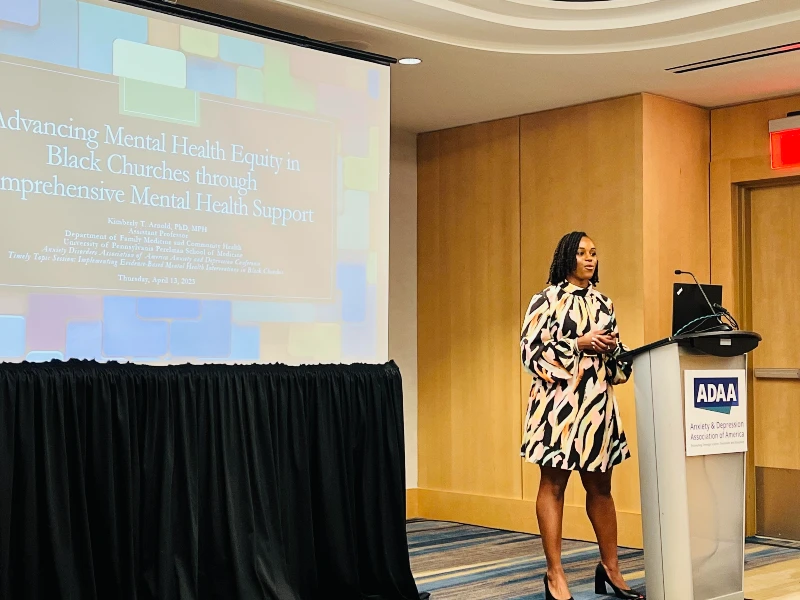
Arnold’s current research focuses on improving health equity in places like schools and churches in majority-Black communities. It’s a strategic approach, she said, because Black children spend most of their time in school and many Black adults are connected to or live near churches.
“Mental health ecosystems within predominantly Black schools and churches have the capacity to provide comprehensive mental health support to Black populations who tend to have limited access to mental health care,” she explained.
In these settings, a three-part approach of mental health education and promotion, screening and intervention, and intensive support or referral to specialized care can be offered to diverse groups of people.

Despite recent progress, there are still gaps between local mental health systems, schools, and churches. In the case of Black churches, economic barriers, lack of partnerships between mental health organizations and faith communities, and stigma may be some of the factors that affect the adoption of these programs. Dr. Arnold states, “Black churches have a long tradition as community hubs of spirituality, social justice, social support, economic and political power, and health promotion, but mental health is still less discussed or addressed in Black churches compared to physical health conditions such as diabetes, cancer, and hypertension. There is still room to improve mental health equity in both schools and churches, so we need to continue to reduce mental health disparities in both settings.”
The future of community-engaged research
Community-engaged mental health research must continue to expand and evolve to meet the needs of diverse communities across the country, and Dr. Arnold spoke about some of the advances he hopes to see in the coming years.
- Contribution to the local community: It is important to involve communities as active and equal participants in all stages of research, including research design, implementation, evaluation and dissemination. This creates a sense of collective ownership, ensures ethical research practices and makes research more responsive, applicable, practical and beneficial to communities.
- Asset-Based Research Approach: Exploring and highlighting strengths, resilience and positive coping mechanisms within communities will lead to more effective and sustainable mental health interventions.
- Culturally tailored interventions: Working with communities to develop, adapt and implement culturally appropriate mental health interventions allows community members to identify with the program and address their specific mental health concerns.
- Diversity of participants and community settings: Actively including and recruiting participants from diverse backgrounds helps researchers understand the unique mental health needs and experiences of various community members, and there is a need to improve the implementation, evaluation, and sustainability of mental health interventions in community settings such as beauty salons, barber shops, and recreation centers in addition to schools and churches.
- Sustainable multi-sector partnerships: Building partnerships with diverse groups—community members, researchers, mental health providers, administrators, and advocates—can help move research forward. These partnerships also help groups collectively develop research priorities and effectively share findings.
Some of these recommendations are already showing positive results on the ground; for example, teaching barbers and hairdressers Mental Health First Aid has helped them recognize the signs of mental health issues in their clients. The Black Faith and Mental Health Coalition, which Dr. Arnold recently co-founded with faith and mental health stakeholders, brings together churches, mental health providers, community-based mental health organizations, civic leaders, and academics to implement evidence-based mental health interventions, connect members of faith communities to local mental health services, and conduct research into community-partnered mental health services. But the work continues.
“Advancement in these areas will make community-engaged mental health research more responsive, actionable and impactful. This collaborative approach has the potential to produce more relevant insights, reduce mental health disparities and promote the overall well-being of diverse communities,” said Dr. Arnold.
