

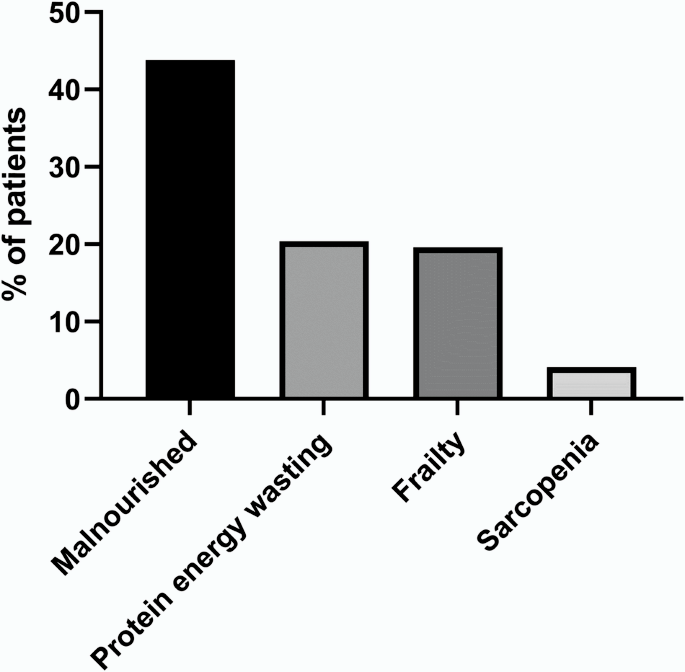
Most studies on nutritional assessment of dialysis patients are from economically developed countries. [15]Here we report on adult patients undergoing dialysis at a public hospital that is the largest tertiary care facility and has the only specialized nephrology unit in the country. Approximately 75% of patients had reduced dietary protein intake compared with the recommendations of the Clinical Guidelines Committee. [3, 19]The prevalence of malnutrition based on the 7-point SGA assessment was 43.8%. [19]Malnutrition was independently associated with lower serum albumin, creatinine, MUAC, BCM, and unemployment. The prevalence of PEW and sarcopenia was low at 20.4% and 4.1%, respectively, and 19.6% were classified as frail with CFS. [11, 15, 22]The seven-level SGA includes assessment of weight change, dietary intake, gastrointestinal symptoms, functional capacity, comorbidities, and physical examination. We found a fair agreement between SGA and frailty, but only a small agreement with PEW and no agreement with sarcopenia. Our patient cohort was younger and had fewer comorbidities than patients typically undergoing dialysis in economically developed countries, which may have influenced the SGA scores. We also used cut-offs from European and North American clinical guidelines to screen for sarcopenia, which may not be appropriate for sub-Saharan African populations, which may be the reason for the low association between SGA and sarcopenia.
Compared with other studies, the prevalence of malnutrition reported in our study was lower than that reported in other studies. [15]A much higher prevalence of 85% was reported in an Egyptian study. [23]1 person from Nigeria (55%) [24]The differences in prevalence in these studies, published almost a decade ago, may reflect differences in access to dialysis: patients in developing countries may have to pay in full or in part for dialysis treatments, dialysis less than three times a week and reuse of low-flow dialyzers, comorbidities, years on dialysis, and differences in dietary habits. [25]On the other hand, all of the patients we report on received three 4-h dialysis sessions per week, which is now considered the standard of care.
It has been reported that the risk of PEW increases if adequate clearance of uremic toxins is not achieved. [26]All our patients underwent 4-h dialysis 3 times per week, yet only 55% achieved session KT/Vurea target ≥1.4, and there was no association between session Kt/Vurea and SGA score, supporting a previous report from Iran that reported no association between dialysis session urea clearance and nutritional status. [27].
Serum albumin can be decreased by inflammation and PEW, and is not only an indicator of malnutrition, but in our patient cohort the mean serum albumin level was below the ISRNM recommended target of 38 g/L. [28]However, serum albumin levels were low in both patients classified as malnourished by SGA criteria and those classified as PEW. [15, 19]Those classified as frail had lower albumin levels than those who were not frail, but the results were not significant. [11]The number of patients classified as sarcopenic was small (yeah= 4), so no further analysis was performed.
Similarly, malnourished patients had lower serum creatinine levels, which is consistent with reports from Turkey. [29]It was demonstrated that low serum creatinine levels in dialysis patients are associated with reduced muscle mass and malnutrition. Both frailty and PEW were lower in malnourished patients compared to non-malnourished patients. The results were not statistically significant for frailty, but the difference was significant for PEW.
However, another observational study from Iran found no association between serum creatinine and malnutrition. [30]In this study, we found a significant difference in the prevalence of malnutrition between male and female patients, with moderate malnutrition being more prevalent in male patients, biasing the study results. Because creatinine is produced from creatine in muscles, patients with more physical activity produce more creatinine. In our study, employed patients were less likely to be malnourished, which is consistent with other reports that physical activity is associated with employment and a lower prevalence of PEW, sarcopenia, and frailty. [9]Malnutrition was found to have lower body cell mass and, more importantly, less lean tissue and less muscle mass in proportion to height. Similarly, MUAC was lower in malnutrition, and there was no difference in fat mass in proportion to height, again suggesting that malnutrition also has less muscle mass in the upper arms.
Creatinine is also influenced by diet, particularly dietary meat protein intake: median nPNA values were found to be well below the 1.0-1.2 g/kg/day dietary protein intake recommended by the 2020 Kidney Disease Outcomes Quality Initiative (KDOQI) Nutrition Clinical Practice Guideline. [3]However, almost three-quarters (74%) of patients had low protein intake (nPNA < 0.8 g/kg/day), which may be influenced by dietary patterns. As the main staple food is starchy food (maize), most people, especially those from poor households, mainly eat only maize and rarely meat, which may explain the low nPNA reported in our study. [31]There was no significant difference in dietary protein intake between malnourished and non-malnourished patients, but this may be because all patients were provided with meals when undergoing dialysis, and therefore most dietary restrictions and recommendations for dialysis patients are designed for economically developed countries. [1, 3]dietary recommendations appropriate for dialysis populations, taking into account geopolitical, religious, and ethnic factors, may be inappropriate for patients living in sub-Saharan Africa. In economically developed countries, a focus on protein and phosphate restriction may be appropriate. [3, 4]In resource-limited settings in developing countries, dietary advice needs to be provided more carefully to ensure adequate nutrition. Unemployed patients are more likely to be malnourished, and economic factors such as lack of funds to purchase essential foods may influence the development of malnutrition. In our study, a higher proportion of unemployed individuals had low nPNA, but the results were not statistically significant when compared with employed individuals.
We report the first study to assess the nutritional status and diet of CKD patients in Japan. As with any observational study, there are some limitations that should be considered. First, this is a cross-sectional study, so we cannot comment on whether the nutritional status of patients has changed over time. Second, this was conducted in the only public hemodialysis center, but private dialysis centers are now opening. Third, the staple food is maize, which is widely eaten in many African countries, but dietary patterns may differ in other countries. As with any observational study, we can report factors associated with malnutrition but cannot determine causation, so findings should be interpreted with caution.
