

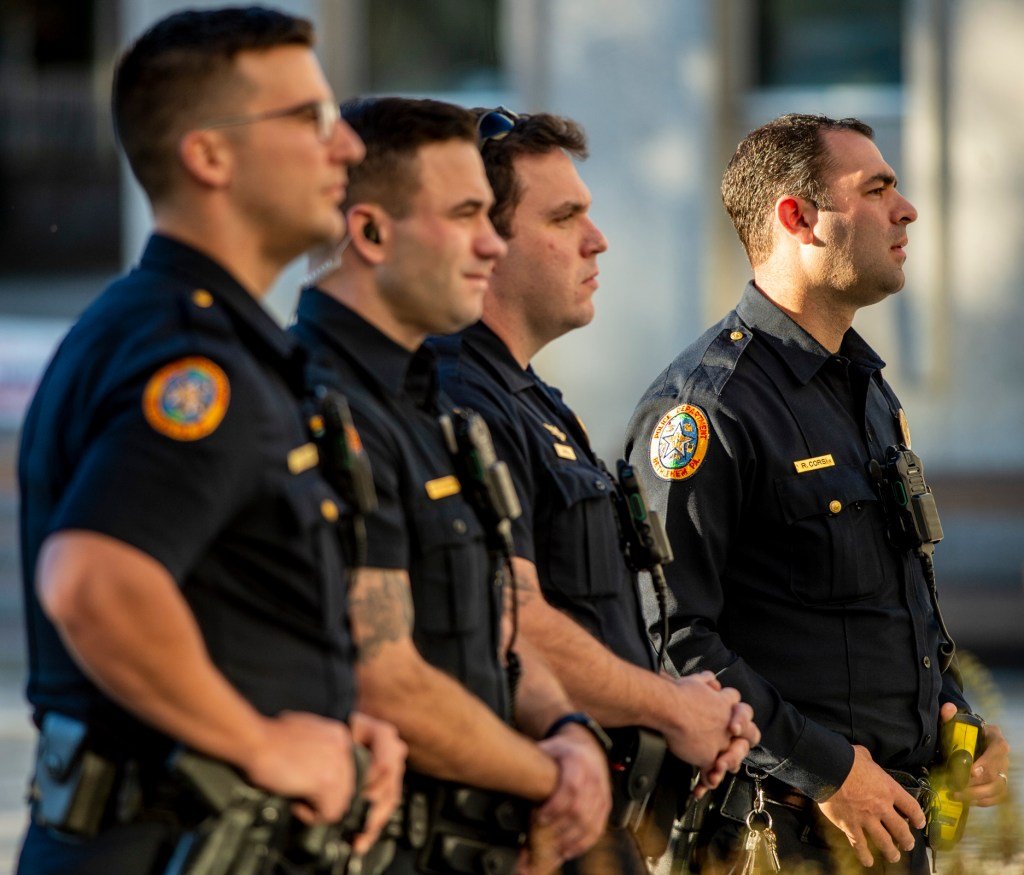
Bethlehem Police Department officers support the petition “No Hate in Bethlehem and the Lehigh Valley” during a press conference in Bethlehem, Monday, Nov. 8, 2021. Local leaders attended the event to show their support for the petition. April Gamiz/The Morning Call
Fred Rooney, Guest Columnist
In my 38 years as a lawyer, few cases have affected me as deeply as the one I was involved in late last month.
A few months ago, the 20-year-old son of a longtime friend was charged with a summary offense (disorderly conduct). Until a year ago, he was a normal student at Liberty High School who enjoyed scouting, sports, and spending time with his family, neighbors, and friends. But his life took a tragic turn when he began to struggle with depression, anxiety, alcohol use, and recreational drug use.
His unexpected decline and its traumatic impact on the entire family left his parents struggling to cope with his new reality. Over time, he was admitted to several hospitals for treatment of paranoia, schizophrenia, delusions and bipolar disorder.
Last November, his father called the Bethlehem Police Department for help after witnessing his son engaging in confrontational behavior at a local store. After Bethlehem officers responded to the scene and issued the son a summary summons, his father made the difficult decision to have his son hospitalized.
I have known his parents for almost 25 years and their son since the day he was born. As a friend and court officer, I have assured them that I will do my best to assist them in serving the summons and accompany them on the day of the hearing.
The charges are misdemeanors and the son had no previous contact with police, but ultimately a judge will decide the outcome of the case.
Upon arriving at the District Court, I waited to speak with Officer Corey Gonzales prior to the hearing. I wanted to assure him that this young man had recently been released from a 30-day hospital stay, was attending church, taking medication and feeling better. When his partner, Officer Sam Domenico, arrived, I sensed he knew this young man had mental health issues, as the hearing had been postponed due to the defendant’s hospitalization.
“What happened that morning in the parking lot of the district courthouse was one of the most moving events I have witnessed as an attorney. As both officers began speaking to the young man, his parents, and me, it was clear that they deeply understood the importance of effective communication with individuals and families dealing with an ever-increasing number of mental health issues and the law. The compassion they showed as representatives of the Bethlehem Police Department touched me deeply.”
Domenico candidly shared the very personal reasons why he is so familiar with mental health issues: His twin brother, Frank, had struggled with bipolar disorder for over 15 years. He was a brilliant Rutgers University graduate with dreams of becoming a teacher, and a caring, generous man whose mental health issues were not properly managed. Frank’s futile attempts to self-medicate ended tragically: he died of an overdose after just a few uses of fentanyl.
“Despite all his faults, he was a much better person than I was,” Domenico said.
By sharing his own story and encouraging this young man to follow his treatment plan, Domenico brilliantly demonstrated a deep understanding of how untreated illness can be harmful to individuals, families and society.
When I tried to better understand how he developed such deep sensitivity in responding to people in crisis, Gonzalez explained, “Respect and compassion are foundational to our values. On every call, we strive to humanize the badge, listen to those in crisis, and recognize the importance of mental health. The greatest service we can provide is just to listen.”
Gonzalez and Domenico have worked in law enforcement for 10 years, the other six in Bethlehem. In serving the public, they both strive to “do the right thing, not punish those who break the law,” Domenico said. “We’re fair, and we do it because we love the job.”
The outcome of the hearing will allow this young man to participate in community service and move forward as best he can. The compassion, encouragement and vital advice of the officers will be something he will never forget. It is essential that he follows his treatment plan, does not deviate from his treatment and avoids people and places that could set him back from his path of progress.
Mr. Gonzalez and Mr. Domenico are examples of the best in law enforcement and embody what is possible when our communities approach mental health issues from a healing and therapeutic perspective, rather than one of blame and punishment.
The tears we all shed in the courthouse parking lot were born of renewed hope and deep gratitude for these two incredible officers who demonstrated vulnerability, humanity and courage in the course of their jobs as compassionate professionals and potential livesavers.
Fred P. Rooney is a resident of Bethlehem.
