

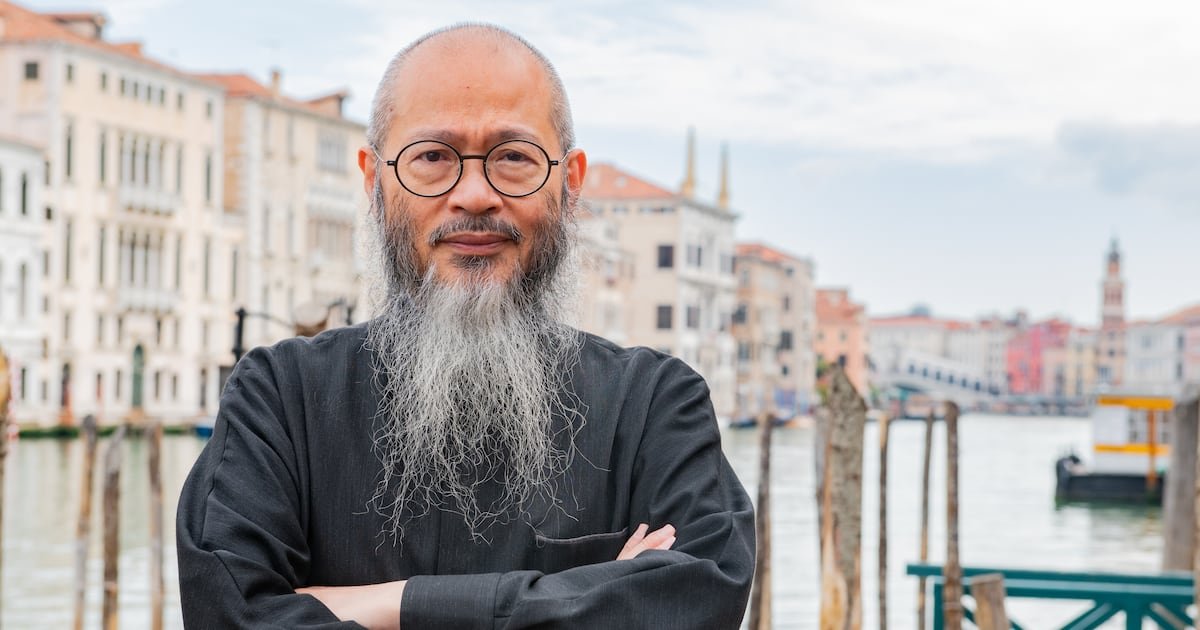
Wallace Chan, the esteemed jewelry designer and creative genius who pioneered the unprecedented use of titanium in large-scale sculptures, has opened his latest exhibition, “Transcendence in the Floating City,” to coincide with the opening of the Venice Biennale.
Curated by James Putnam and staged in the Chapel of Santa Maria della Pietà, the show features four large titanium sculptures suspended from the chapel’s ceiling, exploring themes of spirituality, rebirth and the ability to overcome limitations to reach enlightenment.
“In ‘Transcendence’, I want viewers to contemplate the relationship between humans and nature,” said the Chinese multidisciplinary artist. “I named the work ‘Transcendence’ because I wanted to go beyond the physical limits and reach a higher realm of art in a spiritual sense by exploring a meditative state.”
“The four sculptures are by Vivaldi Spring, Summer, Autumn, Winter“Because this is where Vivaldi lived and performed,” he adds, “at the same time, the chapel is a very sacred and historic place, but we have very modern, space-age materials on display in this historic environment, and I love the contrast.”

Chan began his career as a gemstone carver in 1973 at the age of 16, setting up his own studio within a year after training in Hong Kong. He revolutionised the use of titanium, a material considered difficult to work with and unsuitable for jewellery, in jewellery making and later applied his knowledge to large-scale artistic sculptures.
Many of his works are held in the permanent collections of institutions such as the Museum of Fine Arts, Boston, the British Museum, the Capital Museum in Beijing, and the Ningbo Museum in China.
“Transcendence” is Chang’s third exhibition in Venice, following two previous ones. In 2021, Chang’s first large-scale sculpture and installation art exhibition, “Titans: A Dialogue of Materials, Space and Time”, was held at the Fondaco Marcello. In 2022, the same venue will host “Totem”, a 10-metre titanium sculpture that addresses the concept of uncertainty, dismantled into pieces and scattered across the floor.
What ties all three shows together is Chan’s exploration of the materiality of titanium, which he seeks to challenge: due to its durability, he associates the metal with permanence and change through challenge.

“Titanium is a stubborn, hard material that must be understood before it can be mastered. I see it as the material closest to eternity, and by using it in Transcendence I am emphasizing the eternal nature of the desire to reach an enlightened state,” says the artist. “From the beginning of my career I have felt that everything is constantly evolving, and why shouldn’t titanium not evolve too?”
“I wanted to show the endless possibilities of this material by giving it a new perspective. Titanium is a very special material: it is durable, bio-friendly and has a melting point of 1,700 degrees Celsius,” he adds.
“All these elements fascinated me and I wanted to prove that I could control titanium, because every time I persisted in bending the material to my vision, I felt that I was doing something worthwhile with my existence, making progress with a material that most people don’t want to use in art. I was able to produce and create something that will live on after I’m gone.”
Chang creates his pieces through a process of carving, smelting and sculpting – titanium cannot be worked on using techniques such as melting, casting and hammering that are used with conventional metals.

Due to its extremely high melting point, a way had to be found to move the liquid metal without melting the container. After some experimentation, ceramic was the only solution. The size of the sculptures makes them nearly impossible to form from one single piece, so they are often assembled from smaller parts.
“If you bend it or hammer it, it will snap back into place,” he explains. “If you heat it to its melting point, it will stand like a square until you push it a little, at which point it crumbles into powder. I engrave titanium with diamond tools, but the metal is so hard that it loses its sharpness very quickly.”
The sculptures model human faces in various expressions, the fourth being a large tulip, a symbol of eternity and rebirth. The face starts out very distorted but gradually becomes calm. The altar is followed by two smaller figures of Jesus and Buddha.
As viewers move through the small chapel, the sculptures’ expressions change, moving from states of conflict to ones of peace and tranquility — a soundscape by musician and composer Brian Eno enhances the experience.
Drawing inspiration from Chinese Buddhism and Zhang’s own experience growing up interfaith, the exhibition seeks to open a dialogue about the building’s Catholic context, with the artist explaining that religions are ultimately the same at their core and we should look for similarities rather than differences.
“At the altar, you can see that Jesus and Buddha have actually swapped bodies. While Jesus is in the lotus position, there is a cross in front of Buddha, which actually shows the interconnectedness of spirituality,” he says. “When I was about eight or nine years old, I went to church, but only because I wanted bread and milk. I came from a very poor family and didn’t have much money for food, so I started going to church. But when I got home, my grandmother would usually ask me to light incense for my ancestors and for Buddha.

“Having grown up practicing both religions, I felt a bit conflicted, but ultimately realized that all religions are connected by teaching love, unity, and kindness,” he added. “These sculptures were a way for me to express this moment in my life by moving beyond the confusion to a higher understanding that sees religions as part of the same spirituality.”
“I reflect this idea in my work. When you go beyond form and material, it becomes a higher form of art,” Chang says.
TrancecEndence is on display at the Church of Santa Maria della Pietà in Venice until September 30th.
Updated: June 14, 2024 10:03 AM
