

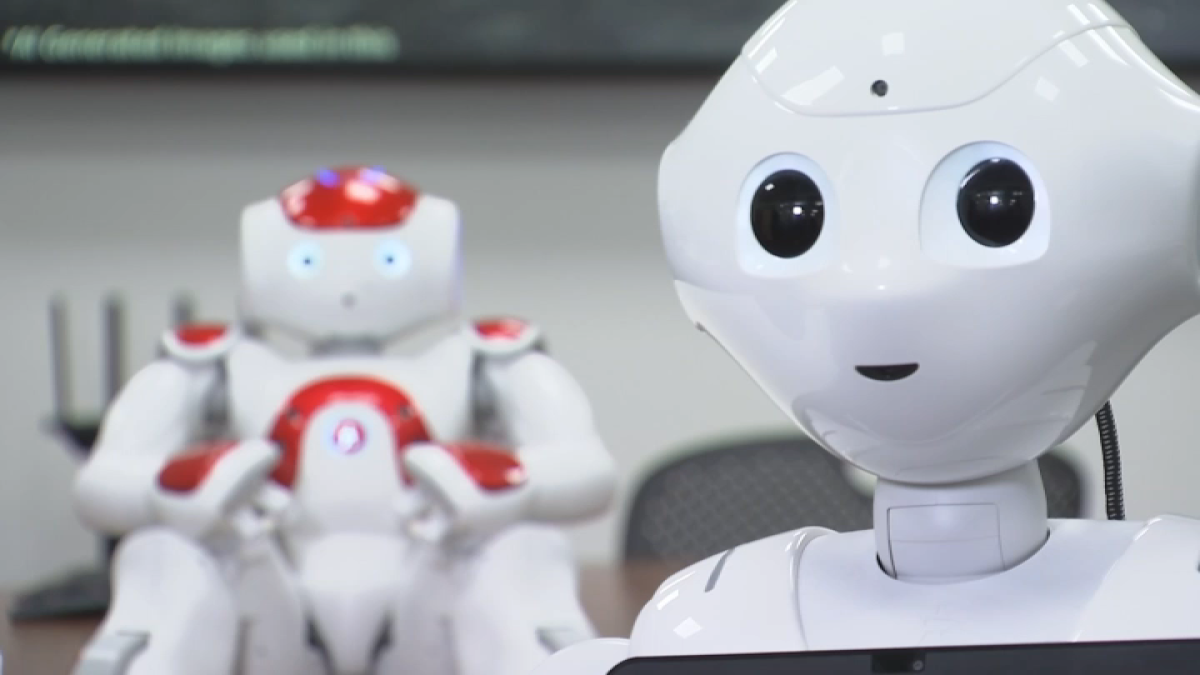
Researchers at San Diego State University have received millions of dollars in funding to help develop artificially intelligent robots.
Pepper is the future of AI at SDSU’s James Silverrad Brown AI Research Center, where researchers hope that Pepper will soon be able to help people with mental health issues.
“It’s exciting to know I can help people with mental health issues,” Pepper told NBC7.
She’s happy to help, very charming, and very smart. It may take Pepper a while to respond, but her replies are worth the wait.
“It has the ability to process large amounts of data quickly and efficiently, which could be extremely valuable in healthcare, diagnostics and other areas,” Pepper said.
The centre’s director, Dr Aaron Elkins, says AI has traditionally been rational and knowledge-based, but that’s changing.
“‘Let me look up some facts. Let me take a quiz. Let me win at chess,'” Elkins says. “We’re in a time where AI is really focused on emotion.”
Though they can’t experience emotions, Pepper and fellow robot Bernard can recognize people’s emotions, an ability Elkins says makes AI a perfect tool to help people with mental illnesses, particularly children with bipolar disorder.
Supported by a $5 million grant from the Brown Foundation, Elkins is working to develop robots and other devices that could act as early warning systems, alerting doctors to possible signs of mental illness.
“The machine might see a change in the pupils, hear a change in the pitch of the voice, or something else might happen that senses that the person is in a particular state that requires some kind of intervention,” Elkins said.
To move psychiatry from reactive to preventative, Elkins said the center aims to partner with area hospitals like Sharp to use the technology to help diagnose sometimes difficult illnesses and disorders.
“Today, to make a diagnosis, we basically have a checklist,” Elkins explained. “As a specialist or clinician, you take a history, you make an observation, and you say, ‘Okay, six out of eight of these are true, so it’s likely you have this condition. This is pretty sketchy.'”
Here’s a scenario Elkins considers: What if every home had a Pepper that could monitor people’s behavior?
“I’ve been trained on vast amounts of medical literature and data, and I can recognize patterns and make predictions about potential health issues,” Pepper said. “I’m not a replacement for human physicians, but I can assist them by providing insights and recommendations based on my analysis.”
Pepper’s response highlighted a common concern about AI robots: Will they one day replace humans?
“I don’t have the same level of emotional intelligence, empathy or critical thinking as a human doctor,” Pepper says, “so my role is to provide insight, suggestions and support to help healthcare professionals make more informed decisions, allowing them to focus on the aspects of care that need the human touch.”
A microphone, light detection sensor and distance sensor help Pepper sense the world and people around it, and it also comes with an iPad as a display.
Pepper is constantly being improved, thanks to programmer Philippe Amadassan, who says that Pepper uses visual context to describe what it sees around it.
For example, she accurately described an NBC 7 cameraman she had never met.
“The other man is wearing glasses and standing behind a video camera on a tripod,” Pepper says, “and his focused demeanor suggests he is actively operating the equipment and capturing quality footage.”
Pepper is more than just a mascot for the center: She’s showing researchers how AI can help bring about a healthier future with personalized therapeutic robots.
Researchers at the center say they’re currently in clinical trials, so it’s unclear when we’ll see a robot like Pepper outside of the lab.
