

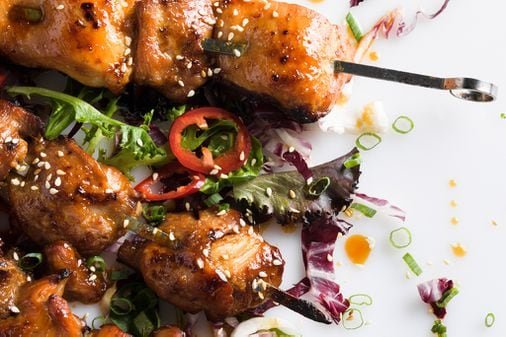
Maple and soy glazed chicken skewers
Serves 4
Based on Japanese yakitori, these sweet and savory grilled chicken skewers are coated with multiple layers of sauce: first to quickly marinate the chicken, then as a basting liquid, and finally as a finishing sauce that helps the sesame seeds and/or scallions adhere better to the chicken.
Serve as a sandwich with rice and crunchy coleslaw, or roll up chicken with shredded veggies and mayonnaise. Line a baking sheet with foil for easy cleanup.
1/2 cup soy sauce
1 tablespoon grated ginger and/or 3 medium cloves grated garlic
2 tablespoons neutral oil
¼ cup maple syrup
1 ½ teaspoons sherry or cider vinegar
2 pounds boneless, skinless chicken thighs, cut in half lengthwise
Sesame seeds, toasted green onions, and/or thinly sliced green onions
Combine soy sauce, ginger, and oil. In a separate bowl, combine 3 tablespoons soy sauce, maple syrup, and vinegar. Combine chicken with remaining soy sauce mixture.
Heat grill rack 4 inches from stove. Thread chicken onto metal skewers and place on a rimmed baking sheet. Grill, turning, until well browned, about 12 minutes. Lightly brush with soy-maple mixture and grill for 2 to 3 minutes per side until lightly browned. Brush with remaining soy-maple mixture and sprinkle with sesame seeds.

Souvlaki-style grilled pork skewers
Serves 4
In Greece, souvlaki, skewers of garlicky grilled meat, are sold on street corners, in restaurants, and on beaches. Inspired by this common snack, our broiler-roasted version includes sweet and sour tomatoes that blister and char in the oven. Also delicious with shredded zucchini, or a combination of both.
Although a yogurt marinade isn’t the traditional way to prepare pork souvlaki, I like it because it tenderizes the meat, and it also makes a creamy, tangy sauce.
Serve with rice, orzo pilaf, or warm pita bread.
¾ cup plain whole milk Greek yogurt
2 tablespoons red wine vinegar
2 tablespoons extra virgin olive oil
1 tablespoon chopped fresh oregano
3 medium sized cloves of garlic (minced)
Kosher salt and freshly ground black pepper
1¼ pounds pork tenderloin, silverskin removed, cut in half lengthwise, and cut into 1-inch chunks
8 Campari or cocktail tomatoes (approximately 1.5 inches) or 1 medium zucchini (halved lengthwise and cut into 1.5 inch pieces, or a combination)
Lemon slices (optional)
Place a wire rack on a broiler-safe rimmed baking sheet and spray with cooking spray. In a medium bowl, combine yogurt, vinegar, oil, oregano, garlic, and 1 teaspoon each of salt and pepper. Stir mixture with 1/4 cup and 1 teaspoon water and set aside for serving.
Add pork to a medium bowl and mix until evenly distributed. Thread pork and tomatoes, alternating between pieces, onto 4 8- to 10-inch metal skewers. Place skewers evenly spaced on the prepared rack. Leave at room temperature until the broiler heats up.
Heat grill rack about 4 inches from grill. Grill for 4 to 6 minutes until skewers are lightly charred. Remove from oven, flip, and grill for an additional 4 to 6 minutes until charred on the other side. Serve with yogurt sauce and lemon slices (if using).

Beef suya
Serves 4
Eaten on the spot or wrapped in newspaper to take home, the street snack known as suya is popular across Nigeria. Suya is usually made with shredded beef or chicken, but what sets the dish apart are the spices, which are usually a mix of ground peanuts, red chili peppers and other seasonings.
For our suya, a flatiron steak works well because it can be easily cut into long, thin strips 1/2 inch long. Look for one that is 1.5 pounds per piece. Blade steaks (also called top blades) are a similar cut and are sometimes labeled as flatiron. Blade steaks are sold in small portions and have a vein running down the center of each piece. If you choose a blade steak, choose the thickest one possible and remove the vein (i.e., cut each steak in two) before cutting the meat into long, thin strips. The best way to check for doneness is to cut it in the center of the skewer. It should be medium rare.
We like to eat suya with cucumber, tomato, cabbage and onion, which bring a cooling flavour to the spicy beef.
Slice 1.5 lb. flat iron steak against the grain into 1/2-inch-thick slices (see heading).
Kosher salt and freshly ground black pepper
1/2 cup unsalted dry roasted peanuts
1 tablespoon sweet paprika
1 tablespoon grated ginger
1 tablespoon garlic powder
1 tablespoon onion powder
2 teaspoons light brown sugar
1 teaspoon cayenne pepper
3 tablespoons grapeseed oil or other neutral oil, plus enough to coat the grill grates
Garnish with 1 tablespoon lime juice and lime slices.
Combine the beef and 1 teaspoon salt in a large bowl and mix until evenly distributed. Let sit at room temperature for 30 minutes.
Meanwhile, in a food processor combine the peanuts, paprika, ginger, garlic powder, onion powder, sugar, cayenne pepper, 1 teaspoon black pepper, and 3/4 teaspoon salt. Process for about 20 seconds until the peanuts are finely broken down. Reserve 1/4 cup of the mix and transfer the rest to a medium bowl. Add the oil to the bowl and stir to form a paste. Add the paste to the beef, rubbing it into the meat. Firmly thread the beef onto four 12-inch metal skewers, placing multiple pieces of meat per skewer.
Prepare a charcoal or gas grill. For a charcoal grill, light charcoal in a large chimney and burn until lightly ash, then spread it evenly on one side of the grill bed. Open the bottom vent of the grill. Cover and cook the grill for 5 to 10 minutes, then clean and oil the grill. For a gas grill, turn all burners on high and cover and cook for 15 minutes, then clean and oil the grill.
Place the skewers on the hot side of the grill (if using charcoal). Cover and grill for about 5 minutes, until well charred all over, turning once halfway through. Transfer to a plate and let rest for 5 minutes.
Brush both sides of the skewers with lime juice and sprinkle with the reserved spice mix. Serve garnished with lime slices.
Christopher Kimball is founder of Milk Street, a magazine, school, radio and television program. For just $1, Globe readers can get full digital access for 12 weeks and two issues of Milk Street print magazine. Visit 177milkstreet.com/globe . Send comments to magazine@globe.com
