

The UEFA European Championship 2024 will kick off on 14 June. The month-long tournament, held in Germany, will see 24 teams from across the continent take part in the bid to be crowned European champion.
While many Catholics may view sporting tournaments with skepticism and generally see them as an unnecessary distraction from spiritual life (not to mention the terrible greed that comes with the astronomical amounts of money that go to a lucky few), isn’t it more important to focus on God than 11 players kicking a ball?
However, recent events throughout June suggest this is not the case, suggesting that things are not as simple as the football field being divorced from spirituality. It has been demonstrated that even those involved in football can sanctify their work by thanking God for what they have achieved on the pitch.
Related: Blood and Blessings? Catholicism and Bullfighting
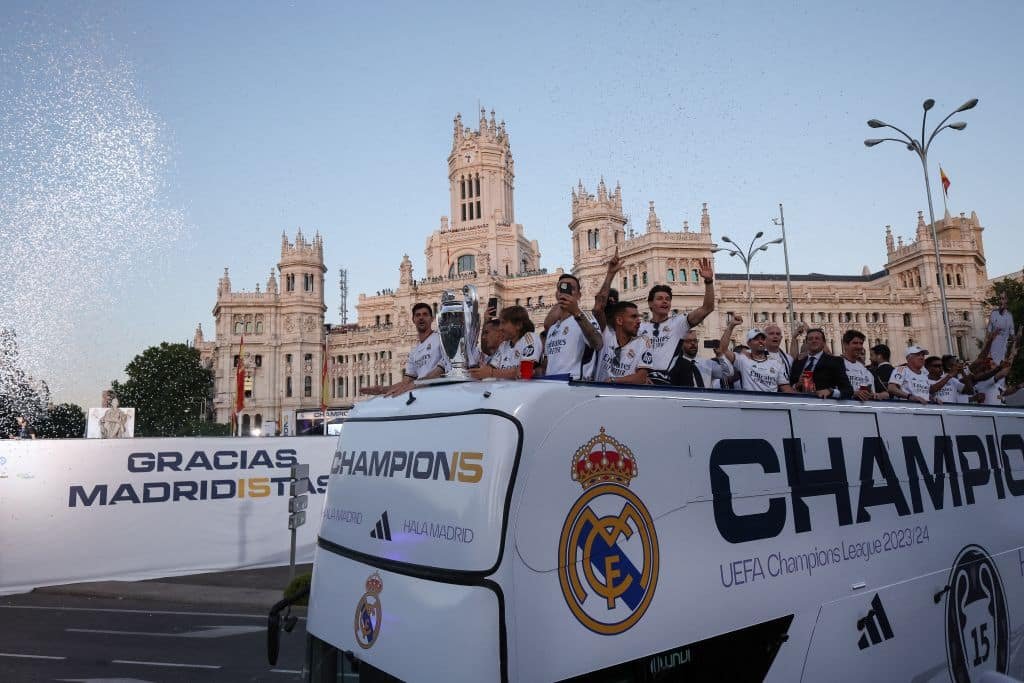
The first instance occurred at the Almudena Cathedral in Madrid on June 2. The day before, Spanish soccer team Real Madrid had defeated German rivals Borussia Dortmund 2-0 in the UEFA Champions League final at Wembley Stadium.
As part of the Champions League triumph celebrations, the club was welcomed at Almudena Cathedral by the Archbishop of Madrid, Cardinal José Cobo Cano, who held a ceremony inside the cathedral to honour Real Madrid’s achievements at the end of the football season.
It’s traditional in Spain for clubs to present trophies in local churches or cathedrals – for example, Sevilla FC dedicated their Europa League trophy last year to the Virgin Mary at Seville Cathedral.
Attending Real Madrid’s ceremony at the Almudena Cathedral were club president Florentino Pérez, manager Carlo Ancelotti and his coaching staff, as well as the entire player team, all dressed in formal suits.
Cardinal Cobó congratulated the club on their Champions League victory and then invoked the name of the Lord, saying: “Jesus is also here and wants to thank us for giving us this cup. He helps us realize what is truly important in life.”
Making special mention of Our Lady of Almudena, the cardinal explained: “As a good Mother, she cares for and intercedes for her children, for the faithful and non-believers. From here she always blesses and welcomes the prayers and hopes of all those who have recourse to her and who search deeply for the deeper meaning of life.”
Our Lady of Almudena is the title given to the Virgin Mary as the patron saint of the city of Madrid. Local Catholic legend says that her original statue was brought back from the Holy Land by Saint James the Great, the patron saint of Spain and Rome. Heroes of the Camino de Santiago.
When Muslims invaded Spain in the 8th century, faithful Catholics living in what is now the city of Madrid hid the statue of the Virgin of Almudena in the walls of one of the fortress towers to protect it from destruction by Muslim conquerors. Centuries later, in 1085, after Catholics recaptured Madrid, King Alfonso VI marched around the fortress and, according to legend, part of the wall collapsed, revealing the statue of the Virgin Mary behind the rubble, next to a lit candle.
The statue then came to be venerated as the Virgin of Almudena (“Almudena” comes from the Arabic “almudaina”, meaning “fortress”). The spot where the statue was discovered was later to become the site where the Almudena Cathedral, dedicated to the Virgin of Almudena, was built. The original statue was lost, but the current one in the cathedral dates back to the 15th century.
As part of the ceremony, the cardinal called on the players to climb the steps and present the Champions League trophy in front of the statue of Our Lady of Almudena. There was a jubilant moment when the crowd outside the cathedral saw team captain Nacho Fernández raise the trophy to the statue, with applause drowning out the choir singing Spanish hymns. Club president Florentino Pérez then presented a small replica of the trophy to Cardinal Cobo.
A few days later, Real Madrid midfielder Luka Modric was once again caught up in the fusion of football and religious ceremony when, along with other players from the Croatian national team, he attended a private audience with Pope Francis at the Vatican’s Apostolic Palace.
Despite having a population of less than four million people, Croatia boasts an impressive national team that recently finished third in the 2022 World Cup and reached the final in 2018, losing to France in a thrilling match.
The Pope was presented with a Croatia shirt and ball, and after congratulating the team on their performance in the World Cup, he gave his congratulations to the team, explaining that “being a team is the aspect of sport that I want to highlight, because it is a metaphor for social life in different environments, where one lives and works together with other people.”
The Pope stressed the “honor, friendship, fraternity, loyalty and self-control” that athletes should have. The Cardinal similarly emphasized fraternity, noting that “on the playing field it doesn’t matter where someone comes from, what language they speak or what culture they have,” and spoke of the importance of sport to society.
In their respective speeches, both prelates also mentioned the responsibility these footballers have towards society, with the Pope reminding the Croatian people of the influence they have on the country’s youth.
Whether the Real Madrid and Croatia players are devout Catholics or not, the Church reminds these footballers that, despite their wealth and fame, they have a duty to be strong examples in society, especially to young people. The Christian values of sport far surpass the money that accompanies and may seem to taint the sport.
Spain and Croatia are historically Catholic countries that suffered anti-Catholic persecution throughout the 20th century, persecuted by the anti-clerical Spanish Republicans in the 1930s and the Yugoslav Communist regimes, respectively. Overcoming these evils and the tide of secularism, recent public events have How deeply ingrained the Catholic faith is in their culture.
Meanwhile, in our historically Protestant country, we will probably have to wait a while longer to see whether the Three Lions will receive a blessing from the Pope in the Vatican if they win the World Cup, or whether the next Super Bowl winner will decide to present the trophy inside the National Cathedral in Washington, DC (although this year the Super Bowl winner will be presenting the trophy inside the National Cathedral in Washington, DC). Harrison Butker caused a Catholic stir. He attracted attention in secular circles with his “controversial” speech at a university graduation ceremony.
Yet Catholics may feel motivated ahead of the UEFA Euro 2024. Many non-religious soccer fans claim that soccer is “their religion,” but they may also be aware and reflect that some of the world’s most famous soccer players and biggest teams follow the Catholic religion and understand the need to glorify God and his Virgin Mary in public — something we can all learn from in our daily lives.
Pictured: Real Madrid players board buses at Cibeles Square and march through the city of Madrid to celebrate their 15th Champions League title, the day after their win over Borussia Dortmund, in Madrid, Spain, June 2, 2024. (Photo by THOMAS COEX/AFP via Getty Images)

