

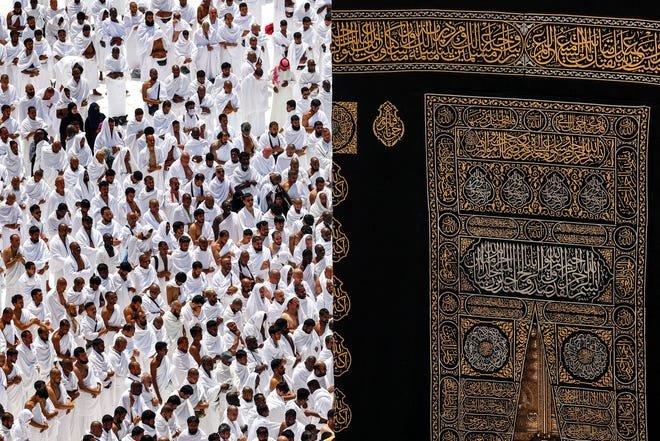
- The Hajj, or pilgrimage, is one of the fundamental foundations of the Islamic faith and one of the five pillars of Islam.
- The Hajj takes place in Mecca, Saudi Arabia.
With Dhul Hijjah, the final month of the Islamic calendar, approaching, some Muslims will be preparing to travel to Saudi Arabia to undertake the obligatory spiritual journey known as the hajj, or pilgrimage.
The month of Dhul Hijjah is expected to begin with the sighting of the crescent moon on the evening of June 6.
So what is the Hajj? When does it start? Here’s what you need to know.
When is Hajj?
The Hajj period is predicted to begin on June 14 and end on June 19, lasting for five to six days, as it begins on the eighth day of the month of Dhul Hijjah and ends on the 12th.
What is Hajj?
The hajj, or pilgrimage, is one of the fundamental foundations of Islamic faith and one of the five pillars of Islam, according to Islamic Relief. The pilgrimage takes place in Saudi Arabia’s holy sites.
The five pillars of Islam are:
- Testimony of Faith (Shahada)
- Prayer (Sarah)
- Charity (Zakat)
- Fasting (Sawm)
- Pilgrimage (Hajj)
Hajj must be performed once in a lifetime, but Muslims have the option to go multiple times if they have the financial means.
The history of the Hajj dates back to Prophet Abraham, who built the Kaaba, and later Prophet Muhammad began the pilgrimage in 628 AD during Dhul Hijjah.
What is that Kaaba?
The Kaaba, known as “Baitullah” or “House of God,” is ultimately a mosque and Muslims do not worship it.
It was built by Prophet Abraham and his son Prophet Ishmael, and was subsequently used by polytheistic pagan Arabs until the introduction of Islam and the initiation of the Islamic pilgrimage when Prophet Muhammad designated it a holy place.
Today, when Muslims perform their five obligatory daily prayers, they do so facing specifically towards the Kaaba, wherever they are in the world.

Who goes to Hajj?
Hajj is obligatory, but only for adult Muslims who can afford to travel and are physically and mentally healthy.
Approximately 2 to 3 million Muslims take part in the Hajj each year. Anyone who performs the Hajj is called a pilgrim.
Where does the Hajj take place?
The Hajj takes place in Mecca, Saudi Arabia.
How do Muslims prepare for the Hajj? What happens during the Hajj?
The hajj is a special spiritual time for pilgrims, some of whom have waited their whole lives. Many Muslims may have been saving up for years to take part in the hajj or waiting for permission from Saudi Arabian authorities, according to the Associated Press.
According to Islamic Relief, to perform the hajj correctly, pilgrims must follow a step-by-step set of rules to complete the journey, which includes maintaining a state of willingness to please God and fulfill religious obligations, and entering the ihram, or mental state, required to perform the hajj.
To maintain the state of ihram, pilgrims must refrain from evil deeds and be careful of their words and actions. Pilgrims must refrain from smoking, sexual intercourse, swearing, shaving their hair, and cutting their nails.
Ihram also involves wearing appropriate clothing for the Hajj.
Men wear two white pieces of cloth wrapped around the waist and shoulders, and women observe the rules of hijab, which requires loose clothing that covers the body from head to toe and covering the scalp. Footwear must be sandals. As the Hajj brings together Muslims, rich and poor, all pilgrims must wear simple clothing with no seams in their clothes.
Ihram is simple but must therefore be observed strictly.
The pilgrims then enter Mecca to begin their pilgrimage.
It begins with Tawaf, walking counterclockwise around the Kaaba seven times. Pilgrims then perform Sai, a walk or run between the hills of Safa and Marwa, which recreates the struggle of Prophet Abraham’s wife Hagar in finding water for her son Ishmael. These two events take place at Mecca’s Grand Mosque, known as Masjid al-Haram.
When permitted to leave ihram, men shave their heads and women cut their fingertip-length hair, after which they resume ihram. Pilgrims camp in an area called Mina and then, on the ninth day of Dhul-Hijjah (known as Ya’um al-‘Arafah), make their way to Mount Arafat, 12 miles from central Mecca, where they make supplication and ask God for forgiveness.
Pilgrims then travel to Muzdalifah to pick up pebbles to throw at the devil in the valley of Mina, believed to be the place where Ibrahim was tempted to disregard God’s command to sacrifice his son.

When is Eid al-Adha?
The second biggest Muslim holiday, Eid al-Adha, translates to “Feast of Sacrifice” and commemorates the day when Prophet Abraham sacrificed his son Ishmael to God, but God stopped him and sent a sheep as a sacrifice instead.
Eid al-Adha will take place during the Hajj, which began on the evening of June 15 and is due to be celebrated around the world on June 16.
On this day, Muslims participate in morning communal prayers at mosques or Islamic centers, make donations to those in need, and spend the day eating meals and enjoying the company of friends and family.
Pilgrims who take part in the Hajj offer Qurbani, the sacrifice of permissible animals, reflecting Ibrahim’s willingness to sacrifice his son and offered a sheep sent by God to sacrifice it. Goats, cows, lambs, camels, etc. are some of the animals that are permissible to be sacrificed. It is obligatory to donate a portion of the meat to those in need.
The hajj ends with Tawaf, the stoning of the devil in Mina, and another round of shaving and cutting of the hair, signifying the rebirth of Muslims.
A more detailed explanation of these steps, verified by Islamic scholars, can be found on the Islamic Relief website.
What is the purpose of Hajj?
Performing the Hajj not only fulfills one of the five religious obligations, it also marks the hardships that Prophet Abraham and his family experienced in Mecca and reminds Muslims of Prophet Abraham’s devotion to God.
Completing the Hajj erases a Muslim’s sins, enhances their spirituality, demonstrates submission to God, and brings unity among those in attendance.
Is the pilgrimage permitted only during Hajj?
The main pilgrimage, Hajj, can only be performed between the 8th and 12th days of Dhul-Hijjah and takes 5 to 6 days to complete, however there is also a lesser pilgrimage called Umrah, which in most cases can be completed in one day.
Umrah is not obligatory but is highly recommended for those who can afford it and are healthy. It has fewer steps than the Hajj and can be performed at any time of the year.
