

image:
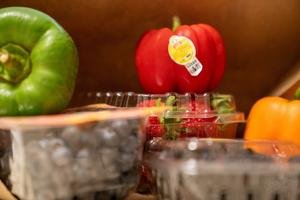
The Food is Medicine program aims to prevent and treat diet-related illnesses and promote the overall health of food-insecure people.
View more
Photo by Max Esterhuizen, Virginia Tech.
There are many different types of food.
Food nourishes our bodies, delights our senses, brings us together and is also a powerful cultural symbol, reflecting the traditions, values and histories of communities around the world.
But for researchers in the College of Agriculture and Life Sciences, food is also medicine.
Dr. Bailey Hotaling (2019), a registered dietitian, works to promote the overall health of low-income and food-insecure people with the goal of preventing and treating diet-related diseases.
“Eating adequate, nutritious food is essential to an individual’s health,” says Houghtaling, a 2019 PhD graduate who is an associate professor in the Department of Human Nutrition, Foods, and Kinesiology and a registered dietitian. “‘Food is medicine’ encompasses a variety of interventions.”
The White House Conference on Hunger, Nutrition, and Health in September 2022 renewed national attention and called for action to eradicate hunger and reduce the prevalence of chronic disease in the United States by 2030. The “Food is Medicine” program could help achieve this goal.
“While these programs are promising and the focus is currently on understanding their effectiveness for promoting food and nutrition security, it is important to recognize that Food is Medicine programs are being implemented in a variety of communities and health care organizations with different levels of support and capacity,” said Houghtaling, who is also a research scientist at the Center for Nutrition and Health Impact, a national nonprofit research and evaluation center. “Understanding factors related to these contexts that influence the adoption, implementation, sustainability, and scalability of programs for public health impact is critical.”
Houghtaling has authored two papers that focus on the barriers and opportunities for integrating food as medicine: The first paper looks at organizational factors within healthcare settings that impact the success of food-as-medicine integration programs.
The second paper outlines how nationally representative data on U.S. households can be leveraged to identify individual, household, and community factors that may influence participant engagement and utilization of these programs. This is particularly important for programs that limit exchangeable products to fresh fruits and vegetables. Not all Food is Medicine programs do this, but some do.
The first paper was recently published in the Journal of General Internal Medicine , and the second paper was recently published in the BMJ Journals .
Both papers were funded by a National Institute of Food and Agriculture grant awarded to the Center for Nutrition and Health Effects, which established the Nutrition Incentive Program Training, Technical Assistance, Evaluation and Information Center through the Gus Schumacher Nutrition Incentive Program. The second paper was also supported by the Robert Wood Johnson Foundation.
Food is medicine in health care
Because “Food is Medicine” programs are relatively new, there are no standard guidelines for their implementation in healthcare settings, and Hotaling and her colleagues conducted research to explore barriers to implementing the program in U.S. healthcare settings.
“In our study, we focused on situations where health care partners, such as physicians and other health professionals, implement programs to screen patients who have or are at risk for diet-related chronic diseases for food insecurity,” Houghtaling said. “We focused on programs where health care partners offer low-cost or no-cost healthy food incentives to patients who screen positive. [such as a produce prescription]Fruits, vegetables, etc.
Electronic health record capabilities to identify and track patients and increase data sharing among partner organizations were found to be important to support implementation and evaluation. Strategies to help medical staff execute these programs, such as providing reminders, problem-solving, and supporting technical assistance, were also important.
The study found that engaging physicians, health care workers, and students was also important to successful implementation, as was identifying and addressing capacity barriers early and often. Support from leadership and alignment of the Food is Medicine program with the institution’s mission and values were also key to success.
“Many health care professionals who implemented these programs found it beneficial and noted increased job satisfaction,” Houghtaling said.
Based on the findings of this study, the research team developed an implementation checklist that practices, partner organizations, and technical assistance personnel can refer to to support Food is Medicine programs in these settings.
Houghtaling and his co-authors identified several opportunities for improving food-as-medicine practices in healthcare settings going forward.
Food is the medicine of the community
For the second study, a research team also led by Houghtaling outlined through the team’s protocol paper plans to examine how produce “prescribing” through programs that promote food as medicine affects participation.
Through the Gus Schumacher Nutrition Incentive Program, participants receive a produce prescription that can be redeemed for fresh fruits and vegetables only, not frozen, canned or dehydrated foods.
According to the researchers, this policy restriction may undermine participation and benefits for households living in areas with limited access to fresh produce.
“Several factors increase barriers to households’ access to fresh fruits and vegetables in the United States,” Houghtaling said. “It is important to understand the impact of this policy restriction to inform future ‘food is medicine’ policies that maximize impact and equity.”
In the paper, the researchers will explore this policy constraint to support sensitive policy decisions using a large, nationally representative dataset from the USDA Economic Research Service’s National Household Food Acquisition and Purchasing Survey.
Achieving nutrition security — ensuring that all Americans consume sufficient amounts and varieties of foods and beverages recommended in the Dietary Guidelines for Americans, including fruits and vegetables — is a top national priority, and Virginia Tech researchers are helping to reach that goal.
