

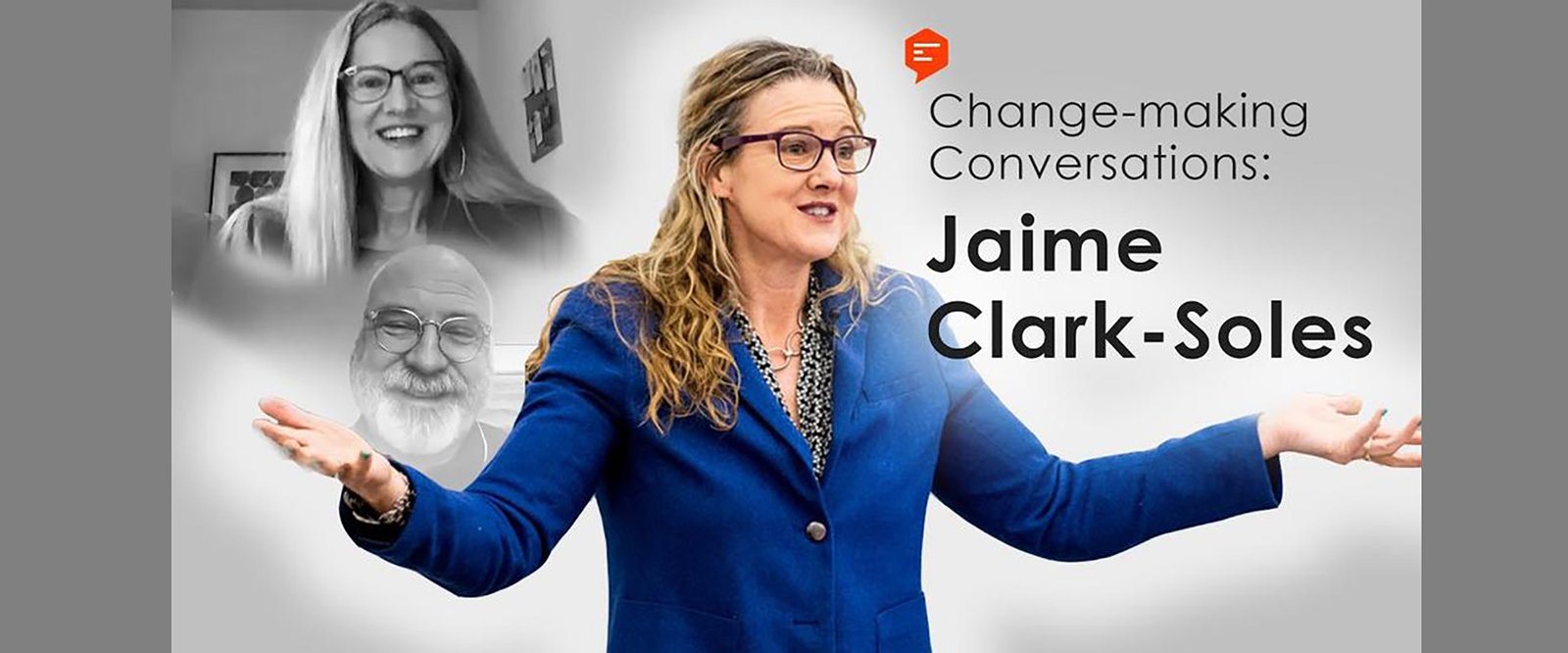
Jamie Clark Soles, professor and Baptist pastor at the seminary She experienced a profound spiritual transformation during a clinical trial with psychedelics that drew her closer to Christ, deepened her understanding of the Bible, and prompted her to write and speak extensively about the experience.
“I encountered God in a beautiful way. I experienced awe, majesty, transcendence, humility and loveliness — all things I already believed and had experienced in bits and pieces throughout my life. But this was completely embodied from head to toe by the Holy Spirit,” she said during a “Transformative Conversations” webinar hosted by Baptist News Global and moderated by BNG Executive Director Mark Wingfield.
Clark Soles is professor of New Testament at the Perkins Theological Seminary, a United Methodist theological seminary, where he also serves as director of its Center for Baptist Studies. He is a member of Royal Lane Baptist Church in Dallas.
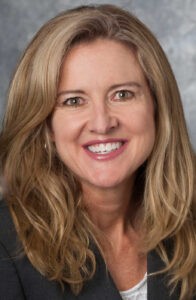
James Clark Solace
In 2017, Clark Soles In a study on psychedelics and spirituality at Johns Hopkins University, she participated in two six- to eight-hour psilocybin sessions with more than 20 Christian, Buddhist, Jewish and Muslim volunteers to gauge the interplay between psychedelics and faith.
Clark Soles’ experiences have inspired her to work with other clergy and academics to research and promote the benefits of psychedelics for emotional health and spiritual development. She has spoken extensively on the subject, even writing a journal article titled “Psychedelics, the Bible, and God.” religionand is currently writing a book titled Psychedelics and Soul Care.
The doses of psilocybin administered in each session were closely monitored and controlled, and there have been a number of unexpected positive effects, including a deepening sense of compassion and a call to practice forgiveness, which is psychologically liberating, she said.
“I truly understand that the Holy Spirit is physically inhabiting my body and what that means.”
“I am within I learned that the Holy Spirit lives in my body and what that means. I learned a lot about myself and my soul. I really connected with myself. I learned about what I need and areas where I need to grow.”
Clark-Soles said she also experienced “special encounters with God” and other highly visual and profound hallucinations common to psychedelics, but hers were deeply rooted in her Christian faith and thorough knowledge of the Bible.
“At one point I was in a building that looked like the ‘In my Father’s house there are many mansions’ in John 14. It was beautiful, bright, clear, and filled with light, and the faces of people I love were reflected in this big space. It was just so, so amazing.”
One of the people she met The vision included a mentor she hadn’t seen in some time, and later learned that he had died during one of her psychedelic sessions.
One webinar participant asked whether the session had changed their understanding of certain Bible passages.
“In a way, yes. I love the Bible and I rely on it,” she replied. “It has given me insight into it from the inside out, not from the outside in. I have thought a lot about Romans 12:2: ‘Do not be conformed to this world, but be transformed by the renewing of your mind.’ I thought this (experience) was what Paul was talking about!”
“I was able to understand the Bible from top to bottom.”
Clark Soles is Through our sessions I discovered that Paul was a true mystic.
“I followed Paul’s own mystical experience in II Corinthians 12,” she explained, “where he wanted to be healed of a thorn in his flesh, but he wasn’t healed. He experienced God and he came out of his body. It’s an amazing, exceptional mystical experience, but it’s not all joyous, and Paul has to figure out how to be grateful for this exceptional encounter with God, but also accept the fact that what he hoped for didn’t happen.”
Indigenous communities around the world have long recognized the value of psychedelic drug use and have developed communal traditions to guide psychedelic drug users, she said, adding that Christians can learn from those ancient practices and explore the gifts of their own faith. “We, like our indigenous brothers, have an environment that is welcoming to these kinds of experiences, and one of the features of that is that we have a strong focus on community. We don’t expect you to have a spiritual experience alone.”
Similarly, a Johns Hopkins University study Other experts who recommend psychedelics for spiritual development warn against using them alone, just as the Bible says the fruits of the spirit are only valuable if they are used for community service, she said.
“Your description reminded me of what the Apostle Paul wrote about glossolalia in the early church,” Wingfield said. “There must be an interpreter. You can’t be the only one who has had this ecstatic experience. There must be something that can come out of it.”
“Exactly,” Clark Soles says. “After all, does your religious experience deepen your connections with other people and your community? Is it rooted in some tried-and-true tradition? And does it create in you a desire and equip you to serve God’s world?”
“Ultimately, is your religious experience making you more connected to other people, more connected to your community?”
Exercise combining hallucinogens Clark Soles said the faith is building on this idea by calling for the training of psychedelic chaplains: “Chaplains are perfectly suited to lead these spaces because they’re trained interfaith. They’re taught to hold space, not impose religious beliefs. So this is a new avenue for people who want to specialize in this to be part of the practice.”
She said the Center for Psychedelic Spirituality at Emory University will eliminate the title of “chaplain” for these ministers and replace it with “spiritual health clinician” or “spiritual health practitioner.” “By 2030, we will need 30,000 psychedelic therapists, let alone chaplains.”
But psychedelics aren’t absolutely necessary to have life-changing spiritual insights, Clark Soles added: “Some people should stay away from psychedelics. You don’t need psychedelics to have a profound, embodied encounter with God.”
In addition, treatment Psychedelic drugs make the taker a better Christian than other believers, she says: “I would never force or encourage anyone to take psychedelics. No one needs to. These states can be achieved through breathwork, fasting, drumming, any method of soul work. I want to be very clear on that.”
Still, churches and religious leaders need to know about psychedelic therapy because as word spreads about the spiritual uses of psychedelics, their followers are becoming increasingly interested. Clark Soles said her new book will address the issue.
“At the very least, the church shouldn’t get in the way of medical care and healing through therapy. I want to write a primer, get all the basics covered, and then say, ‘Let’s have a more meaningful conversation.’ Pastors need to come in, ask questions, and understand the people who are actually experiencing these things.”
In this book, She said psychedelic drugs are part of spiritual formation: “Christians have a long tradition of mystical experience. We know how to host these conversations. And we also need to reconnect with our bodies and focus on transformation… healing and wholeness of ourselves and creation.”
Currently, psilocybin and other psychedelics are not legal for everyday use in the United States, but that could change in the future, he said, and could lead to increased use of these drugs, particularly in treating PTSD in soldiers.
Watch the full webinar video here:
Related article:
Baptist scholar speaks and writes about his experience in clinical trials of psychedelic drugs
A Psychedelic Renaissance Needs a Christian Counterculture | Analysis by Caleb Graves
