


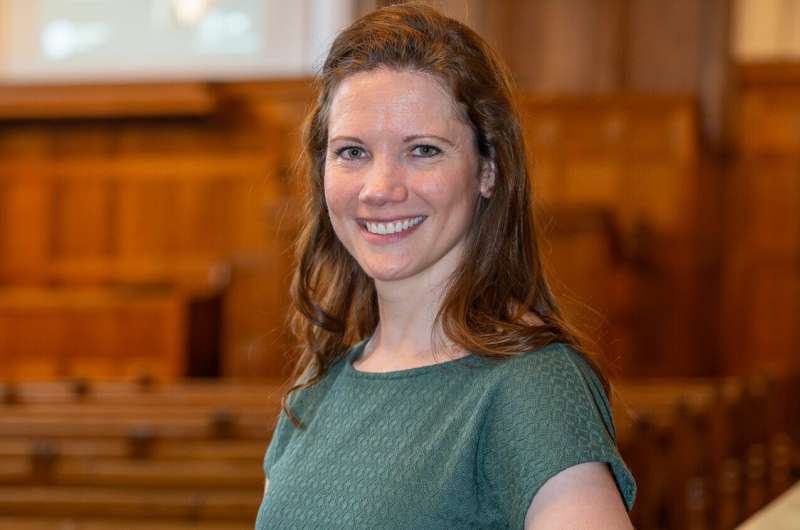
Erin DeKeyster: “We want to safely introduce scientifically proven ketogenic interventions into healthcare.” Photo credit: Monique Shaw/Leiden University
Autism, Alzheimer’s disease, bipolar disorder: could the onset of these mental illnesses be influenced by the ketogenic diet? A growing body of research suggests that it might. “For those for whom the ketogenic diet can help, it could be life-changing,” says neuroscientist Erin DeKeyster.
More than 700 people attended Eleen DeKeyster’s talk on nutrition and the brain, both live and online, showing just how popular the subject is – and neuropsychologists say it’s no surprise.
“A lot of people suffer from mental health issues, and research is showing that nutrition plays a key role,” she explains. DeKeyster is director of the Lifestyle Brain Interactions Lab, where she studies how nutrition influences the development of conditions like Alzheimer’s and autism. Can lifestyle and diet help prevent such mental health issues? “Yes, I think so,” she asserts.
The Power of Ketones
DeKeyster and her colleagues are studying the impact of ketogenic interventions on mental health: “Ketogenic interventions are ways to put the body into a state of ketosis, which occurs when there are certain amounts of ketones in the blood. Ketones are not only a fuel for the body, they can also regulate DNA expression and affect gene expression. They also have anti-inflammatory properties and protect brain cells,” she explains.
Entering Ketosis
So how do you achieve a state of ketosis and its potential benefits? “There are three ways,” Dekeyster explains. “First, fasting. When you go without food for an extended period of time, your body first uses up glycogen from carbohydrates. Then your body starts burning fat, releasing it from your tissues and converting it to ketones in your liver. Second, taking a liquid or powdered ketone supplement. Finally, following a ketogenic diet, which is a low-carb, high-fat eating pattern.”
Bread, grains, potatoes
Your body doesn’t easily enter ketosis without making a conscious effort. “Unlike hunter-gatherer times, we no longer go without food for long periods of time. In fact, food is readily available and many people eat throughout the day.” Additionally, the average Western diet is high in bread, grains, potatoes and rice, and a low-carb diet is needed to switch your body to burning fat and entering ketosis.
Is Keto Safe for Everyone?
Although DeKeyster is positive about the effectiveness of ketogenic interventions for a variety of conditions, he emphasizes that the ketogenic diet is not suitable for everyone: “The ketogenic diet can be dangerous. If you have uncontrolled diabetes or consume too much alcohol, you can have too many ketones in your blood, which can make your blood acidic and impair oxygen transport.”
“Also, the ketogenic diet is not recommended for people with certain metabolic disorders, kidney disease, heart rhythm disorders, and in combination with certain medications. Be sure to consult with your doctor if you’re interested in following one.”
Hippocrates
Despite the proliferation of ketogenic cookbooks and a growing body of research on the subject, ketogenic dietary interventions are not new: “Hippocrates suggested fasting as an effective treatment for a variety of conditions as early as 500 BCE,” says DeKeyster.
“And since 1921, the ketogenic diet has been the standard treatment for epilepsy patients. Half of patients experience a 50% reduction in the number of seizures, and 10% experience a complete recovery.”
Symptom management
DeKeyster found that there is growing evidence that ketogenic interventions are effective in preventing autism. “People with autism often suffer from anxiety and depression, and current treatments focus on managing symptoms. I wanted to address the underlying mechanisms of autism.”
Ketones and Autism
One approach is to target genetic mutations associated with autism: “In our study, we bred mice that had the same genetic markers as people with autism. These mice showed repetitive behaviors, difficulties with social interaction, and increased anxiety – all symptoms commonly seen in autism. Because ketones can activate or inactivate certain DNA, we put them on a ketogenic diet. The mice’s symptoms were reduced.”
Human studies have also shown promising results, “but these are still small studies, up to 45 people,” Dekeyster noted.
Hopeful
Additionally, various studies suggest that ketogenic interventions may also be effective in preventing Alzheimer’s disease and reducing symptoms of bipolar disorder. Together with his Lifestyle Brain Interactions Research Group, DeKeyster aims to further study how ketogenic interventions work for various psychiatric disorders, ultimately with the goal of safely introducing these interventions into mainstream medicine.
“The keto diet works for some people and not others, but for those it works for, it can be life-changing. It gives hope, especially when there are no other treatment options.”
Want to learn more about keto?
Courtesy of Leiden University
Quote: Nutrition and Fasting for the Brain: Why the Keto Diet Shows Promise (June 4, 2024) Retrieved June 4, 2024 from https://medicalxpress.com/news/2024-06-nutrition-fasting-brain-keto-diet.html
This document is subject to copyright. It may not be reproduced without written permission, except for fair dealing for the purposes of personal study or research. The content is provided for informational purposes only.
