

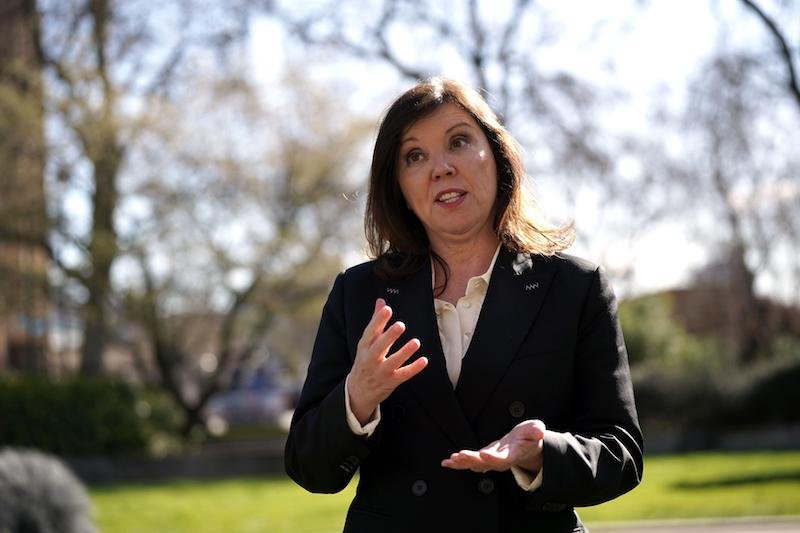

Rachel de Souza, photographed in 2023, was delivering this year’s Allen Hall Lecture.
PA Images/Alamy
The Children’s Commissioner said all schools should cater for the educational, material and psychological needs of children as well as their spiritual needs.
Rachel de Souza said England had a strong tradition of pastoral care provided by schools, which was sometimes forgotten. Speaking at the Catholic seminary Allen Hall last week, she said: “I was a religious education teacher and the Education Act implicitly says we need to address children’s spiritual, social and moral development.”
She noted that the debate over whether prayer rooms should be allowed in secular schools has revealed different ways of thinking about the education system.
“Recently, there has been a misconception in discussions in these areas that we have some kind of secular French education system,” she says, “but I’ve always been grateful to the Church of England because [without them] At the turn of the century the school system would not have existed.
“We have always had a pastoral system and looked after the spiritual and moral needs of children.”
And she has made it clear that she supports the provision of prayer rooms in secular schools – in stark contrast to the High Court which recently ruled that Michaela School in Wembley was within its right not to provide such facilities.
Ms Rachel was delivering her annual lecture at Allen Hall, titled ‘Big Ambitions: The Story of One Million Children’, in which she reflected on the lives of children and the research she commissioned into how they feel about growing up in Britain today.
It has become clear that many children who experienced deep isolation due to lockdowns and interruptions to their education caused by the COVID-19 pandemic have yet to recover.
“Since the lockdown, there has been a tsunami of anxiety, with one in five of the 500,000 children citing mental health and anxiety as their main concern,” she said. “Children’s mental health is deteriorating at every level.”
Ms Rachel also paid tribute to the education she received in Catholic schools, her upbringing in a stable Catholic home and parish community, and the rigorous theological training she received as an undergraduate at the Jesuit school of Heythrop College.
She said the nuns at the Catholic comprehensive school she attended “not only did everything to keep me safe and look after me, but they also taught me values. It was part of something much bigger. When it comes to children, I want to contribute in that way.”
She told the audience that when she first began working with children, she thought education was the first priority, but now she believes that family is the foundation of society and “a loving family is the foundation for everything else.”
Her comments are similar to those of Cardinal Vincent Nicholls, who said the family was the most important issue in the general election when voting guidelines for Catholic voters were published by the Bishops’ Conference of England and Wales last week.
“How do we build a society where families can thrive? That’s the basis,” he said. “My view is that the next administration should strive to create an environment where families can thrive.”
Ms Rachel told the audience that she, like other civil servants, is “laying low” during the election campaign, but she has already made her views known to ministers on certain issues, urging the Government to rethink the two-child universal benefit cap and expressing concern about the plight of children arriving in the UK on small boats.
She described them as “children who have lost everything – their families, their possessions – who have experienced unparalleled suffering, who are victims of trafficking, organ harvesting and rape, who arrived in seawater with nothing.”
“We have the opportunity to treat these children with the love and dignity they deserve. We have the power to choose to treat them with love and help them feel like so much is possible,” she said.
Ms Rachel also spoke of the importance of churches supporting families, and although statutory services need to step in, she believes churches and other voluntary organisations also have an important role to play.
“The volunteer sector can exist and is often highly valued and trusted,” she said.
