

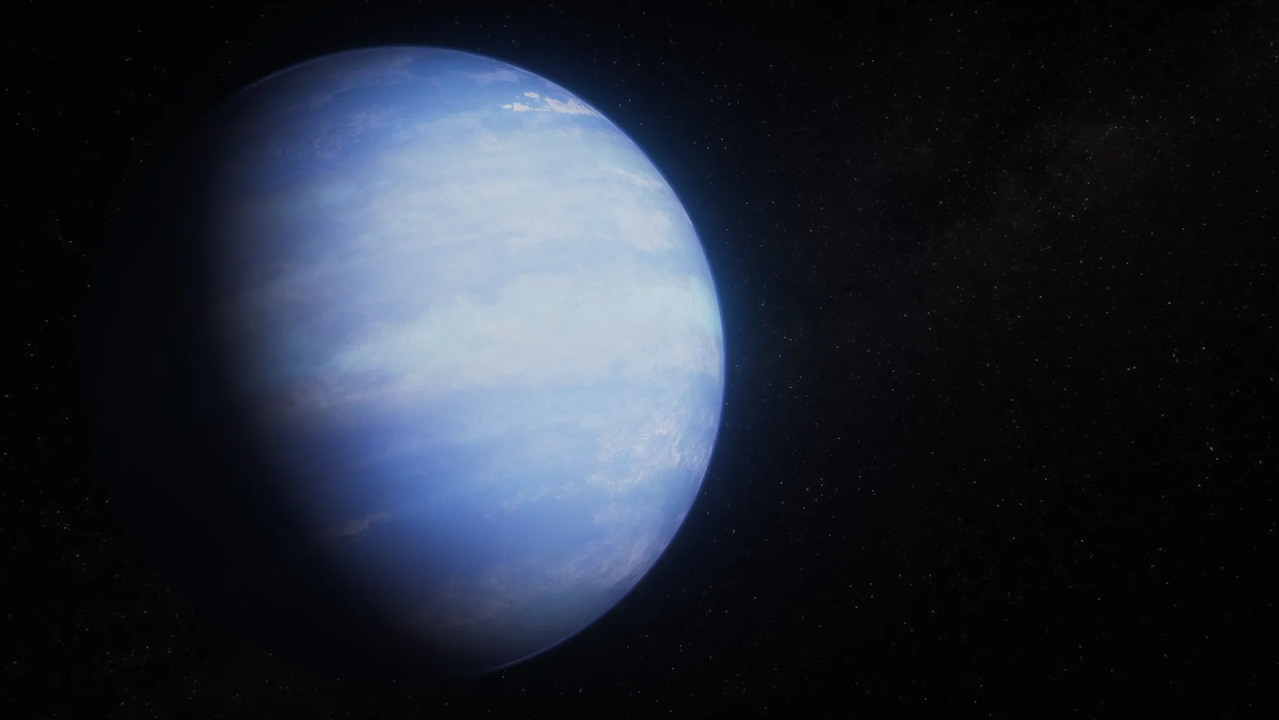

Carbon-rich giant planet — NASA
The study of the carbon-to-oxygen ratio has provided interesting insights into the composition of nearby giant exoplanets and has led to a clear classification: carbon-rich planets, whose atmospheric carbon-to-oxygen ratio is greater than or equal to 1, as opposed to giant planets, whose carbon-to-oxygen ratio is closer to that of the proto-Sun.
In contrast, despite numerous space missions being sent to the outer solar system and the vicinity of Jupiter, Saturn, Uranus and Neptune, our understanding of the carbon to oxygen ratios on these giant planets is still severely lacking.
Determining this ratio is crucial as it serves as a marker that directly links the planet’s volatile composition to its formation region in the disk. In this article, we provide an overview of our current understanding of the carbon-to-oxygen ratio in the four gas giants of the Solar System and explore why the possibility that Jupiter, Saturn, Uranus and Neptune are carbon-rich planets has not yet been completely rejected. Furthermore, we elaborate on the three main formation scenarios proposed in the existing literature that explain the bulk carbon-to-oxygen ratio of the giant planets being greater than one.
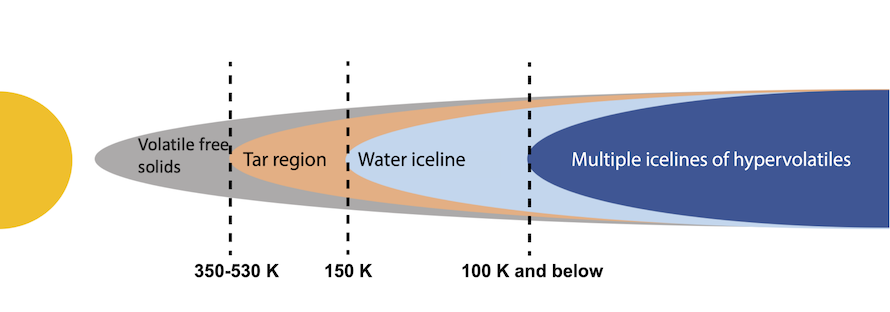
A schematic diagram of the relative positions of the various condensation lines in the PSN and
Corresponding temperatures. Carbonaceous material forms in the region between the tar line and the ice line. Material accreted by the giant planets and derived from this region of the PSN should be rich in organic matter..—astro-ph.EP..
Accurately estimating the carbon-to-oxygen ratios of the gas giants in our solar system is a major challenge. Estimation methods include integrating in-situ measurements from penetrating probes equipped with mass spectrometers and remote sensing observations at microwave wavelengths from orbiting satellites. However, these methods are limited in their exploration depth, typically in the range of 10-100 bar, and therefore cannot fully determine the abundance of carbon and oxygen deep within the gas giants.

Schematic of the entire system under consideration: a proto-Sun surrounded by PSN.
The radial distribution of the volatiles under consideration is influenced by the diffusion past the condensation front where the vapor condenses into ice particles, and the radial inward drift of those particles. — astro-ph.EP
Olivier Moussis, Thibaut Cavallier, Jonathan I. Renine, Kathleen E. Mant, Ricardo Hueso, Artyom Aguitin, Antoine Schneeberger, Tom Benest Cousineau, David H. Atkinson, Vincent Hu, Mark Hofstadter, Udmurad Sristinwong
Comment: Space Science Reviews, in press.
Subject: Earth and Planetary Astrophysics (astro-ph.EP)
Source: arXiv:2405.19748 [astro-ph.EP] (or arXiv:2405.19748v1 [astro-ph.EP] For this version
https://doi.org/10.48550/arXiv.2405.19748
Focus on learning more
Submission History
By Olivier Moussis
[v1] May 30, 2024 (Thu) 06:51:21 UTC (1,067 KB)
https://arxiv.org/abs/2405.19748
Astrobiology
