

In addition to manufacturing D2C cosmetics brands, the company is also actively engaged in research and development of new plant-derived ingredients.
Among the cannabis-derived cannabinoids, cannabidiol (CBD) is non-psychotropic and has been reported to have various cosmeceutical effects against pruritus (atopic dermatitis), psoriasis (barrier dysfunction), and inflammation (sebum and acne).
According to Satisinh Medical, while consumers are interested in the benefits of CBD, they are hesitant to use cannabis-derived ingredients.
To that end, the company has been searching for phytocannabinoids from Japanese plant materials that have CBD-like effects.
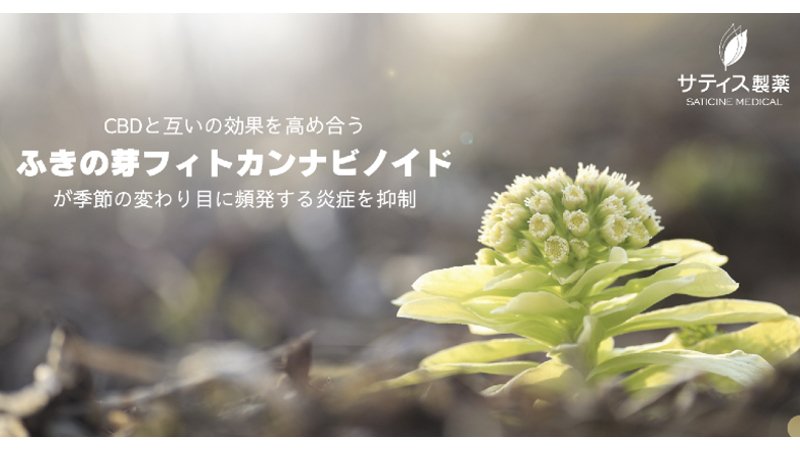
Butterbur is rich in terpenes (aromatic compounds) unique to plants, including isopetacin, which has almost the same molecular weight as CBD and a similar structure.
In addition, butterbur buds store bitter compounds called sesquiterpenes to protect them from predators.
Based on this, Satisin Medical conducted a study on “butterbur phytocannabinoids” and found that the compound can exert CBD-like effects, especially in anti-inflammation.
In particular, the combination of purified CBD (99% pure) with butterbur phytocannabinoids significantly enhanced the anti-inflammatory effects.
This is known as the “entourage effect,” and it results in greater synergy and activity when other cannabinoids are used alongside CBD compared to using CBD alone.
“Unrefined cannabis-derived ingredients are contaminated with tetrahydrocannabinol (THC), Because it is prohibited by the Cannabis Control Act, the use of refined CBD is mainstream in Japan. However, CBD has a stronger physiological effect when it is combined with multiple cannabis-derived phytochemicals rather than when used alone (isolated).
“In this study, purified CBD had no anti-inflammatory effect, but the addition of butterbur bud phytocannabinoids significantly increased their effect. This indicates that butterbur bud phytocannabinoids can be used alone as a CBD-like ingredient or combined with CBD to enhance each other’s effects.” The company said.
Skin stabilizer
During seasonal changes, environmental factors such as the difference in temperature between spring and autumn, dry air and pollen dispersion from winter to spring, and increased ultraviolet rays from spring to summer can weaken the skin’s barrier function, making skin inflammation more likely.
Oxidative stress, which can also be caused by external stimuli, can worsen dry skin, leading to rough, sensitive skin.
In Japan, seasonal pollen is one of the major causes of exogenous dermatitis. It is said that one in two people in Japan suffers from hay fever, but it is known that even people who do not have hay fever symptoms can develop hay fever dermatitis.
Furthermore, in Japan, various types of pollen are released throughout the year, such as cedar pollen in the spring, grass pollen in the summer, and ragweed pollen in the fall.
In this study, cedar pollen was selected to evaluate the anti-inflammatory effects of phytocannabinoids contained in butterbur buds in epidermal cells.
Addition of the cedar pollen allergen Cryj1 to cultured keratinocytes significantly promoted the production of reactive oxygen species (ROS) within the cells.
This is a cellular response to external stimuli that results in inflammation in the body and accelerates skin aging.
The results showed that the phytocannabinoids contained in butterbur buds have the ability to suppress ROS production and inflammation, and may improve various signs of skin aging, including rough skin, sensitive skin, dryness, wrinkles, and dark spots.
“We will be incorporating phytocannabinoids derived from butterbur buds into many of our cosmetic products to reduce skin troubles during times when the skin is more susceptible to external stimuli, such as during seasonal changes.”
“Furthermore, we will also consider developing products with enhanced efficacy by combining it with CBD, which is expected to become increasingly popular in the future. Legal reformAt the same time, we will continue to utilize Japanese plants in unique ways to develop highly effective cosmetic ingredients.”
