

Carlo Acutis will soon be a saint.
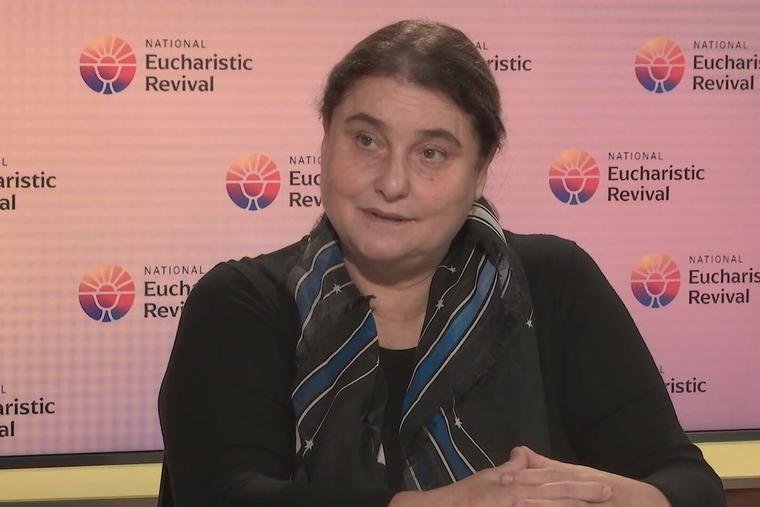
Antonia Salzano AcutisThe mother of Father Carlo Acutis spoke to the Register on May 29 about the news that her son will soon become the first millennial saint. In a two-part series, Father Acutis discusses the second miracle attributed to the holy teenager, his testimony and popularity, and his deep devotion to the Eucharist.
Why is your son so popular?
These are the mysteries of Carlo Acutis, my son! [laughing]
There is certainly a lot of interest in Carlo because he is a modern-day millennial, and the issues facing today’s youth are something that everyone feels deeply about, believers and non-believers alike.
But Carlo is an interesting character in some ways.
Another reason for the great interest in him is that people call Carlo the “patron saint of the Internet.”
What about Carlo’s “Eucharistic Miracle” exhibition? Did this help to spread Carlo’s fame?
And of course there is the fact that Carlo’s exhibitions have reached thousands of parishes all over the world: China, Japan, India, Africa, America, Brazil, Europe. This is really amazing. In the end, this work of Carlo’s really spread and we have seen the results. We have seen conversions and, incredible, even healings during the exhibition of the “Eucharistic Miracles”. Healing of Tumors: Incredible! In fact, when we speak of the Eucharist, we are speaking of God in us. And our Lord is glorified from this, because He is pleased that we speak of the Eucharist. Perhaps the Lord gave us these signs to wake us up a little.
Let’s talk about Carlo’s canonization. Do you know when and where it will take place?
It will be in Rome. The date will be announced in June. It could be this year or during the Holy Year of 2025. There are some “hot” dates, it could be during the Youth Holy Year in April 2025 or the Young People Holy Year in July 2025. We don’t know yet.
Can you talk about the journey that led to Carlo’s canonization? We know that the second miracle attributed to his intercession was the healing of a Costa Rican woman named Valeria, who was in a bicycle accident in Florence in 2022 and suffered a traumatic brain injury.
We already knew about this miracle because there are different stages in the canonization process. The most difficult stage is the medical commission, where about 15 doctors investigate. There are different steps. Depending on the condition (the specific illness or injury that was healed), they need to find a specialist in that field. And you don’t just need one doctor, you need several experts in the same field. Then they have to vote. Some doctors might vote against the conclusion (that it was a miracle). In Carlo’s case, the vote that it was a miracle was unanimous.
Then there is the Theological Commission. Then there is the Commission of Cardinals. And then there is the Pope. The Pope, of course, decides everything, because he can decide, “This is no good, we can’t go ahead.” That’s why there’s always a big fuss when the Pope signs something. Everything is on hold until the Pope signs it.
Tell us about Carlo’s other miracles – how did you find out about them?
As you know, we receive daily news about possible miracles due to Carlo’s intercession. We hear news of healings with medical documentation from all over the world. We hear about favors, conversions and graces. The Church chooses one miracle each for beatification and canonization. But there were many other miracles. Some were, in my opinion, truly amazing. I can’t tell you about them all. We also hear stories of instant healing of leukemia without chemotherapy. The first miracle due to Carlo happened at his funeral. There was a woman who had breast cancer. She had already undergone histological tests and had been told that she needed to start chemotherapy immediately. She prayed to Carlo on the day of his funeral mass and the tumor disappeared instantly.
So, on the day of Carlo’s funeral miracles began to happen already.
How is your relationship with Carlo now? Does your family pray for his intercession every day?
I pray the novena prayer cards, as everyone does now. I talk to him. I feel his presence in my home. I feel his help and support for the brethren. I constantly hear news of Carlo appearing to others, healings, graces, conversions. I see God actively at work through him.
I have a special ability to feel the intercession of God. I also feel the work of the Lord and the Virgin Mary. These are inner feelings that I don’t know how to explain. I’m not a mystic, but I attend Mass every day. I attend Eucharistic Adoration every day and I spend time in prayer. I’m lucky that I don’t need much sleep, only about five hours a night. So, if I wake up at 4 a.m., I use that time to pray. This makes me more sensitive to God’s presence. The more I pray, the more I feel God’s presence and work in my life. And one learns. The more one prays, the more one learns. If one doesn’t pray, one doesn’t feel God’s presence.
Why was it so important for Carlo to receive the Eucharist every day? What effect does the Eucharist have on our souls?
Carlo received Holy Communion for the first time when he was seven years old. On that day, he wrote in his notebook, “To always be in union with Jesus. That is my life plan.” From that day on, he began to go to Mass every day and to adorate the Blessed Sacrament every day before or after Mass.
What is the effect of Holy Communion? Holy Communion is the body and blood, soul and divinity of God in our midst. Holy Communion is the living presence of Christ. When I receive Holy Communion, the infinite meets the finite. I come into contact with heaven.
This contact awakens something in me. In fact, this has nothing to do with the holiness of the priest or the person receiving Holy Communion. Jesus always acts. But it is clear that the more I respond to the grace of receiving God, the more He fills me with grace. God can always do extraordinary things, but the effort we put into our spiritual life also matters. It is like a vase. When you try to get fresh water, if you have a small vase, you get very little water. If you have a bigger vase, you get a lot of water. The same thing happens during Holy Communion.
How does Holy Communion help us live virtues?
You know that when the Church declares someone a saint, it is because they lived the Christian virtues — there are over 200 of them, but there are seven main ones: prudence, justice, faith, hope, charity, fortitude, and temperance.
Virtue is a stable attitude of the will towards the good. Virtue requires strength of will. For example, without strength of will, one would never be able to take a university exam; one would never be able to study. Sometimes, thanks to willpower, a less intelligent person can do better in an exam than a smarter person.
Our virtues need to be strengthened and through the Eucharist Jesus strengthens our will and helps us to fight temptations. The Eucharist is truly the medicine for our souls. It heals the wounds we carry as a residue of original sin.
When I receive Communion, I feed from a fountain of love, and Jesus helps me grow in my capacity to love God and my neighbor.
Carlo often said that the Eucharist was “the highway to heaven.” What did he mean by this?
The Bible says in John 6:56, “Whoever eats my flesh and drinks my blood abides in me, and I in him.”
This means that Jesus promises a special union through the Eucharist.
I know many people who suffered from severe depression and started going to daily Mass. They had seen the best psychologists and psychiatrists, but nothing in their life was solved. They continued to have the same problems. Once they started going to daily Mass, these problems were cured. It was like they were reborn.
Through Holy Communion we are transformed. There is nothing more supernatural on earth than Holy Communion. Holy Communion is Jesus among us. Jesus is really present. Carlo used to say when he was teaching the catechism, “If there was a fire in the church, who would go and rescue the living Jesus from the tabernacle? We have to, because Jesus is a living being. Jesus lives among us.”
Carlo was a great promoter of Eucharistic adoration. Carlo would often say, “When we face the sun, we get sunburned… but when we stand before Jesus in Holy Communion, we become saints.”
Let us remember that when Moses prayed to God on Mount Sinai (Exodus 34), his face shone with light. This also happens to us. We do not realize it, but the light of God surrounds us. It transforms us, it purifies us.
Tell us about the Eucharistic miracle and what should Catholics know about it?
Over the centuries, Jesus has performed amazing miracles in the Eucharist to demonstrate his true presence in many countries. In the past, we did not have the means to study them, but today, science is on our side.
Jesus is sending us signs, like the famous miracle of Lanciano, Italy. [from A.D. 750), which was studied by the World Health Organization. The Eucharistic Host there was transformed into flesh, which turned out to be the myocardium, part of the heart.
In 1996, in Buenos Aires, a Eucharistic miracle took place, which was investigated by Pope Francis, who was archbishop there at the time.
In 2006, there was a miracle in Tixla, Mexico; then, in 2008, in Sokolka, Poland.
In 2013, in Legnica, Poland, a Eucharistic Host was transformed into flesh. It was found to be the myocardium — again. It had the AB blood type, which is the same as that of the Shroud of Turin. There were also intact white blood cells.
What is the meaning of these miracles, that Eucharistic Hosts have transformed into heart tissue?
You know the word “heart” is found in the Bible 1,000 times.
Jesus is sending us his heart — his myocardium, which is the part of the heart which causes it to pulse. We know that the Eucharist is the heart of the Church because it is God, in Person, in the midst of us.
All of these miracles where Jesus is showing us his heart. It is, frankly, so moving to see God’s love for us — that he is sending us his heart [through these extraordinary Eucharistic miracles].
These are difficult cultural times, and perhaps that is why Carlo’s example offers so much hope.
In 2006, we didn’t have Facebook or Twitter, but Carlo’s words took the form of tweets.
“Not the love of self, but the glory of God.”
“Happiness is not seeing yourself, but seeing God.”
“We are all born originals, but most of us die copies.”
This is his method of catechesis, and it makes a lot of sense.
These words resonate with people more than the treatises of mystics. Nobody reads these treatises anymore. Today we need a more dynamic and essential catechesis. God is very simple.
The more complex we become, the further we are from God; the more simple we become, the closer we are to God.
Indeed, Carlo’s spirituality was quite simple: the sacraments, the Virgin Mary, the Rosary, prayer, Scripture reading, charity – a spirituality that anyone could follow.
Learn more about Carlo
MiracoliEucaristici.org
CarloAcutis-en.org
