

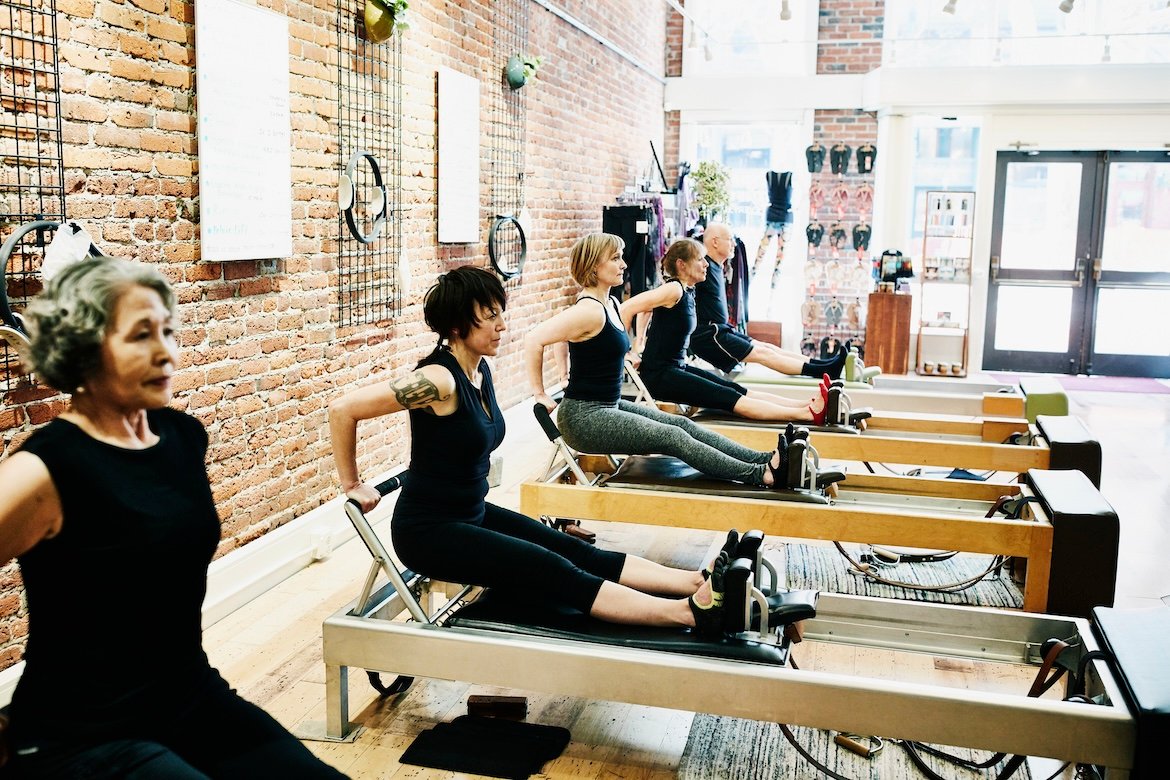
PAlthough Iratis has been around for over a century, this exercise method has never been more popular than it is today.
In 2023, approximately 12 million Americans will report practicing Pilates, up 15 percent from the previous year. According to the Pilates Education Association, Google searches for “pilates” have tripled in the past five years, and the market is expected to double in size by 2030. Heck, Pilates was thrust into the pop culture spotlight with a recent skit on SNL.
Why are so many people passionate about Pilates? Perhaps it’s because the training method developed by Joseph Pilates in 1926 combines controlled movement and proper breathing with a holistic mind-body-spirit approach that could be the perfect antidote to busy, stressful modern lives.
Not only does Pilates have a wide range of benefits, it’s also low-impact and can be done by people of all ages and fitness levels, says Portia Page, CPT, NCPT, nationally certified Pilates teacher and Balanced Body education curriculum coordinator.
“Pilates can have great benefits when done a little bit every day,” says Page. “It’s a form of exercise that stretches and strengthens the body, with an emphasis on balance, alignment, proper breathing, and core stability and strength. It only takes a few sessions of Pilates to see how true, flowing movements can benefit the mind and body.”
Related article
Not only does Pilates help you physically, improving your everyday posture (for those of us who are hunched over a screen all day), strength, and mobility, but it also helps you mentally and emotionally by teaching you how to properly use your breath and boosting your confidence when you overcome a challenge, Page explains.
But to get the most out of your Pilates sessions, whether you’re a beginner or a long-time enthusiast, and whether you prefer mat or reformer classes, there are a few things you should keep in mind.
Here are 6 expert Pilates tips you can try to get the most out of your Pilates workout.
If you’re new to Pilates or just don’t have the time or energy, there’s no need to force yourself into long sessions. Paige says 10 to 15 minutes of Pilates a day is fine, especially if you’re a beginner. “This gives you time to practice, slowly build up strength, and get better at moving every day,” she says. “Practice really does lead to perfection, or as close to perfect as you can get on that day.”
1. Focus on your breathing
Joseph Pilates is quoted as saying, “Above all, learn to breathe properly,” and this mantra remains the foundation of Pilates. Each Pilates exercise is timed with your inhale and exhale, and proper breathing is essential to maintaining focus and enhancing each movement, says Page.
“Breathing helps focus the session and brings the mind and body into the present moment,” she says. “I always start by finding and following the breath, which gives the body time to register where it is. Bringing attention to the breath from the beginning reminds participants to stay focused on the breath throughout the session.”
Want to make sure you’re in tune with your breath? Jamie Maitland, certified health coach, Pilates and fitness instructor, and founder of boutique fitness studio The Office 954 in Fort Lauderdale, Florida, recommends the following:
- Start by placing your hands around your rib cage and feeling it expand as you inhale and contract as you exhale.
- Start by counting one for each inhale and one for each exhale.
- As you get more comfortable, increase the number of inhalations and exhalations to 3-5 times.
2. Start your session slowly
A common mistake with Pilates, says Page, is to rush into the more complex exercises without gradually building the skills needed for the more challenging movements. To use a swimming analogy, Pilates is about dipping your toes in the water and slowly entering it, rather than diving in headfirst.
“Warming up thoroughly with small micro movements builds a strong foundation of posture in any position and prepares your body for more challenging exercises and movements,” says Page. “This allows you to slowly and effortlessly build to your end result – building the skills you need step by step, rather than forcing yourself into a position or exercise.”
If you don’t know how to warm up or if you’re not sure if you’re warming up enough, try taking a class at a Pilates studio or on a virtual platform where an instructor will walk you through everything.
3. Practice perfect alignment
In Pilates, alignment refers to making sure your body parts — your head, spine, feet, and ankles — are in the right position in relation to one another during an exercise. Alignment is a fundamental element of Pilates, helping to ensure balance and proper form so you get the most out of each exercise, explains Maitland.
One of the best ways to ensure proper posture is to take a class where the instructor gives verbal instructions and gently changes your position as needed, says Maitland. If an in-person class isn’t available, try taking an online class, pausing as needed to adopt the same posture as the instructor or check your posture in the mirror.
Maitland also likes to place a towel or band on the floor to ensure your knees, feet, and hands are aligned properly while you move, and if your feet slip and your form suffers, you could try wearing non-slip socks designed for Pilates.
To improve your balance, Page recommends doing this exercise daily in a variety of positions, including standing, sitting, lying on your back, on all fours, and lying down.
- Get into a good posture, close your eyes and breathe.
- Be aware of your balance and keeping your head in line with your ribs, pelvis, and feet (if standing). This alignment will feel very different in each position.
- Use your breath and fine tuning to find what feels right for you (this is the most important part).
“Quality over quantity. Focus on precision and perfection of movement, not speed. Less is more.” —Jamie Maitland, Certified Pilates Instructor
4. Slow and controlled
If there’s one thing Pilates isn’t competitive, it’s that it’s not a race: Each movement must be performed with proper form and control, Maitland says.
“Quality over quantity. Focus on precision and completeness of movement, not speed. Less is more,” she says.
How do you know if you’re going too fast?
“You won’t feel the effect of the exercise,” says Maitland. “For example, if you’re doing leg raises while lying on your side or in a side plank position and you’re swinging your legs around without thinking, you’ll just feel a bouncing sensation. If you keep your core tight, keep the rest of your body still, and use your glutes to lift your legs, you’ll feel a lot more benefit.”
You’ll know you’re working out at the right pace when, within 5-10 seconds, you feel the muscles you’re working start to burn.
5. Stay focused
Pilates is meant to nourish and strengthen not just the body, but the mind and spirit as well, which means you want to focus on the present moment rather than chatting with your neighbor, looking at your phone, or thinking about your to-do list.
“One of the most common mistakes I see is not being focused,” Maitland says. “When I teach classes, I often can tell the difference between a focused client and a disfocused one. A person’s posture reflects their mental state. Pilates is very mental, so you need to be focused.”
If you find yourself losing focus, Maitland suggests rubbing your thumb and index finger together for a few seconds, like a little violin, to bring you back into the present moment.
6. Use equipment to take your training to the next level
Anyone who’s done Pilates will tell you that you don’t need any equipment to get a great workout. But if you’re looking for a new challenge, adding some Pilates equipment like resistance bands, light weighted balls, and dumbbells will take it to the next level. Maitland also likes to use a Pilates ring to add variety and intensity to her workouts.
One of Maitland’s favorite Pilates ring exercises:
- Lie on your back with your knees bent and your feet flat on the floor.
- Place the Pilates ring between your inner thighs.
- Raise your feet into a tabletop position with your knees bent at a 90-degree angle (you can also keep your feet on the floor for comfort).
- Slowly and with control, squeeze the ring with your inner thighs and return to starting position.
- Repeat this 15 times, then pulse for 15 more (smaller movements, pressing in about a quarter of a second).
- Squeeze your thighs and hold for 15 seconds.
- Repeat the entire sequence 3-4 times.
Pilates equipment to try
- Gaiam Restore Mini Loop Bands 5-Pack ($15, Gaiam.com)
- Gaiam Grippy Yoga Barre Socks ($10, Amazon.com)
- Balanced Body UltraFit Circle Pilates Ring ($40, Amazon.com)
- Balanced Body 3-pound weight ball ($17, Amazon.com)
These products are independently selected by our editors, and if you buy through our links, Well+Good may earn a commission.
