

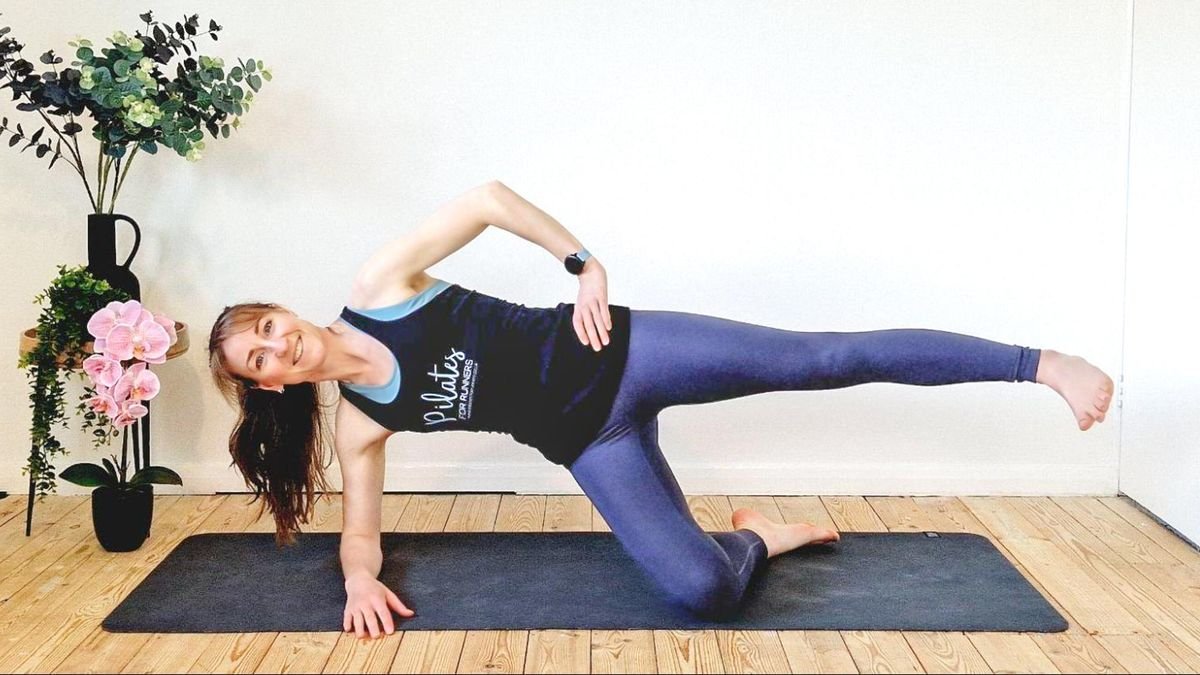
Pilates is a low-impact exercise that focuses on strengthening your core, which is important because it connects your upper and lower body and helps maintain balance and improve posture.
Roll out your yoga mat and master the art of this mind-body practice to improve your flexibility, increase your strength, and build a super-strong core. Pilates also has some pretty impressive powers: it can improve your posture and build longer, leaner muscles.
One of the biggest fans of this holistic workout is Liz Patient, a certified Pilates instructor and founder of Pilates for Runners, who uses it to improve her running performance. But whether you’re a runner or not, Patient says one of the best things about Pilates is that it’s so versatile.
“This means that each workout can be customised to your specific needs, age and targeted muscle groups, meaning there’s sure to be a workout to suit people of all abilities,” she adds.
To prove the point, Patient has created a seven-movement Pilates flow to help build core strength and tone lower body muscles.
Liz Patient is a certified Pilates instructor and founder of Pilates for Runners. She created her business by refining her own Pilates routine to improve movement, increase strength, and sustain running.
How to do a 7-move Pilates workout
There are many different types of Pilates – from wall Pilates to reformer Pilates – but this workout, Patient’s designed, is a no-equipment, mat-based session that can be added to a strength workout or as a dedicated 25-minute core-focused routine.
This single-legged Pilates workout helps improve balance, build strength, and correct muscle imbalances. There are seven total movements, and the goal is to complete three sets of 12-15 repetitions on each leg.
1. Knee lift lunge back

Do you know how to do a lunge properly? According to Patient, take this move to the next level by adding a knee lift. “This strengthens the single leg, hips and core, improving balance and stability,” explains Patient.
- Stand tall and take a big step back with your left foot into a lunge, with most of your weight on your front foot.
- Bring your left knee as close to the floor as possible.
- Then lift your back left leg and pull it back, finishing by lifting your knee forward while maintaining balance.
- Repeat this 12 to 15 times, then switch legs.
2. Heel-up split squats

Patients say this move builds much-needed calf strength, essential for activities that put a lot of strain on the ankle, like running or walking long distances.
- Stand tall and take a big step forward with your left foot into a split squat position.
- Keep your back straight and bend both your front and back knees to a 90-degree position.
- Lean your hips slightly forward so that most of your weight is on your front leg.
- Lift the heel of your front foot and squat up and down in this position, keeping your front heel lifted the whole time.
- Repeat this 12 to 15 times, then switch legs.
3. Lunge and spin

Of course, the best exercises using a stability ball help improve balance and mobility, and the same goes for rotational movements, which Patient says also improve core strength and balance.
Patients are encouraged to hold a kettlebell in each hand for this exercise to strengthen the core and maintain balance, but you can perform this move without one if you don’t have one nearby.
- Holding a kettlebell in each hand, lunge back with your left foot, bringing your back knee as close to the floor as possible. Keep your lunge about hip-width apart, no wider than that, to really test your balance and stability.
- Maintaining a lunge position, extend the weight forward and rotate to raise it over your front knee.
- Bring the weight back to the front and complete the rotation 12 to 15 times before switching feet.
4. One-leg hip hinge with rotation

“Single-legged exercises are great for strengthening your hips, legs and core, while rotational movements further develop balance and stability,” Patient says.
- Straighten your spine and extend your left leg behind you.
- Bend at the waist and push your hips back, lengthening your spine as you bring your chest toward the floor.
- Lean forward and at the same time raise your other leg back as high as you can while maintaining your balance.
- Reach your opposite hand toward your balancing foot.
- Repeat this 12 to 15 times before standing up and switching to the other side.
5. Partner

In Pilates, side kicks allow you to practice core control techniques while working your quads, glutes, and hips. If you haven’t already, protect your joints by using a cushioned yoga mat for this lower-body exercise.
- Lie on your side with your elbows on the floor and your knees bent, lowering your hips off the floor and straightening your top leg.
- First, raise your top leg up to hip height, then, keeping your hips off the floor, raise it back up to hip height again, being careful not to drop your hips as you move your leg.
- Repeat this 12 to 15 times, then switch to the other side.
6. One-legged bridge

Bridging is a key foundational movement in any Pilates routine: “It develops strength in your core, hamstrings, hips and glutes,” says Patient.
- Lie on your back with your knees bent and hip-width apart.
- Lift one leg so that your knee is over your hip. Raise your hips toward the ceiling. Pause and straighten the leg, keeping your hips high and level.
- Bend your legs and slowly lower your hips to the floor, alternating sides for 12 to 15 repetitions.
7. Around the World

Another exercise that tests single-leg stability is the one-legged around-the-world rotation, in which you rotate one leg in front of, behind and outwards from your body while keeping your standing leg as still as possible. “This exercise develops all of these skills while building strength in your core, hips, legs and ankles,” Patient explains.
- Stand tall and tap one foot forward on the floor. Next tap one foot to the side. Next tap one foot behind you. Finally, cross your legs behind you and tap the floor.
- Keep your standing leg and torso as still as possible. Your knee should be directly over your ankle.
- Then reverse the movement and return to the starting position. Repeat this 12 to 15 times before switching to the other side.
