

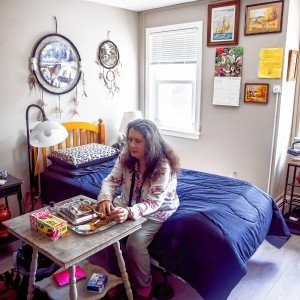
A collection of perfume bottles and jewellery sat in one corner, a pile of DVDs in the other, artwork and paintings hung on the walls, and the sheets were tightly rolled up on a neatly made bed.
This is Denise DeRue’s sanctuary: not in her own home, but in a residence for people recovering from mental illness, the space is so thoughtfully curated that you’d never guess it wasn’t her own home.
She also has a small table by her bedside with tobacco leaves for rolling her own cigarettes.
“I love it here! I don’t want to move,” DeRue said, looking around the room as she realised her dream of personalising the space. “It’s easier than when I lived with my mother.”
She found this haven through Fellowship Housing Opportunities, a transitional housing program in Concord.
DeRue lives in the group home with 12 other residents, all of whom receive 24-hour support in their mental health recovery. They have completed inpatient psychiatric treatment and are now working towards independent living.
The Chesley Street residential facility where DeRue lives is a community residence that offers the highest level of care and attention under the Fellowship Housing Opportunity.
Spread across Concord, the organization manages seven buildings, each customized to serve individuals with different levels of mental health needs, all backed by the clinical support of Riverbend Community Mental Health.
“We started out as a kind of halfway house to give people who were released from state hospitals a place to live instead of forcing them onto the streets,” said Herb Carpenter, executive director of Fellowship Housing Opportunities.
Today, the organization has grown to provide housing for 63 people in the Concord area.
Carpenter, who is interested in building more housing, said he couldn’t find data to assess the need for different levels of care.
Safe, affordable housing is hard to find in New Hampshire.
But the struggle is even more pronounced for people transitioning from inpatient psychiatric facilities, like New Hampshire Hospital, said Susan Stearns, executive director of the New Hampshire Alliance on Mental Illness.
“I think some people will end up in New Hampshire Hospital for long periods of time even though, clinically, therapeutically, they no longer need that level of care,” Stearns said, highlighting the impact of a lack of transitional housing options for people with mental illness.
“It compounds the problem of emergency department admissions because beds are being taken up by patients who no longer need that level of care. So it clogs the system.”
According to data from the New Hampshire Department of Health and Human Services, 68 stable patients have been waiting for discharge from New Hampshire hospitals for more than 15 days since May 1.
The reasons for the delays vary, but one major factor is the lack of supportive housing in the state. These people are unable to live independently and need the intensive, coordinated services they can receive in residential facilities.
The transition from a highly restrictive environment, such as a closed ward in a psychiatric hospital like New Hampshire Hospital, to life in the community is crucial for individuals in recovery.
Program Services Director Ed Austin said residents spend years in those environments, but eventually, when they’re ready and feeling better, they’ll move into an unlocked environment, like a community residence, where they’ll be able to move around freely.
“Once they feel better, their medication is working, and they’re feeling better, they come to these unlocked places,” said Austin, the community residence manager. “People can come and go whenever they want.”
After packing up her belongings, Ms. DeRue left her room and walked down the stairs to mingle with other residents in the community space. She spotted Zachary Ropo, a resident who had been there for six months, and struck up a conversation with him.
The overall atmosphere encourages residents to return to the community.
“It’s motivating to be here and it’s actually comfortable,” said DeRue, who has been living in the housing facility for a year.
Upon entering the building, there is a notice board detailing residents’ chores, from preparing meals to washing dishes. Besides private rooms, there is a shared lounge for watching TV, a games room, and a dining area.
While the government is responsible for providing food, New Hampshire’s Food Bank also serves as a lifeline to community members.
Sometimes residents are responsible for preparing meals.
The smell of bacon wafted through the kitchen on Wednesday afternoon after a resident made some delicious BLT sandwiches.
Each night, staff prepare a family-style meal with the residents’ help.
“We don’t teach them, but we guide them, like if they need any help preparing dinner,” said Ethan Harmon, manager of the community residence, who considers the building a second home and spends most of his time there.
Staff at the facility also provide therapeutic behavioral services, and residents receive assistance with grocery shopping and transportation.
The program charges rent to individuals who stay there, but Carpenter said it’s low-income housing.
Rents are largely covered by Housing Choice Vouchers in some areas or through Housing and Urban Development subsidies, ensuring all residents receive assistance with paying their rent.
After spending a year and a half there, making friends, working toward mental recovery every day and turning his room into a real home, DeRue couldn’t imagine it any other way.
“I’m happy here. I think we’re all in a really good place,” she said.
