

As the lighting space expands for integrators, we begin to understand how ambiguous the term “human-centric” has become. CE Pro In my recent article, “The Difference Between Human-Centric and Circadian Lighting,” I tackled that very subject.
Simply put, all circadian lighting is human-centric, but not all human-centric lighting is circadian lighting – for example, lighting that reduces flicker and glare can also be beneficial to humans.
This article provides a great starting point for conceptualizing a whole-home, human-centric lighting solution. By breaking that solution down into its component parts, dealers can help customers understand the full range of options available to them.
The Role of Circadian Lighting in Human-Centric Lighting
Lighting that mimics the patterns of sunlight and follows the rhythms of the human body, which influenced Homo sapiens for thousands of years before the invention of electricity, is attracting a lot of attention.
Your client will likely be aware that adjustable LEDs can reflect these patterns, so it’s a good starting point for the conversation.
There’s growing consensus that the beneficial effects of circadian lighting are more than just a theory, as researchers continue to learn more about how lighting in particular can benefit overall health, including improving sleep patterns.
Below is one of several examples we covered on Crestron’s blog.
“Researchers at the Center for Light and Health Research at the Icahn School of Medicine at Mount Sinai in New York conducted a study of 20 people living in apartments. To immerse the subjects in circadian light, they used electrochromic glass windows for a week and compared the data with a week spent with traditional windows and blinds.
“When participants were exposed to light that mimicked outdoor light patterns, they fell asleep earlier in the evening, slept more regularly, and woke up feeling more energized – or rested. (Because the study was conducted during the pandemic, participants were already spending most of their time indoors.)”
Aesthetic Lighting Applications
It’s important to note that not all lighting fixtures need to be programmed to provide circadian rhythms. In fact, a balanced design is absolutely critical for a human-centered solution. This is something I learned in a conversation with Mark Greenawalt, senior project manager and lighting design engineer at Arizona firm Creative Designs in Lighting.
“There are essentially three key pillars of lighting,” Greenawalt explains. “Indirect lighting for illumination, accent lighting for drama, and interesting fixtures like chandeliers for ‘sparkle.’ When these three elements work in harmony, you have a balanced design.”
But even when those elements are expressed, Greenawalt points out errors.
“The biggest mistake I see is missing opportunities,” he says. “For example, brick or stone walls are so beautiful when the light ‘grazes’ them. That means designing with the light close to the surface, so you can capture the texture of the masonry.”
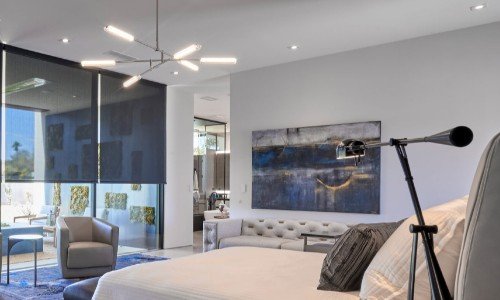
Properly lighting a beloved piece of art or accenting an area of a room for effects that range from dramatic to inviting can create a space that enriches the people who live in it. That said, experts like Greenawalt believe that a harmonious combination of ambient, accent and natural light is essential to a satisfying human experience.
Adding Motorized Shading to the Mix
Automated shades are another important component of any beneficial lighting solution. After all, part of any good lighting plan is the ability to bring natural light into a space rather than mimicking it.
Blackout curtains can block out light that might disrupt your sleep, but as Creston’s vice president of hospitality Michelle Gass points out, there’s another side to blackout solutions that isn’t immediately obvious.
“If your client has a beautiful natural view outside their home, motorized shades that open automatically allow them to enjoy the view without any hassle,” she says.
“If it’s all manual and you have to operate the blinds every day, opening and closing them, it’s unlikely that the client is going to do that every day, especially in a large luxury home.”
The right shading solution also impacts the climate of your home, and when blinds are automated and assist your HVAC system in heating and cooling, the benefits are incredible. After all, what could be more human-centric than creating the perfect temperature?
This is where combining a few spot solutions – for example, smart sensor lighting in the bathroom that “knows” not to be turned on at 100% brightness at 4am – is another aspect of holistic lighting in the home.
By understanding lighting as a “whole home” solution, we can create thoughtful, immersive experiences that deliver on the very definition of human-centric lighting.
Michael Short is Crestron’s Senior Director of Marketing Operations and Residential (Luxury Homes, Hotels and Superyachts).
