

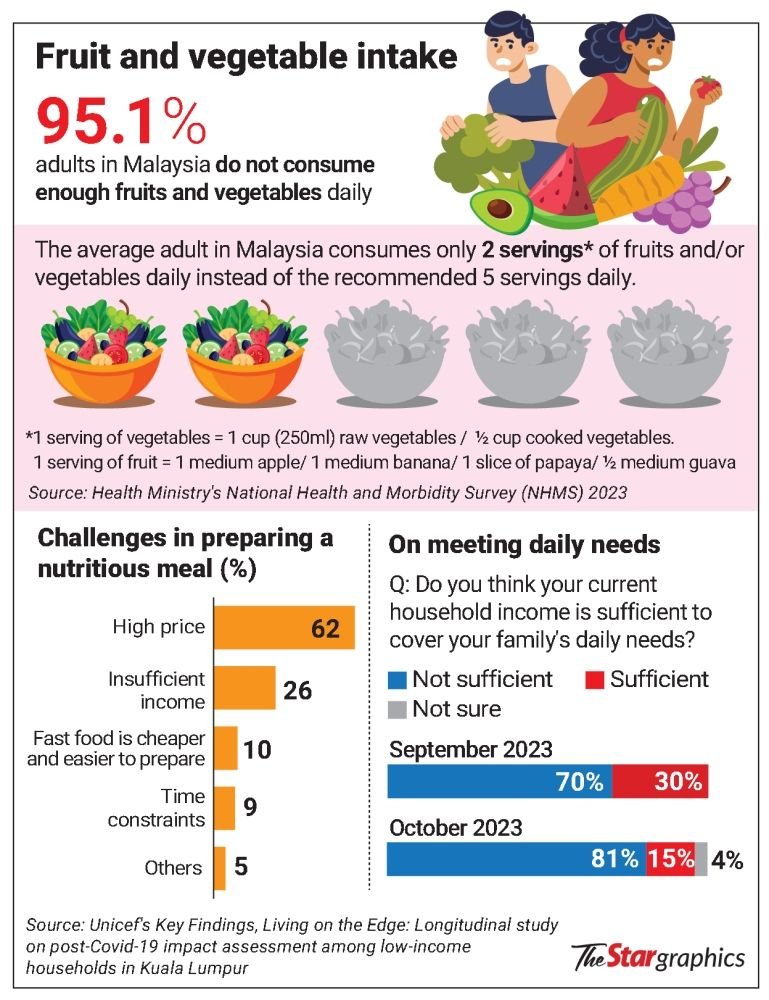
Noranna Arifin, a mother of six, makes sure to include cucumbers and lettuce in her family’s dinners and lunches every day.
But when it comes to green vegetables, these are the only two she buys at the market for her picky eater family, as most other vegetables are beyond her grocery budget.
“We can still buy cheaper leafy vegetables like sawi, kangkung and bayam, but my children are picky eaters and they don’t like those vegetables, so we don’t want to waste money,” said the housewife from Kedah.
When it comes to fruit, mangoes are the cheapest fruit in her area when they’re in season.
“Also, my kids are picky eaters and their favourite fruits are apples and grapes but they’re very expensive now, so fruit isn’t something we eat every day.
“I only buy fruit from the pasar malam or wholesale market when it is on sale or in bulk. During fruit season, I can also find bargains at the pasar tani (farmers’ market) or pasar pagi (morning market), but I can’t go there very often as I don’t have transportation when my husband is working,” she says.
The Ministry of Health says Noranna and her family’s eating habits are becoming the norm in Malaysia.
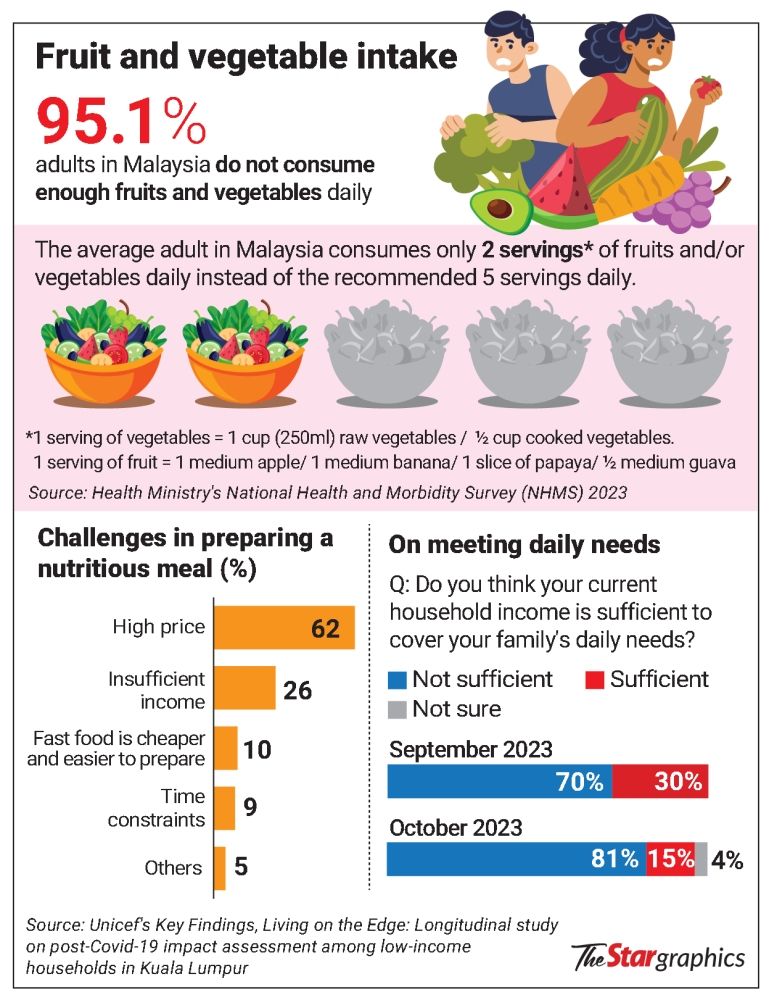
More than 95 percent of Malaysian adults do not consume enough fruits and vegetables daily, as revealed in the recently released National Health and Morbidity Survey (NHMS) 2023. Malaysian adults typically consume only two servings of fruits and vegetables per day, instead of the recommended five servings per day.
Notably, while there are various reasons why the majority of Malaysians have unhealthy dietary habits, the rising cost of living appears to be one of the reasons for the increasing trend, especially when it comes to the volatility of fresh food prices.
Issues emerge
While dietary choices may seem like a personal decision, rising food prices could affect grocery choices for many households.
Vegetable and fruit prices in particular appear to be fluctuating due to unreliable weather and supply issues caused by geopolitical tensions.
According to the Department of Statistics Malaysia (DOSM), inflation in the food and beverage sector rose 0.3 percentage points month-on-month to 2% in April.
 Addressing Malaysians’ unhealthy eating habits is important because, if left unchecked, it could lead to an overburdened healthcare system and a society with lower productivity and economic growth, Ng said. — Chan Boon Kai/The Star
DOSM also recorded that the Consumer Price Index (CPI) for fruits and nuts increased by 0.9 percent in April this year compared to April last year.
DOSM found that over the same period, the CPI for vegetables surged 3.2 percent, with different varieties of onion and red spinach recording the highest increases.
Experts agree that there is a strong correlation between the high cost of living and fewer Malaysians eating healthy foods.
Dr Ng Ai Kah, senior lecturer at University Malaya’s School of Social and Preventive Medicine, said the correlation between financial constraints and unhealthy eating habits was a well-documented phenomenon.
“Limited financial resources can prevent individuals and families from purchasing and consuming healthy foods, such as fruits and vegetables.
“What’s more, even though other foods are often high in sugar and fat, they are usually cheap, tasty and filling,” Ng says.
She added that there may be other reasons why fewer Malaysians are eating healthy foods, such as the lack of time for food preparation, especially among working mothers, and the limited availability of fresh produce in certain areas.
Federation of Malaysian Consumers Associations (Fomca) vice-president and legal adviser Datuk Indrani Thuraisingham agreed that affordability and practicality are two of the main factors behind unhealthy eating habits.
“I think the two go hand in hand. It’s all about practicality – where’s the closest location, where’s the most convenient location. [to get groceries]” says Indrani.
While unhealthy diets may not seem like the country’s most pressing health issue, if they continue, they could lead to a decline in the overall health of the population, which in turn could lead to lower productivity and hinder economic growth, Ng said.
“Unhealthy eating habits contribute to the spread of chronic diseases such as obesity, diabetes, cardiovascular disease and certain cancers.
“Poor public health leads to lower productivity, individuals take more sick days off, are less effective at work and ultimately hinders economic growth,” she said.
At the same time, more financial resources will be needed to support a health care system strained by a sick population, she added.
 Indrani says instead of concentrating most of the country’s arable land on crops, farmers should be encouraged to plant more fruits and vegetables. — News Agency
Reduction
Of course, Malaysia’s low-income households are the most at risk.
A UN-backed survey published in early May, just before the NHMS results were released, found that rising prices since the pandemic have forced many B40 families to cut back on food spending, with some children eating less than three meals a day.
As of October 2023, about 81% of household heads said their current household income is not enough to meet their family’s daily needs, up sharply from 70% in a similar survey in 2020 during the pandemic era.
“Households have resorted to various coping mechanisms to cope with the rising cost of living, but some of these strategies, such as reducing dietary intake, have negative impacts on nutritional status,” wrote the United Nations Children’s Fund (UNICEF) study, titled “Living on the Edge: A Longitudinal Study of Post-Pandemic Living Cost Impacts in Low-Income Households.”
The survey, which targeted 755 households with a median monthly income of nearly RM3,000, is a follow-up to UNICEF’s previous surveys in 2020 and 2021 which tracked the impact of the Covid-19 pandemic and lockdown on low-income households.
The survey found that 62 percent of household heads cited high prices of raw materials as the main challenge in preparing nutritious meals.
Additionally, about 32% of respondents said they had reduced their food consumption as part of a strategy to mitigate rising living costs.
“Dietary habits have changed significantly, with increased consumption of eggs, rice and instant noodles.
“However, consumption of unhealthy foods has increased, with 46% reporting an increase in instant noodle consumption during the pandemic compared to 40%,” the survey said.
One of those interviewed, a 35-year-old kuih seller who asked to be identified as Ms M, a widow with a small disabled child, said the current rice price “makes me want to cry.”
Another interviewee, Mr S, 25, who works in a retail shop, said that he used to be able to buy a lot of things with RM50.
“Now, with RM50, I can only buy two or three items such as rice and cooking oil.”
 ‘Click to enlarge’
Better incentives
While there are many things individuals can do to improve their diet, governments can also lower the prices of fresh produce and encourage people to eat healthier meals.
Indrani says it can start with something as simple as providing low-income families with cash vouchers that are only valid for purchasing fresh produce.
The habit of eating fresh produce regularly can also be instilled in Malaysians from an early age by including fruits and vegetables in school feeding plans such as supplementary food programmes, she suggests.
Indrani, a vocal advocate of urban and community gardens, said Putrajaya should simplify red tape for people who want to use idle land for gardening.
At the same time, the government should rebalance how the country’s fertile land is used for agriculture in general and implement policies that encourage farmers to use more of their fertile land for the agri-food industry, rather than focusing on produce.
It was previously reported that only 16.26% of arable land in Peninsular Malaysia was used to grow crops. By comparison, the remaining 83.74% was used for commodities such as oil palm and cocoa in 2021.
The area of land used for growing agricultural products is projected to grow by just 1.2 per cent between 2021 and 2025, the government said in the 12th Malaysia Plan Mid-term Review.
“Most farmers tend to opt for more commodity-based products as they can earn higher income, but what happens to our food security when they do that?
“Paddy farmers are receiving price subsidies. [on their raw costs] But what about fruits and vegetables?
“Why don’t we give subsidies to these farmers to grow more fruits and vegetables? As of now, they don’t see it as a good source of income for them,” Indrani said.
