

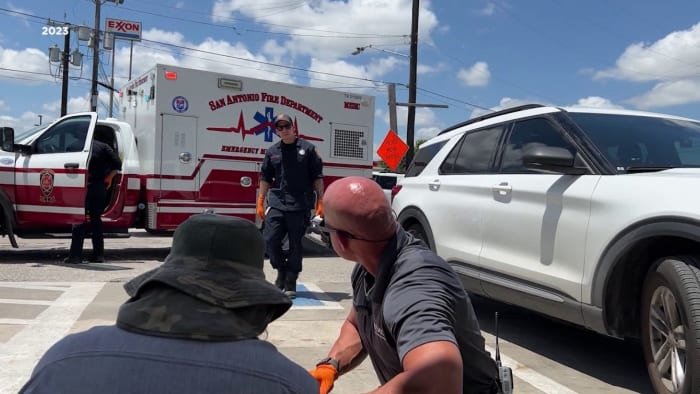
San Antonio – San Antonio’s mental health program is in the midst of rapid expansion after a much-praised start.
And it’s clear city leaders have an appetite to expand it even further.
The San Antonio Community Outreach and Resilience Activities (SA CORE) program launched as a pilot program in April 2022. Three-member teams consisting of officers from the San Antonio Police Department’s Mental Health Unit, San Antonio Fire paramedics, and clinicians from the Medical Services Center responded to mental health calls in downtown and west side neighborhoods.
Their focus is on helping people in mental crisis rather than arresting them for a crime, and they prefer to solve problems on the spot – they may take someone into emergency custody or to a clinic or psychiatric hospital, but very few cases result in arrests.
The polo-shirt-clad team’s soft-touch approach impressed city council members, who enthusiastically agreed to expand the program to include around-the-clock coverage rather than just covering the entire city, as city staff had proposed.
“We’ve been reaching out to mental health providers and organizations that work in this area, and they’ve been very supportive,” said City Council Member Melissa Cabello-Havruda (D-6th District), who chairs the Public Safety Committee.
All funding for the expansion was secured for 2023, but it will actually be implemented in the first seven months of 2024.
The program has already achieved citywide coverage in January with the addition of two teams: The three SA CORE teams operate daily from 7am to 11pm, each covering a specific third of the city.
The expanded program produced results similar to those of the pilot program.
The city plans to add more teams from July 1 to establish a 24-hour security system.
“I’m really proud of how quickly we’ve moved forward and the support we’ve gotten,” said SAFD Paramedic Issac Gomez, who has been involved with SA CORE since the pilot phase.
He believes one of the reasons the program is successful in avoiding arrests is that it sends people to the right facilities and then contacts them later.
“We work on the day,” Gomez says, “and clinicians follow up within 24 hours, then follow up again seven days later, and then we have a process for following up with the patient to see what they missed that day — why they had a crisis, what caused that crisis, and how can we make sure they don’t get into that situation again?”
The team filters out calls involving weapons or people who are physically aggressive, and a friendly response can increase the time it takes to process each individual call.
Thus, with over 32,000 mental health calls made to police via 911 in the past two years, it is clear that even with a 24-hour response, SA CORE cannot respond to every call.
“It would be nice if we could have more SA CORE teams to deal with all of this. It’s not realistic right now, but maybe one day it will happen,” said SAPD Deputy Chief Karen Folkes.
However, given the Council’s affinity to SA CORE so far, it seems likely that it will be expanded further in due course.
“I believe the council will continue to push further but this will go beyond the council,” Kabelo-Haburda said, “which means it will be a few years before we are able to address the majority of mental health issues with the SA CORE team.”
Copyright 2024 by KSAT – All rights reserved.
