

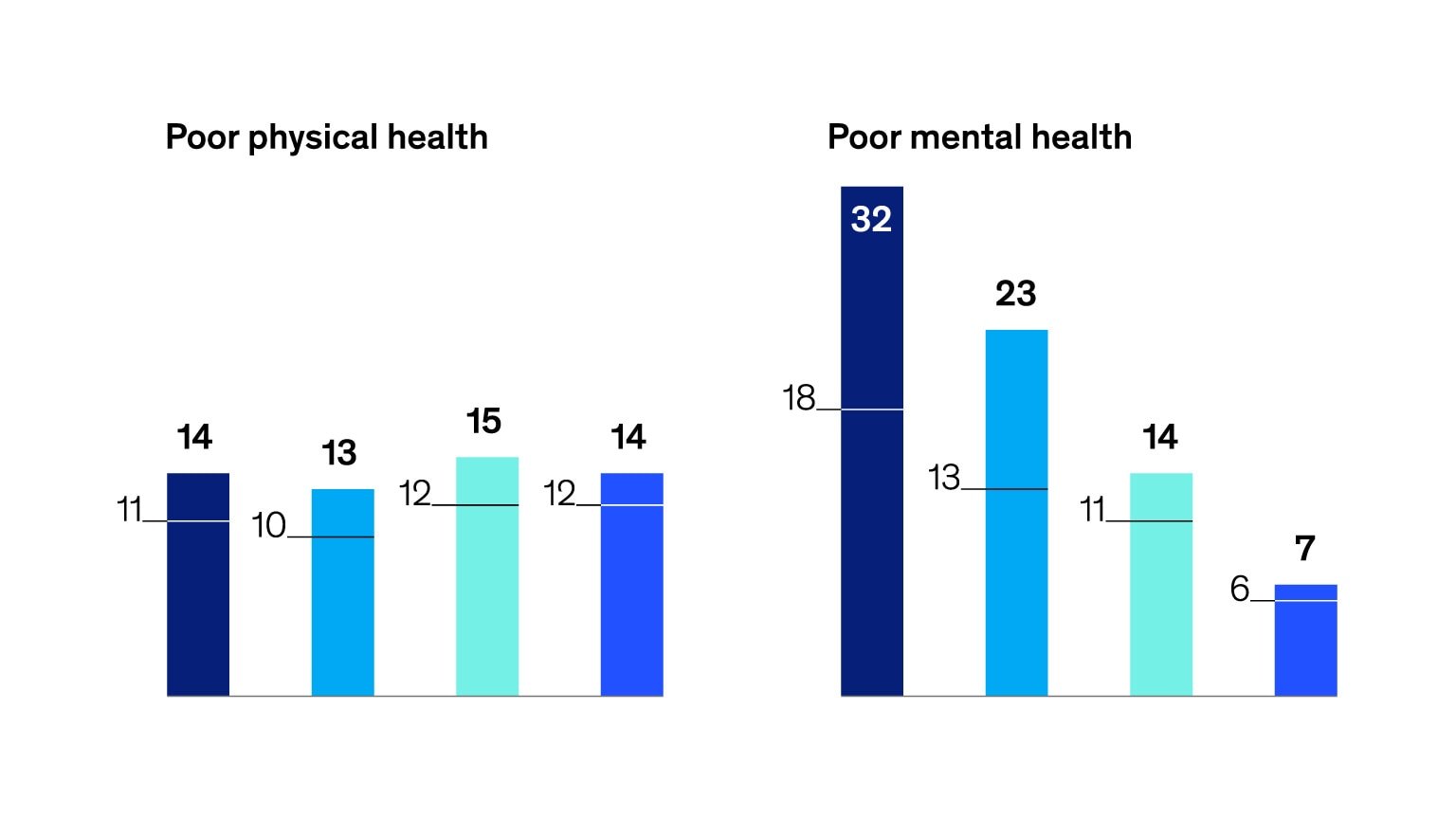
Gen Z’s mental health is lagging behind other age groups. In a McKinsey Health Institute survey of more than 41,000 respondents across 26 countries, partner Erica Coe and her coauthors found that Gen Z overall reports more mental health challenges than non-Gen Zers. For example, Gen Z is three times more likely to report poor mental health than Baby Boomers. Because mental health (having a sense of purpose and connection to something bigger than yourself) overlaps with other aspects of overall health, insights into these aspects may lead to greater resilience.

Image description:
The four bar graphs show that US survey respondents perceive their health as poor or very poor across four dimensions: mental health, social health, physical health and spiritual health. The data is further broken down by generational response rates within each health dimension and compared to the global average for each dimension and generational group. Overall, US respondents report a higher percentage of their health as poor or very poor across all dimensions than the global average. This is most notable for Gen Z in the social and mental health dimensions, where 32% of US respondents report their health as poor or very poor, compared to the global average for that age group of 14%. 23% of US Gen Z report their social health as poor or very poor, compared to the global average for that age group of 14%.
Source: McKinsey Health Institute Global Gen Z Survey (2022) (n = 41,960).
That’s the end of the image description.
To read the article, see “In Search of Self and Something Greater: The Quest for Mental Health,” May 13, 2024.
