

Gen Z includes those born between 1997 and 2012, ranging from college graduates to high school students.
“About 40% of high school students [nationally] “People said they felt very sad and hopeless for at least two weeks and felt like they couldn’t carry out their normal activities,” said Dr. M. Daniel Fallin, dean of Emory University’s Rollins School of Public Health. “These are frightening numbers.”
Ernst & Young’s 2023 National Gen Z Survey found that nearly two-thirds report experiencing at least one mental health issue within the past two years.
That’s why young people say they’re prioritizing their mental health as they navigate a world that is, in some ways, very different from that of generations before them.
Social Exhaustion
Social media has far-reaching effects on all aspects of health, with sources describing it as both a blessing and a curse.
“Constant social media use can interfere with healthy sleep habits, as well as the habit of going outside and engaging in other activities that promote physical health,” Fallin said, before moving on to discuss mental and emotional factors.
“Data suggests that watching more than three hours of television a day is likely to have an impact on health. Among the content of most concern is content that harms one’s sense of self, appearance, sense of belonging, relative worth, and perception of oneself compared to others with similar experiences.”
“There are so many things to think about, like where to live and what job to get.”
Niles Francis Georgia Southern University Student
Priscilla Arroyo, a DeKalb resident in her early 20s, said while social media can be beneficial in spreading social and political awareness, it can also have a negative impact on young people’s mental and emotional health, especially when graphic and traumatic images are allowed into the algorithms.
“When I’m scrolling through TikTok or Instagram I see something really funny and then the next thing I see is something really sad… It’s shocking and really hard to accept,” she said.
She tries to avoid graphic imagery as much as possible, but says it’s often difficult: Many of her posts recently have been about the war between Israel and Hamas.
“It’s really hard to get over it, but it’s also hard to ignore it and let it go, because I want to be aware and I want to think, ‘Oh, what can I do to help?'”
“[Social media users know] “How do you get angry? How do you get sad? How do you get happy? How do you process your emotions? And how do you get back to normal?” Fallin said.
“And we all go through those cycles, but when you’re literally bombarded with something new every two seconds, every two minutes, every two hours, or as many times as you allow yourself, it can be really hard to maintain that mental health balance.”
Case Hand, a junior at Kennesaw State University, said he has made being mindful of the time he spends online a priority after experiencing mental and emotional burnout from social media while in high school.

Case Hand, 21, prepares to record a podcast with friends, one of the ways he believes it’s helping him maintain his mental health. (Matthew Pearson/WABE)
“I want to live in the moment and remember everything, and that helps me connect with people better,” he said.
He also believes that while social media can be a great tool for communication and expression, he points out that it can also quickly cause division and conflict.
“It’s really about thinking about what your standards of politeness are,” Hand says. “Some people have a standard of politeness that says you have to like everyone, you have to accept everyone as they are, and you have to listen to what they have to say. And some people have a standard of politeness that says you have to like everyone, you have to accept everyone as they are, and you have to listen to what they have to say. [they believe] “I don’t have to like you [or your beliefs]. “
I saw it, but did you hear it?
In the midst of an election year and with political unrest growing abroad, more Gen Zers in Georgia are taking a stand and making their voices heard.
Pro-Palestinian protests have spread to various universities across the state.
“First, we need to recognize that the current protest situation is not the first time this generation has been exposed to the feeling that they have to participate in protests,” Fallin said, pointing to young people’s contributions to the Black Lives Matter and Me Too movements.

Arrests were made after Atlanta Police and Georgia State Police ordered pro-Palestine and “Cop City” protesters to disperse from a plaza on the Emory University campus on Thursday, April 25, 2024. (Matthew Pearson/WABE)
“But we’re seeing this happening across the country, and now around the world, particularly on higher education campuses.”
Fallin said while many students are inspired by the effort, they can also feel emotionally drained and worried about their safety.
“People feel conflicted, like, ‘I’m doing something and no one is listening,’ or, ‘I’m doing something and I don’t feel safe.’ These are important things that we need to figure out how to support each other.”
She added that having open conversations about uncomfortable topics is essential at Rollins to ensure students feel safe both emotionally and physically.
“[Fostering safe spaces] Share and express your opinions in a productive way… [students] “Feeling the positive psychological effects of doing something rather than feeling unseen and unheard,” she said.
“It’s really difficult. [social media]But it’s also hard to ignore it, because I want to be aware and think, ‘Oh, what can I do to help?'”
Priscilla Arroyo, Gen Z in Georgia
The woes of elections
The upcoming presidential election has been another source of frustration and anxiety for many young people this year.
“Many of us are not particularly excited about once again having to choose between Joe Biden and Donald Trump, but that is the reality,” Francis said.

Poll worker Dawn Perry cleans ballot cards during the midterm elections at the Church of Our Savior in Sandy Springs, Georgia, Tuesday, Nov. 8, 2022. (Associated Press/Ben Gray, File)
Arroyo said she plans to vote but has not decided who to vote for, citing a lack of confidence in the candidates.
“Anyone who gets into office makes these promises,” she said. “Obviously, they want you to vote for them, so they tell you what you want to hear. … And I feel like there were a lot of false promises.”
Despite her disappointment with the current political climate, she still believes young people should vote for the candidate they feel will best benefit their future.
“This is really like our grandparents’ generation’s last hurrah for power,” Hand said, adding that he believes many elected officials are not addressing the issues that matter most to young people.
Fallin said the uncertainty about which candidate will take power in November could create feelings of fear and anxiety among many young people about the political and social direction of the country.
“The anxiety of not knowing can be psychologically distressing for many people,” Fallin said, noting the importance of support systems and personal activities to reduce stress.
“It’s going to be important that we recognize that the next six to eight months in this country are going to be really tough, and that we find ways to think about tools that can increase the resilience of individuals and communities.”
Extremely high prices
Related to politics, another stressor for many Gen Zers in Georgia is the economy, specifically rising costs that Francis said are making it hard for young people to live comfortably.
According to a recent Ernst & Young national survey, 65% of Gen Z surveyed in 2022 were working full-time or part-time jobs, and about 40% had both a job and a “side hustle.”
“A lot of us struggle just to get to the grocery store. Some of us struggle, some of us have to work multiple jobs, and that’s outside of school, and that’s expensive in itself,” said Francis, who is a full-time student and also works two jobs.

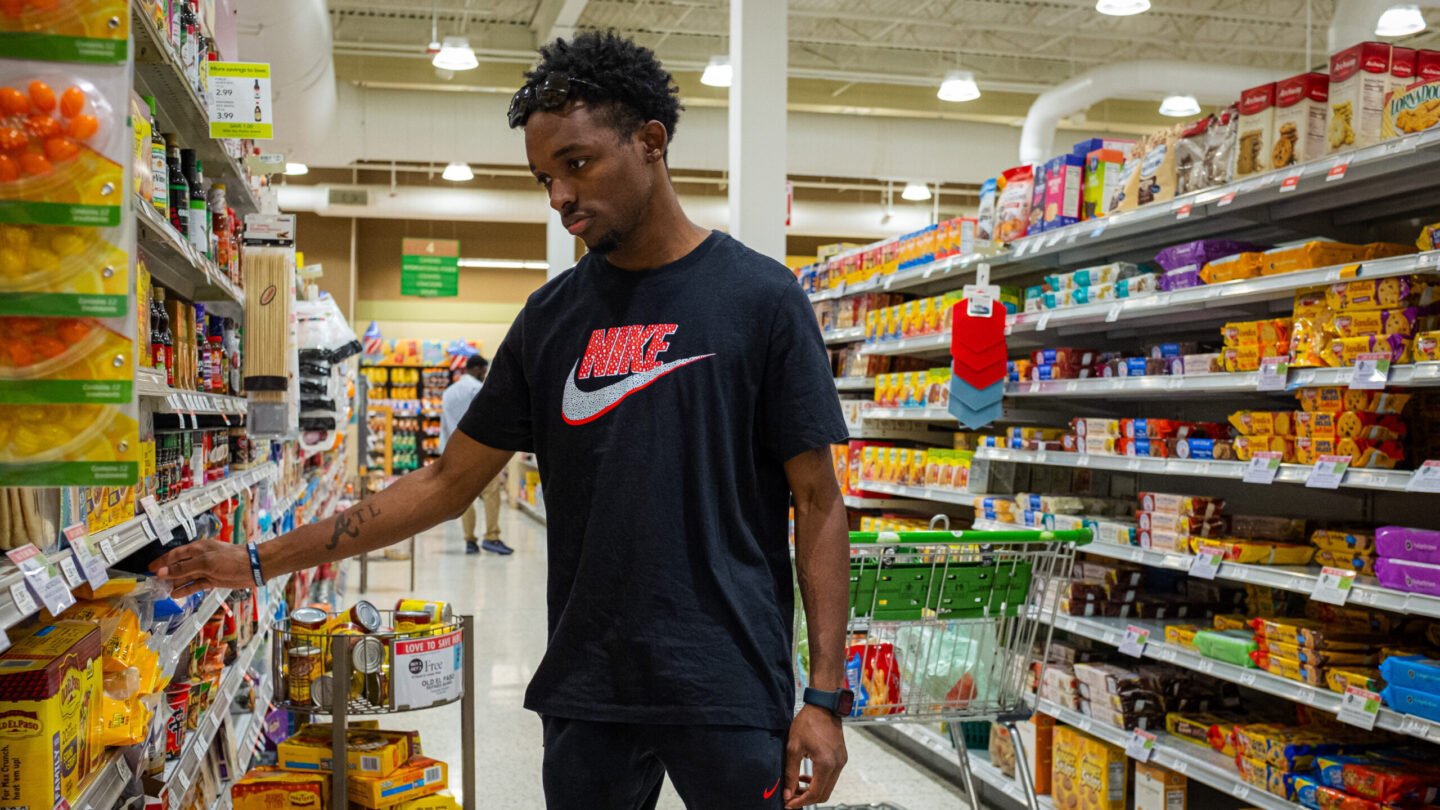
Georgia Southern University and Mableton resident Niles Francis checks out grocery prices during a recent shopping trip. (Matthew Pearson/WABE)
Hand worries about how inflation and declining job opportunities will affect his future and that of his friends.
“There’s no homeownership anymore,” he said, referring to buying single-family homes on Wall Street. “Pre-COVID, you could buy a home. [although] Things were getting harder, inflation was soaring, and the minimum wage wasn’t rising with it.”
He also pointed to the frustration many in Gen Z feel at older generations’ lack of understanding about the struggles they’re facing to get their lives and careers off the ground.
“Our parents’ generation and grandparents’ generation will never understand the struggle,” he said. “My parents were really set in their ways and said, ‘If you work hard, one day you’ll buy a house,’ but that’s not true.”
Arroyo added that after spending thousands of dollars on higher education, searching for a high-paying job presented an unexpected setback.
“It’s going to be important that we recognize that the next six to eight months in this country are going to be really tough, and that we find ways to think about tools that can increase the resilience of individuals and communities.”
Dr. M. Daniel Fallin Dean of the Rollins School of Public Health at Emory University
Arroyo still lives at home, but she has seen firsthand how friends and peers struggle to juggle multiple financial responsibilities.
“It was quite difficult. [for them] “You’re struggling to pay rent and bills, and it’s really hard to find work these days,” she said, “even if it’s well-paid.”
Fallin said the stress of financial stability is also affecting younger Gen Zers, including her son, who is in high school.
“My father said, ‘I’m worried that our generation will have to work twice as hard with half the purchasing power,’ and I thought, ‘Oh, that’s terrible.’ It’s a heavy burden for a young person to really feel like that’s what their future holds.”

Georgia Southern University and Mableton resident Niles Francis arrives at his car after grocery shopping. (Matthew Pearson/WABE)
Living for the Future
Despite the challenges ahead, Fallin believes Gen Z still wants to maintain healthy levels of stress and mental health.
“These social determinants of mental health are real,” she says, “and while it can feel overwhelming, I like to go back to the idea that the most positive thing you can do for your own mental health is to figure out where in the puzzle of this really big challenge you can do something small that will impact how you feel like you’re contributing to the solution.”
Looking for an outlet to express his views, Hand and a few friends created “Kuttin’ Loose,” a comedy-based podcast that launched earlier this year. Hand believes this outlet is a major factor in keeping his mental and emotional health strong.
“I would like to express my perspective as a member of Generation Z.[er]”When talking about being the youngest of his two co-stars, he said:

Case Hand (far right) laughs during an appearance on “Kuttin’ Loose,” a comedy podcast he co-hosts with (from left) Mileigh Chenat, Jeffrey Saylor and Holden Schneider. (Matthew Pierson/WABE)
Now working two jobs and often seven days a week, Arroyo began making plans to spend time with friends and take time for herself as a way to lighten the load of her hectic work life.
“I had to change my mindset and how I looked at things and start thinking, ‘What can I do after work?'” she says. “I started making plans and buying myself treats… that really helped too.”
Hoping to get a job during her final semester at Georgia Southern, Francis started exercising, which she said gives her something to focus on outside of work and school.
“This is my geeky side, but I also like watching Jeopardy,” he says. “As Ken Jennings himself said, this is the only 30 minutes of the day where facts matter to anyone.”
