

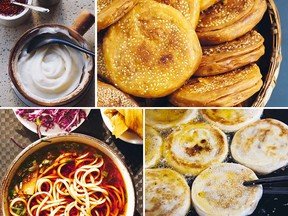
In his third book, author Michael Zee expresses his love of Chinese breakfasts
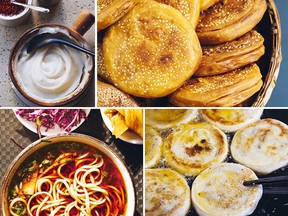
Reviews and recommendations are unbiased and products are independently selected. Postmedia may earn an affiliate commission from purchases made through links on this page.
Article content
Our cookbook of the week is Zao Fan: Breakfast of China by SymmetryBreakfast creator Michael Zee.
Jump to the recipes: Juntun guo kui (numbing meat pies), xian nai mi bu (Kunming rice pudding) and Lanzhou niu rou mian (Lanzhou hand-pulled noodles in a spicy beef soup).
Article content
Michael Zee has built a career on his love of breakfast. In 2013, he created an online phenomenon when he started the Instagram account SymmetryBreakfast while working in the learning department at the Victoria & Albert Museum in London. The shots of the symmetrical breakfasts Zee made to share with his now-husband, fashion designer Mark Van Beek, became a full-time job. A book of the same name followed in 2016, and in 2019, Zee released his second book, Eat Like a Local: Shanghai.
Advertisement 2

Article content
Despite all the talk about breakfast being important, “people massively overlook it,” says the Milan-based author. In Zee’s new book, Zao Fan, he combines his love of breakfast with his love of China and photography, offering 100 recipes, more than 50 of which he documented on video linked by QR code, and portraits of the cooks he met running breakfast shops and stalls across the country.
“If you’ve seen my social media, I’ve been the breakfast guy for 10 years,” says Zee, laughing. “And it was like, ‘How can I lean into that without just totally throwing it all away?’ But at the same time moving on from social media.”
As a third-generation Chinese cook, Zee has put his own mark on the family business of food. Growing up in Liverpool, he worked at his dad’s Chinese and English chippies (fish and chip shops) on weekends and school holidays. His grandfather, Zee Pao San, to whom he dedicated Zao Fan, was also a restaurateur.
Despite Zee’s passion for food, a culinary career wasn’t part of the plan. Zee has been a photographer since he was seven or eight years old. Before his digital camera, he took photos on 35mm film, developing them in an at-home darkroom. “When I grew up, it was very unglamorous,” he says of restaurants. “My dad worked really, really hard, and we were still broke.”
Advertisement 3
Article content
After studying photography at university, Zee became an art teacher. Following a stint in the U.K. school system, he got a master’s degree and moved to museums. “And then, through my relationship with, now, my husband, the food thing came back full circle.” In Zao Fan, “basically, all these threads in the ether have come together: the China thread, the family thread, the photography, the education, the food. Everything’s suddenly coming together.”
Zee and Van Beek moved to Shanghai in 2017, the city Pao San had left for Liverpool 68 years prior. They lived there until moving to Italy in 2021, but Zee spent most of 2022 in China finishing work on Zao Fan. He had spent years building friendships and professional connections there when Van Beek was offered a job in Italy. Just as Zee was getting into the rhythm of life, his time in Shanghai was over in the blink of an eye. The book became a way to encapsulate what he’d achieved in five years.
When Zee visited China for the first time, he was struck by the availability of made-to-order food — at any time of day and seemingly on every street corner. In Shanghai, you can buy a jianbing (a savoury pancake from Tianjin) for roughly $1, which vendors make fresh in less than a minute. “But they have the setup, the prep, the skill. They have all the mise en place ready, and they’re churning out one after the other after the other. You take yours, leave, and think, ‘Wow, that was fast.’ But actually, the amount of preparation is enormous.”

Cook This
Article content
Advertisement 4
Article content
Zao Fan captures the vast range of Chinese breakfast in chapters devoted to noodles, breads and doughs, rice and other grains, Xibonese breakfast, soy and tofu, eggs and some meat, dumplings, morning tea, soups, sauces and pickles.

Zee wrote Zao Fan’s recipes for a Western kitchen, but he wanted to offer more than reproducible instructions. “Part of the attraction of this sort of book is that it is that window into China, like a travel book, like an experience of you going there.”
Talking with a couple who cooked Huangshan-style cai fan (vegetable rice) near the Shanghai neighbourhood of Laoximen made him think of his family. They didn’t have children and knew that when they retired, the shop would close. Exchanges like these reinforced how much is missed when human interactions are cut from the food equation. Featuring portraits of the people behind the breakfasts in the book was as important as the dishes themselves.
“You see the professionals. It’s not me taking the glory for their work. It’s like me saying, ‘Here’s the person making it. This is the professional. This is who you’re really going to learn from.’”
Advertisement 5
Article content
This personal touch extends from the photographs and videos to Katy Wang‘s illustrations on the book’s endpapers, depicting hands pulling noodles, folding, flipping, shaking and stirring. “It’s the idea of random movements. It’s not a machine. It’s not a graphic. It’s not a gif. It’s a doodle of someone really there.”
Cooks make almost everything by hand at breakfast shops and stalls in China — “machinery is impersonal and robs the sellers of their pride.” Zee wanted the same handmade feeling with the cover design. “It needed to feel like it was hand-drawn and squiggly and a bit odd and a bit wrong, just to push this idea of the handmade further.”
Breakfast in China reflects the lifestyle of Chinese people, says Zee. Even in places that are not megacities, going out for breakfast is commonplace. In this way, he draws a parallel with life in Italy. “Some Italians might make a coffee at home, but 98 per cent go to the bar and stand and have a chat and have a pastry, and that’s breakfast. And it’s very unusual if someone is raised otherwise.”
Not every Chinese person can afford fine dining, says Zee, but breakfast stalls offer a multitude of options at different price points. While lunch and dinner in China could be an elegant banquet, breakfast is “remarkably unpretentious.” When people do eat breakfast at home, it tends to be leftover-driven and thrifty.
Advertisement 6
Article content
“There’s so much within that bubble, that menu of breakfast in China across this gargantuan country. And it’s also just diverse. That’s what’s so interesting about it, because the size of the country lends itself to diversity just because of the magnitude of the place.”
Recommended from Editorial
-

Cook This: 3 tropical recipes from Islas, including sugarcane smoked chicken
-

Cook This: 3 recipes from The Book of Sandwiches, including an extra-crispy twist on a BLT


JUNTUN GUO KUI

Numbing Meat Pies
Makes: 8 pies
1 2/3 cups (200 g) all-purpose flour
1 tsp instant yeast
1 1/2 tsp baking soda
A pinch of salt
1/2 cup (120 ml) lukewarm water
Neutral oil, for greasing and frying
White sesame seeds, to garnish (optional)
For the filling:
2 tbsp Shaoxing wine
3 scallions
1 thumb-sized piece of fresh root ginger
2 tbsp water
7 oz (200 g) fatty ground pork (15 per cent fat)
1/2 tsp ground cumin
1-2 tbsp ground Sichuan pepper
Step 1
First, prepare the filling. Put the Shaoxing wine, scallions, ginger, and water into a blender and blend to a smooth paste.
Step 2
Scrape this into a bowl, then add the pork and mix thoroughly. Add the cumin and Sichuan pepper, mix again, then set aside for the flavours to mingle.
Advertisement 7
Article content
Step 3
Put the flour, yeast, baking soda, and salt into a bowl, then add the water. Bring together into a smooth dough with your hands, then knead for 4-5 minutes until smooth and springy. Cover and leave to rest at room temperature for 30 minutes.
Step 4
Meanwhile, preheat the oven to 350F (180C).

Step 5
Weigh the dough and divide it into eight equal-sized pieces, then lightly oil your hands and roll each piece into a long oblong about 2-2 1/2 in (5-6 cm) wide and 12-14 in (30-35 cm) long.
Step 6
Next, weigh the pork mixture and divide it into 16 portions. Using your hands, smear the oblongs of dough with a portion of the pork mixture, then roll them up. Turn the rolls on their side and press down with your hand to create a spiralled bun like a snail.
Step 7
Roll out each piece into an oblong again and repeat the process, smearing with the pork mixture and rolling it up, then pressing into a snail bun. At this point, you can press the bun into some sesame seeds if you are using them.
Step 8
Finally, roll each bun out into a flatter and slightly larger circle. You want it to be around 1/2-3/4 in (1.5-2 cm) thick.
Advertisement 8
Article content
Step 9
Pour enough oil into a frying pan to shallow-fry the breads. Cook the pies over medium-low heat for 17-20 minutes, flipping regularly, until they have a deep golden crust. Transfer the pies to a baking sheet as you go.
Step 10
Bake the pies in the oven for 10-12 minutes so that the centre is fully cooked, then serve hot.
XIAN NAI MI BU

Kunming Rice Pudding
Serves: 1
3 tbsp rice flour
3 1/2 tbsp whole milk
1 tbsp granulated sugar
1/3 cup (75 mL) water
Step 1
Put all the ingredients into a small clay pot over high heat and use a pair of long cooking chopsticks to stir until well combined.
Step 2
Cook undisturbed for 2-3 minutes. Nothing much will happen at first, but when the heat picks up, start stirring continuously. After 7-8 minutes you will feel the mixture start to thicken. This is when you need to pick up the pace and stir quickly until it comes together into a smooth consistency.
Step 3
Remove the pudding from the heat and keep stirring for a further 30 seconds.
Step 4
Slide the clay pot onto a plate and serve.
LANZHOU NIU ROU MIAN

Lanzhou Hand-Pulled Noodles in a Spicy Beef Soup
Advertisement 9
Article content
Serves: 4
For the soup:
5 1/2 lb (2.5 kg) beef brisket (or any stewing cut)
2 scallions
1 3/4 oz (50 g) fresh root ginger, cut into large chunks
4-5 garlic cloves
1 oz (30 g) cilantro leaves
3/4 oz (20 g) dried sand ginger or 1 3/4 oz (50 g) fresh galangal (optional)
4-5 whole dried chilies
3-4 bay leaves
2 black cardamom pods
2 star anise
2 cinnamon sticks
1 tbsp fennel seeds
1 tbsp Sichuan peppercorns
1 tbsp long pepper (optional)
1 tbsp black peppercorns
2 tsp ground white pepper
1 tbsp salt
1 tbsp rock sugar
For the noodles:
4 cups (500 g) all-purpose flour
Generous 1 cup (280 mL) water
1 tsp table salt
Neutral oil, for greasing
To serve:
A few cilantro leaves
1 scallion, chopped
2-3 tsp chili crisp or chili oil
Liangban Ziganlan (recipe follows)
Step 1
The day before, make the soup and noodles. Put the beef into a bowl, cover with water, and leave to soak for 1 hour to remove any excess blood or impurities, then discard the water.
Step 2
Place the beef in a pot and cover completely with fresh water. Bring to a boil, then boil for 3-4 minutes until there is a visible amount of white scum floating on the surface. Reduce the heat to low and use a slotted spoon to remove the scum.
Advertisement 10
Article content
Step 3
Add all the rest of the ingredients for the soup, then simmer over low heat for 4-6 hours until the beef is tender enough to break apart with the gentle pressure of a fork. Alternatively, transfer to a roasting pan with a lid and cook in the oven at 325F (160C) for the same amount of time.
Step 4
I like to cook the beef this way, as you can be sure it won’t boil dry. Once cooked, remove the meat from the pot or pan and set aside to cool completely. Remove the spices from the cooking liquid with a slotted spoon and reserve the liquid as the soup base for your noodles. Store the beef and soup in the fridge.
Step 5
Meanwhile, make the noodles. In a large bowl, combine the flour, water, and salt and bring together into a dough with your hands. Knead for 10 minutes until the dough is smooth and firm, then generously oil the dough and leave it to rest, uncovered, for 30-45 minutes at room temperature to allow the gluten to relax.
Step 6
Brush a large plate with oil. Using oiled hands, squeeze and shape the dough into a long sausage about as thick as a thumb. Coil the dough on the oiled plate and cover with plastic. Chill in the fridge overnight, or for at least 12 hours.
Advertisement 11
Article content
Step 7
The next day, remove the dough from the fridge and set aside for about 1 hour to come to room temperature. Break off an 8-12 in (20-30 cm) piece and use your hands to stretch it to double the length. Fold it in half and repeat. If you want very fine noodles, you can do this again.
Step 8
When you’re ready to serve, thinly slice the beef and warm the soup in a pot until gently simmering.
Step 9
Bring a large pot of water to a boil and cook the noodles in batches for 2 minutes. They won’t all float to the surface when cooked, but even if they are a little undercooked, it is OK, as they will finish cooking in the bowl.
Step 10
Ladle some of the hot soup into four bowls, then add the noodles and finish with the cilantro, a pinch of scallions, and the chili crisp or chili oil. Serve with the liangban ziganlan.
LIANGBAN ZIGANLAN

Purple Cabbage Salad
Serves: 4-6
1/2 red cabbage, shredded
2 tsp salt
1 tbsp granulated sugar
1/3 cup (75 mL) rice vinegar
1/2 tsp ground white pepper
1 tbsp sesame oil
1 tbsp toasted white sesame seeds
1 oz (30 g) cilantro, leaves picked
Step 1
Put the cabbage into a bowl, add the salt, and massage it into the cabbage for 1 minute. Cover and chill in the fridge for 1 hour.
Advertisement 12
Article content
Step 2
Meanwhile, combine the rest of the ingredients in a bowl and set aside.
Step 3
Remove the cabbage from the fridge and drain off any liquid but don’t wash off the salt. Add the dressing and give it a second massage. Refrigerate again for 30 minutes, then serve with something hot and spicy.
Recipes and images excerpted from Zao Fan: Breakfast of China by Michael Zee. Text copyright ©2024 Michael Zee. Photographs copyright ©2024 Michael Zee. Published by Interlink Books. Reproduced by arrangement with the Publisher. All rights reserved.
Our website is the place for the latest breaking news, exclusive scoops, longreads and provocative commentary. Please bookmark nationalpost.com and sign up for our cookbook and recipe newsletter, Cook This, here.
Article content
