

May 21, 2024
Billions of people around the world are affected by deficiencies in essential vitamins and minerals in their diets, but a team from a top Canadian university has developed a breakthrough solution that fortifies staple foods with iron and other nutrients. We have developed a strategy.
This article was originally published on theguardian.com as part of the University of Toronto and Guardian Institute’s ‘What’s Possible?’ Ask the Toronto campaign.
It is estimated that more than 2 billion people worldwide have micronutrient deficiencies. These vitamins and minerals are the building blocks of good health, and not getting enough of them can have serious consequences. For example, insufficient levels of vitamin A are the leading cause of preventable blindness in children. Zinc is good for your immune system. Iron deficiency is also the most common cause of anemia, which can lead to poor cognitive and motor development in childhood and reduced productivity in adults.
The situation is so serious in many developing countries that Member States of the World Health Assembly recently adopted a resolution to accelerate efforts to prevent micronutrient deficiencies through food fortification.Professor at University of Toronto Levente Diosadi His team at the Institute of Food Engineering has spent more than 20 years working on ways to fortify salt with iron and iodine. Initial pilot projects in India have been successful, and other recent projects in Africa have also shown promising results.
Of the 3.5 million schoolchildren who participated in a 2004 study in Tamil Nadu, 85% were found to be anemic. Almost a third were cured after eight months of eating hot school lunches prepared with twice the fortified salt. Since then, the Uttar Pradesh state government has spent $40 million distributing salt to 24 million low-income residents, and other states have plans to conduct their own trials.
“As of today, about 50 to 60 million people in India are consuming double-fortified salt, which is pretty good,” Diosadi says. “When we first tested it in Tamil Nadu, it was an unexpected success. The cost per person is also relatively small, about 25 cents per person per year.”
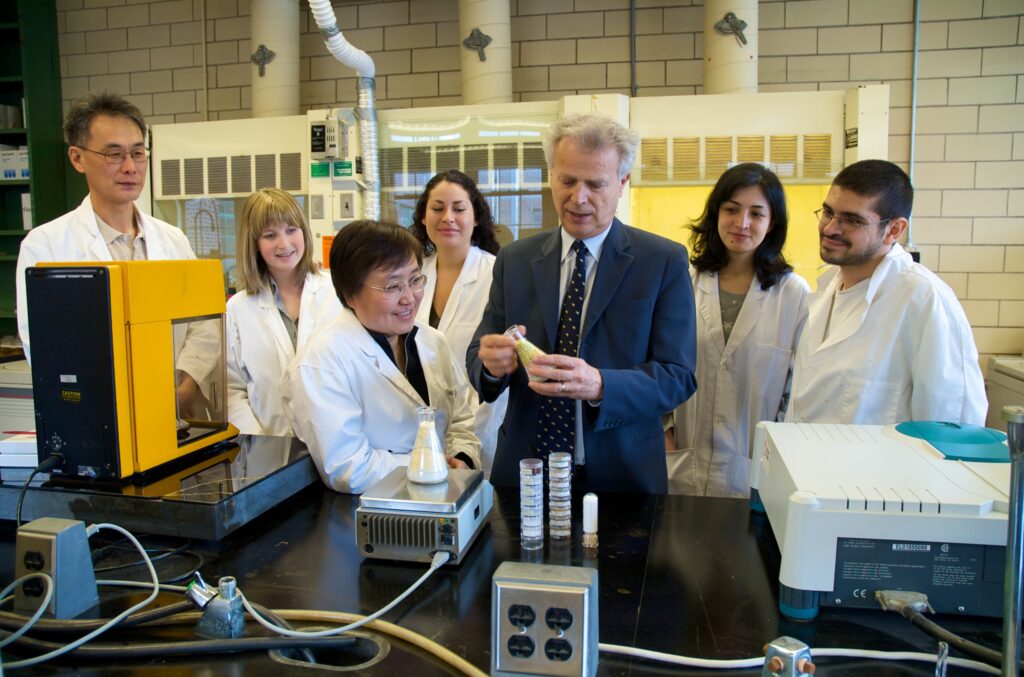
Diosadi’s interest in salt dates back to the early 1990s, when he was consulted by a senior advisor at UNICEF. Venkatesh Mannar He comes from a family that produces salt and has worked with children’s charities to create a successful salt iodization program that has resulted in around 89% of people around the world using iodine-fortified salt. Manar wanted to see if the same thing could be achieved with iron. It was a simple vision, but not an easy one to achieve. When Diosady first combined iron and iodine, the two reacted with each other and the iodine evaporated along with its benefits. “I had to find a way to separate them so they couldn’t react,” he says. The solution was microencapsulation. This means that iron particles are coated with a barrier of vegetable fat to prevent them from reacting with iodine.
Once this challenge was solved, the team experimented with adding more nutrients to the salt, such as folic acid, zinc, and vitamin B12. Each addition presented its own set of obstacles. “You always wish it were easy, but there are stability issues with folic acid and there is an incompatibility between folic acid and B12,” he says. “So it’s not going to happen right away. But now there are six things you can put in salt in any combination.” In Ethiopia, trials using salt fortified with iodine and folic acid showed that It has already shown potential to reduce the incidence of birth defects. Other experiments are also being conducted in Tanzania.
Diosadi is also known for his research into adding iron to tea. In 2013, he won a large grant from Saving Lives at Birth: A Grand Challenge for Development, which was supported by institutions in Canada, Norway, the United States, the United Kingdom and the Bill & Melinda Gates Foundation. Research at the Institute of Food Technology is also funded by Dr and Mrs Hugh Cross, engineering alumni who hope to improve the health of women in Tanzania and around the world.
Like salt, tea also attracted Diosadi because of its universal appeal, especially to developing countries. “We were interested in tea because in India, everyone drinks two cups a day, children and adults, rich and poor,” he says. “We’ve made a lot of progress with salt because even the poorest farmers have to buy it. The same goes for tea. We can reach almost everyone.”
It hasn’t all been smooth sailing. Diosadi says adding iron to tea turns it an unappealing blue colour, but the team managed to solve that problem, making great progress in developing an iron-fortified black tea in terms of taste, colour and texture. Adding milk makes it more difficult, but Diosadi is confident they’ll find a solution. Once it’s robust enough for distribution, he hopes their existing relationship with consumer goods multinational Unilever will prove beneficial. “If we get this right, we’ll have the perfect way to introduce it to the world. Unilever produces thousands of tonnes of tea every year.”

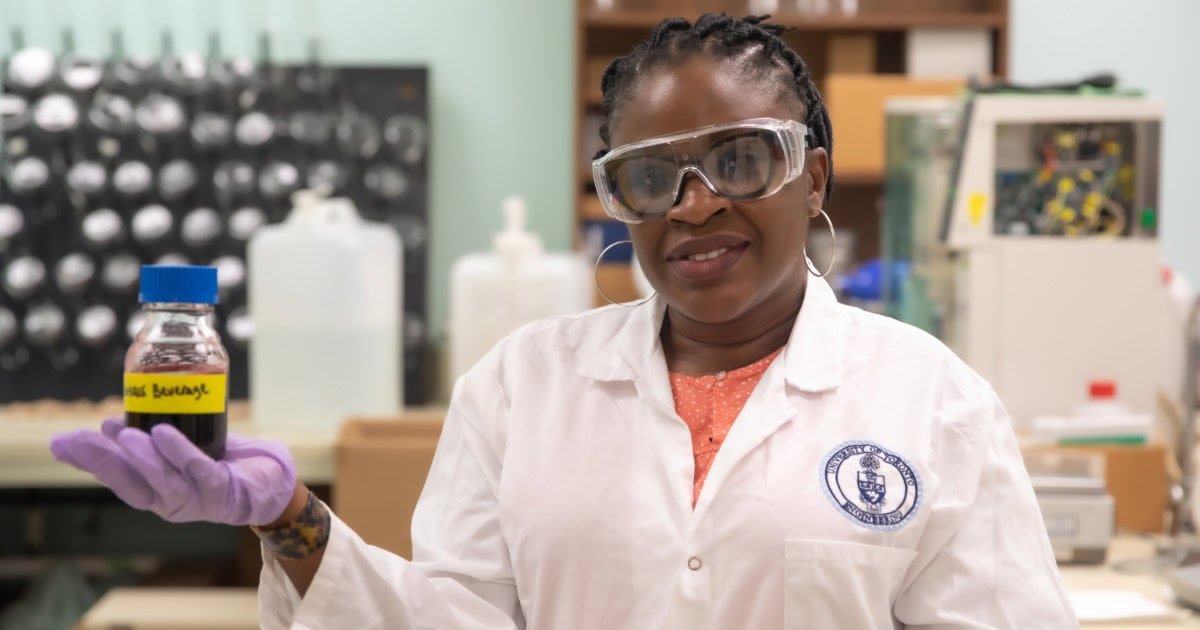
Chemical engineering doctoral candidate Folake Oyewole He’s one of 15 researchers working in Diosadi’s lab. Her thesis project, sponsored by the Schlumberger Foundation, is inspired by Zobo, a Nigerian hibiscus-based drink that she wants to fortify with iron. The World Health Organization estimates that in Nigeria alone, 55 percent of women of reproductive age are anemic. “We started with iron because it’s the most common nutritional deficiency worldwide,” she says.
“However, my research is focused on addressing the problem of iron deficiency in sub-Saharan Africa.Western and central sub-Saharan Africa is one of the top three regions in the world most affected by anemia. Because it’s two of the regions.
Oyewole said local anemia is so prevalent because meat is so expensive that poor people in rural areas rely on plant-based diets. Many plants also contain compounds called polyphenols, which each have their own benefits, but also the downside of limiting iron absorption in the body.
In response, her approach was to improve both iron intake and uptake in the region by fortifying local staple foods, in this case zobo (the main ingredient being Hibiscus sabdariffa) . “Fortifying beverages derived from plants indigenous to this region has the advantage of lowering barriers to entry for challenges such as availability, affordability, and acceptance,” she says.
When Oyewole began analyzing the properties of hibiscus, one of the biggest hurdles was the relationship between the iron content and polyphenols contained in the plant. Hibiscus is a relatively iron-rich food, but its high polyphenol content offsets this. A large amount of iron is also lost in the process of making drinks.
After much experimentation, she managed to fortify the drink with iron salts and introduce drugs that help the body absorb iron despite polyphenols. She hopes this approach will be available to others in the future. “This is more than just a drink. This is a solution that can be applied to a variety of polyphenol-rich foods. By preventing this interaction, we can make iron in foods more accessible to consumers. Masu.”
Diosadi, who began his career in chemical engineering in the 1970s, never expected to work in a developing country, but he found micronutrients appealing because they help improve people’s health, economies, and societies. He says this is based on the idea that even small things like making improvements can have a big effect. social development. And I feel lucky to have had the opportunity to experience him in India, Bangladesh, the Philippines, Indonesia, and parts of Africa, witnessing the local impact of his work.
He believes that engineers can play an important role in solving global challenges and creating social change. “Food, water, urban technology, housing, all these areas are related to engineering,” he says. “It’s so much fun to see what we can do in the lab, but being able to see it in the field is the best.”
Find out how the University of Toronto’s Faculty of Engineering has been driving change and innovation for more than 150 years at 150.engineering.utoronto.ca.
Written by Emma Shepherd
