


e
While there are some minor operational changes being made to the MIRA buses behind the scenes, the Eagle Valley Community Foundation is adamant that the services and resources provided by the Mobile Resource Center will not be affected. .
What Mira is doing
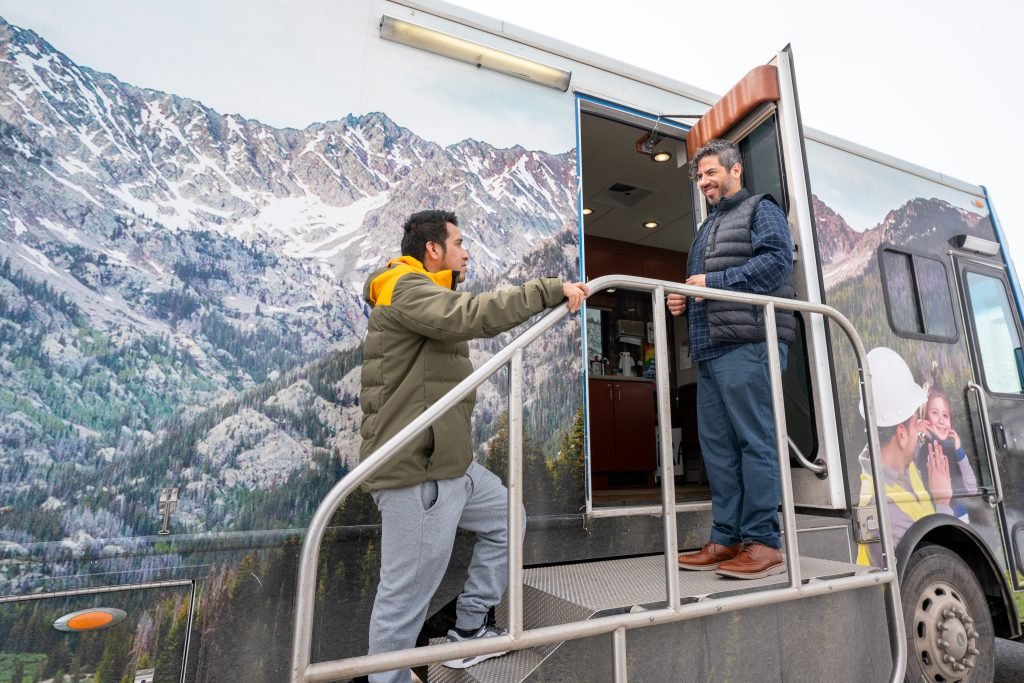
MIRA Bus (short for Mobile Interculture Resource Alliance) was created in 2018 to connect community members with services and assistance for their health and wellness needs.
“The way MIRA works is that we look at all the different social determinants of health. We don’t just treat the symptoms and the disease, but we look at the different social determinants of health that may be preventing someone from living a healthier life. (Acknowledge) that there are issues (including income, education, job insecurity and unemployment, food insecurity, housing, and basic amenities and issues),” said Eagle Valley Community Foundation Development and Marketing. said Director Grace Anschutz. “We are trying to take a serious look at health as a whole person, but what are the barriers to addressing long-term health outcomes?”
MIRA buses provide free health screenings and immunizations, as well as help refer individuals to medical, dental, behavioral health, early childhood, and other services. We work closely with the Foundation’s Community Market to provide free food and address food insecurity. We also help community members enroll in assistance programs such as Medicaid, SNAP, and WIC.
The buses serve all of Eagle County, making regular monthly stops. We work in different regions and not only provide these resources, but also host community events.

support local journalism
MIRA has people on hand every day to respond to these areas of need, but we also rely on partnerships to provide funding and support for additional staffing.
In this way, MIRA acts as a “connector,” hosting bilingual CPR courses in collaboration with local nonprofits like Starting Hearts, Habitat for Humanity Vail Valley, Speak Up Reach Out, and others. Anschutz said.
“There are special occasions when our partners come to the bus, but that doesn’t mean those services aren’t available every day. Our staff is always there, constantly navigating to accommodate your every need.” she added.
shift support
One of MIRA’s partners from the beginning has been Vail Health.
Vail Health has provided “more than $700,000 in direct funding to support MIRA and its community efforts” over the past four years, according to Chris Lindley, Vail Health’s chief population health officer. That’s what it means.
“Vail Health is not withdrawing funds from the Eagle Valley Community Foundation. We will continue to fund preventive health care on MIRA buses,” Lindley added.
However, there will be some changes to what Vail Health offers when it comes to staffing support.
In 2021, Vail Health, in collaboration with the Eagle Valley Community Foundation, Eagle County Public Health Department, Mountain Family Health Center, and Eagle County Paramedics, will continue to support Created the Community Health Program to “help address identified health disparities.” Lindley said.
The program provides basic health screenings and referrals to primary care at Mountain Family, a regional federally qualified health center, for the uninsured, he added.
“The only change is that Vail Health staff are no longer riding the Community Health Program MIRA bus due to the drop in patient numbers,” Lindley said.

However, Anschutz clarified that this will not change services for community members.
“Eagle County Emergency Medical Services, a MIRA bus partner since the beginning, will be conducting critical health screenings on board the buses,” she added. “From the resident’s perspective, we’re just changing who’s doing the work that’s being done on the bus.”
Paramedic services will be available twice a week to provide these medical examinations and health education.
These medical exams can be very important because they are often the first time an individual is undergoing a medical exam, Anschutz said.
“It can make a huge difference to their long-term health,” she added.
One of the other areas where Vail Health and MIRA are collaborating is Medicaid enrollment. Lindley said the initiative will continue, calling it “very successful and impactful.”
“Together, we continue that great work to ensure that every Medicaid individual in our community has access to coverage and comprehensive health care,” he said.
The current agreement between Vail Health and Eagle Valley Community Foundation is in effect until the end of October (the end of Vail Health’s fiscal year), at which time future contracts and funding will be discussed.
funding
Like many nonprofits and programs, this encapsulates one of MIRA’s biggest challenges. “The biggest challenge has always been funding and the uncertainty of funding because it’s often an annual contract,” Anschutz said.
MIRA is currently collecting funding from a variety of partner organizations and individuals.
“The goal of MIRA’s funding model, like most nonprofits, is to be as diverse as possible,” Anschutz said.
This includes support from individual community members and grants, as well as support from the Eagle County Department of Public Health and Environment, which provides “another major source of funding,” Anschutz said.
Currently, MIRA is working with the Colorado Department of Public Health and Environment on immunization grants, with regulators on insurance enrollment programs, and with Hunger Free Colorado on SNAP enrollment programs.
Anschutz thanked the partners who fund and support MIRA, but acknowledged that “like any nonprofit organization, we are constantly striving to increase our revenue.” .
“We are seriously looking at partnership income to see how we can work with paramedics and Mountain Family Health Center on grants so we can continue to increase the opportunities available to our neighbors.” she added.
Growing needs

Increased revenue allows us to meet the growing needs of our community.
From 2022 to 2023, “service usage increased by 89%,” Anschutz said, noting that this was across the company’s various services.
Anschutz added that one of the areas of greatest need in Eagle County is food insecurity. It works directly with community markets and saw an “immediate increase” after SNAP benefits were phased out in February 2023 following the pandemic, Anschutz said.
“Last year, our Community Market attracted an average of 4,800 people per week. Now, we serve over 6,000 and 7,000 community members per week, just as we do when Mt. ” she added.
In this context, MIRA not only addresses the immediate needs of getting people food on the table that day, but also the challenges driving food insecurity and access to other supports. Masu.
“For our neighbors in need, it’s a difficult choice between putting healthy food on the table, paying medical bills, and securing child care during the summer when their children are out of school. We’ve seen each factor influence another,” Anschutz said.
Anschutz said MIRA is seeing increased needs around fall vaccinations, access to early childhood programs and financial support for those programs.
generous support
MIRA remains steadfast in providing resources to the community as it continues to grapple with its challenges and changes.
“One thing that hasn’t changed for us is our commitment to the health and well-being of our community,” Anschutz said.
This includes adapting and expanding to meet the needs of the community. We do this by building trust within our communities and maintaining cultural relevance.
“I believe the work of our staff is a reflection of the communities we serve. They excel in their work because they understand the unique challenges that come with living in our communities. ,” Anschutz said. “We are always listening on the ground, asking our neighbors what they need and always being able to adapt.”
For more information about MIRA, visit EagleValleyCF.org/Our-Programs/MIRA..
