

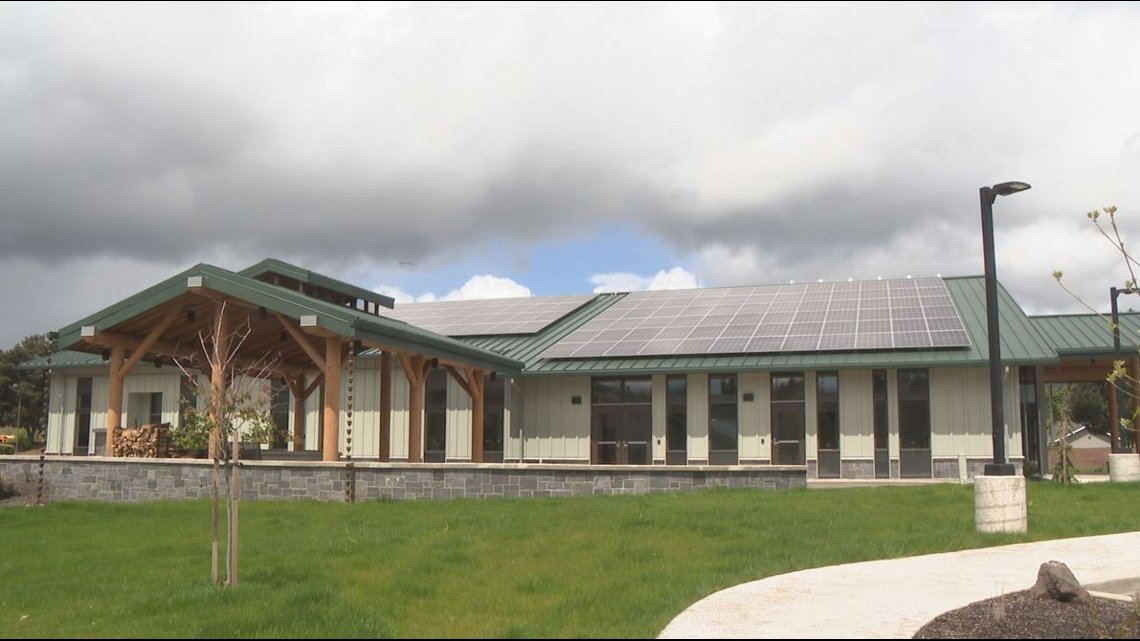
Tribal officials said the priority is to keep the building’s environmental footprint low even as its physical footprint grows.
GRAND RONDE, OREGON —
As Kelly Rowe stands at the entrance to the new health and wellness clinic on the Confederated Tribes of Grand Ronde Reservation, she can’t help but think of all the people it serves.
The building, which will serve to enhance medical services provided at the tribe’s other medical facilities, is nearly complete and a grand opening is scheduled for the next few days.
For Lowe, the tribe’s executive director of health services, the building is more than just a new space to treat tribal members.
“Every time they walk through these doors, there’s a sense that we’re all here,” she said, noting that the design incorporates nods to tribal culture. “This is their clinic. This is not just a clinic that belongs to the tribe. It’s a clinic of tribal members, and the culture is medicine.”
The tribe partnered with the Energy Trust of Oregon, a nonprofit organization that works to improve efficiency, to ensure the health center was equipped with the latest green technology.
“Some of the design choices made to increase efficiency may include lighting upgrades. They install solar tunnels and solar panels on the roof, and they install ventilation systems and individually temperature-controlled We also set up compartmentalized rooms,” said Scott Leonard, Energy Trust program manager.
Ryan Webb, the tribe’s engineering and planning manager, said the priority is to keep the building’s environmental footprint small even as its physical footprint grows.
“Tribes are very keen to be stewards of the land, as they have always been,” he said.
When the pandemic hit, it quickly became apparent that the tribe lacked the infrastructure to serve its members. Older clinics that provided full medical and dental services had no way to provide testing while keeping people isolated. The new wellness center solves that problem.
Heating and ventilation systems are divided into zones, which is useful in situations where people need to be isolated from each other.
“In situations where there is a potential for a pandemic or an airborne disease, you can actually close down the building and bring outside air into the building,” Webb said.
The center also has six exam rooms and two dental clinics, as well as a large community room with a demonstration kitchen. That room is equipped with upgraded audio and visual technology so that cooking demonstrations can be live-streamed to tribal members at their homes on the reservation, across the state, and even around the world.
“This is not just a focus on Western medicine,” Webb says. “It actually shows how nutritional health and cultural practices can heal people.”
A spacious outdoor patio featured a fish hole to showcase the traditional preparation of salmon, a food of great cultural importance to the tribe.
“We can provide health and wellness to our communities in a culturally sensitive way, helping everyone become healthier in who they are and what they do,” Webb said. Ta.
Tribal Council Chair Cheryl Kennedy said history teaches that when tribes need to do something, they often have to do it themselves.
In the 1850s, tribes were forced from their ancestral lands in exchange for recognition from the federal government. But in 1954, the government revoked that recognition in a process called termination.
“It was very difficult for most families because their land was taken away,” Kennedy said. “Layoff meant they came and stripped you of all the land you had and all the services that were provided to you.”
As a result, tribe members had to travel long distances for medical care.
“The services didn’t exist here, so if people wanted medical care, they had to figure out how to get there,” Kennedy said. “The clinic that served Grand Ronde at the time was located in Salem.”
The tribe regained recognition in 1983, around the same time Kennedy joined the leadership and began pursuing health services for tribal members.
The new clinic was a natural next step to help the tribe provide its members with what they need.
“This is very important,” Kennedy said. “(The clinic) is a place where our members can come and we no longer have to fear that we are orphans or that we will not receive the services that other Americans receive. No.’ And Oregonians take it. ”
And there’s a respect for tribal culture throughout the wellness center, Lowe said.
“When you walk into the community room, you’ll see a large round window. That represents several things,” Lowe said. “It’s a representation of the medicine wheel. It also mimics our plank house. It’s a round doorway to the plank house.”
The wood siding is also significant, having been salvaged from tribal land burned in the 2020 Labor Day wildfires.
“We tried to use everything we could from the tribe, source from within and use things that were important to us as a tribe,” Lowe said.
A traditional salmon painting is engraved into the concrete next to the fish farm on the patio.
“We have a salmon stamp on the outside to show that salmon is not just a first food. It’s our relationship with the water, our relationship with the fish. “And how important it is for us to respect that every time we step out on the patio,” Lowe said. It’s part of it.”
