

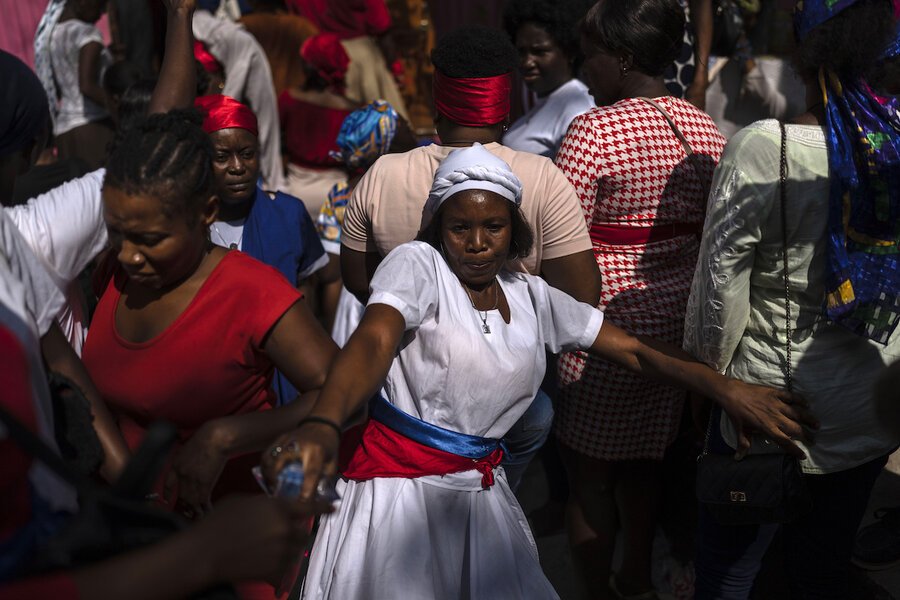
Voodoo believers sing in Haitian Creole, twirling in unison, raising their voices above the sound of gunfire that erupts miles away, as a frenzied drumbeat drowns out their troubles. ”
Voodoo, publicly shunned by politicians and intellectuals for centuries, is transforming into a stronger and more accepted religion across Haiti, where its followers were once persecuted. In recent years, more and more people are seeking comfort and protection from gangs that have killed, raped and kidnapped thousands of people.
The violence has left more than 360,000 people homeless, nearly shut down Haiti’s largest port and shut down its main international airport two months ago. Essential goods such as food and life-saving medicines are in decline. Nearly 2 million Haitians are at risk of starvation.
According to the United Nations, more than 2,500 Haitians were killed or injured from January to March alone, an increase of more than 50% from the same period last year.
Amidst the chaos, many Haitians are praying more and visiting Voodoo priests known as “ungans” to help them with everything from searching for a kidnapped loved one to getting vital medicine needed to keep someone alive. Until discovery, we are seeking various urgent requests.
“The spirits help you. They’re always there,” said Sherry Norzeus, an initiate to become a “mambo,” or voodoo priestess.
In February, when her car was surrounded by 20 gunmen as she tried to flee the Bon Repo community, she invoked Papa Ogwu, the god of war and iron.
Her three children and her sister’s two children, who died during childbirth, sat next to her.
“I’ll burn you alive!” she recalled the gunmen shouting.
The gangs invaded the neighborhood before dawn and set houses on fire amid relentless gunfire.
“I prayed to Papa Ogou. He helped me get out of the situation,” Norzeus said.
When she opened her eyes, the gunmen signaled that she was free to leave.
Voodoo was at the root of the revolution that led Haiti to become the world’s first free black republic in 1804. The religion originated in West Africa and was brought across the Atlantic by enslaved people.
The mixed religion, which combines Catholic and animistic beliefs, has no formal leader or creed. There is a single god known as Bondi, which means “good god” in Creole, and his over 1,000 spirits known as lwa. Some of them are not necessarily benevolent.
During voodoo ceremonies, lwa are offered a variety of treats ranging from papaya and coffee to popcorn, lollipops, and cheese puffs. The ritual is considered successful if the voodooist is possessed by his lwa.
Some experts consider it the religion of the exploited.
“Vodou is a system developed by Haitians to cope with the sufferings of this world, and its purpose is to minimize suffering, avert disaster, soften losses, and strengthen the survival instincts of those who survive. “There is,” writes Haitian sociologist Laennec Harbon. In a recent essay.
Voodoo began to take shape in the French colony of Saint Domingue during the funerals of enslaved people and dances called “Calendars” held on Sunday nights. It was also practiced by slaves known as Maroons who escaped to the remote mountains, led by Voodoo priest François Macandal.
In August 1791, approximately 200 slaves gathered at night in Boixaiman, northern Haiti, for a voodoo ritual organized by Dati Boukman, a famous slave leader and voodoo priest. According to a surgeon who attended the ceremony, they sacrificed a pig, drank its blood, and swore to keep their impending rebellion against slavery a secret.
After 13 years of revolution, Haiti became independent, but Vodou remained suppressed.
The country’s new leaders condemned the cult of Voodoo as well as the Catholic Church.
In 1941, Catholic leaders required parishioners to take an oath to renounce voodoo.
Thousands of Voodoo believers were lynched and hundreds of symbolic spaces were destroyed in what was the most violent attack on the religion in Haiti’s history, according to journalist Herbert Neret.
But Vodou persisted. When François Duvalier became president in 1957, he politicized religion under his dictatorship and appointed certain Ungans as representatives of the religion, Harbon writes.
By 2003, Jean-Bertrand Aristide, a Salesian priest who became Haiti’s first democratically elected president, recognized Voodoo as one of Haiti’s state religions.
Despite its official recognition, Voodoo remains shunned by some Haitians.
“If you say you’re a Voodoo believer, they stigmatize you,” said Kader Basil, a civil engineer.
Mr. Basil was until recently a Catholic. But about two years ago, when he lost his job and his wife left, a friend of his suggested he try Vodou.
“What I’ve found here is spirituality and camaraderie. Being here is like being with family,” he said at the May 1 ceremony honoring Kozenzaka, the lwa of the harvest. he said while doing so.
The person with whom he most sympathizes is Erzulie Dantor, the divinity of love represented by the Black Madonna with a scar on her right cheek.
“That’s the spirit that lives inside me,” he said. “She protects me.”
As the ceremony began, Basil smiled and moved to the beat of the drums as dancers twirled nearby, her long earrings swaying to the rhythm.
Cecil Elian Isaac, a fourth-generation young man, said Voodoo is attracting more followers given the spike in gang violence and government inaction.
“Whenever the community has big problems, they come here because there is no justice in Haiti. It is found in the spirits of the ancestors,” he said.
When Isaac opened the temple in Port-au-Prince many years ago, about eight families from the area became members. Currently, his number exceeds 4,000 in Haiti and abroad.
“We have a group of intellectuals joining us,” he said. “Before, there were people who couldn’t read or write. Now they’re even more visible.”
The credit for this turnaround has been credited to thinkers like Jean Price-Mars, whose 1928 book, “Thus Speaks Uncle,” introduced Voodoo “without blushing the Haitian elite.” It was visualized as a religion, writes sociologist Luis Ampidou Cromeus.
“Until the 1920s, Haitian voodoo was generally viewed as a series of superstitions, witchcraft, and ritual cannibalism,” Cromeus writes. “Talking about voodoo was shameful for Haitian intellectuals.”
Since then, Voodoo has become an important element of Haiti’s rich cultural scene, inspiring music, art, writing, and dance.
It is unknown how many people in Haiti currently practice Voodoo, but there is a famous saying: “Haiti is 70% Catholic, 30% Protestant, and 100% Voodoo.”
On a recent afternoon, hundreds of Haitians gathered on a steep hill, crammed into a small church, and a Christian believed to be a Roman soldier, revered by both Catholics and Voodoo believers alike. celebrated the martyr St. George.
They offered him money and prayers in hopes of helping Haiti overcome its deepening crisis.
“It’s very important to be here,” said Hervé Hippolyte, a chef who practices Christianity and voodoo. “It also gives you strength, courage, and protection.”
Around him was a sea of people wearing khaki and red, the colors of the saints. Some held candles while several women danced nearby.
“Holy George!” cried the priest who was leading the celebration. This caused the crowd to shout, “We need you!”
Josue, a singer and Ungan, said that some young people who become Voodoo seek to change traditional prayers and certain customs, but that Ungan and Mambo do not accept this promotion.
“We are helping them understand that that spirit is a symbol of resistance for the Haitian state,” he said. “There is a lot of content in Voodoo that could lead to the recovery of Haiti.”
This story was reported by the Associated Press
