

research sample
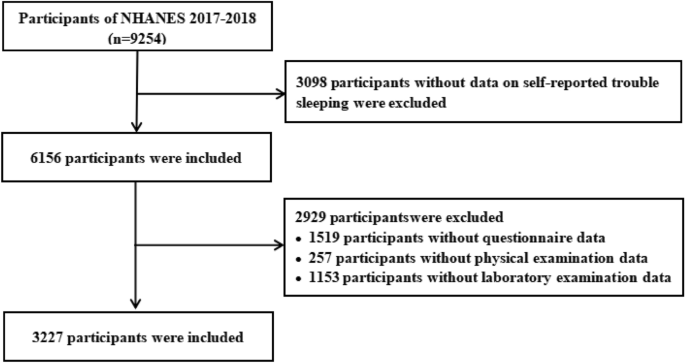
Cross-sectional data were obtained from the National Health and Nutrition Examination Survey (NHANES), which included 9,254 participants from 2017 to 2018. NHANES is a population-based study in the United States. NHANES relied on a complex multistage sampling design to obtain data on demographics, lifestyle factors, and other health outcomes through interviews. The NHANES program was approved by the National Center for Health Statistics (NCHS) Institutional Review Board. After excluding participants with missing data, we finally included 3,227 participants (Figure 1). More information about NHANES can be accessed at https://www.cdc.gov/nchs/nhanes/index.htm..
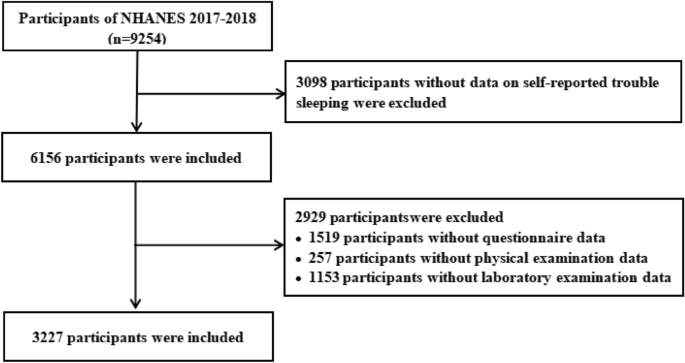
Flowchart showing the selection of the study population.
Self-reported sleep disorders and vitamin C
Sleep problems were measured by asking participants, “Have you talked to your doctor about your sleep problems?” The answer to this question was dichotomized as either “yes” or “no.” This question was administered in the home by a trained interviewer using a computer-assisted personal interviewing (CAPI) system. Serum samples were mixed with 4 parts of 6% metaphosphoric acid to acidify the serum and stabilize ascorbate. All serum samples for vitamin C were stored under suitable frozen (−70 °C) conditions until transported to the National Center for Environmental Health for testing. Vitamin C (mg/dL) in serum was measured using isocratic ultra-high performance liquid.
covariate
We collected baseline data and physical and laboratory indicators for 3,227 participants from NHANES. Baseline data included gender (male, female), age (years), race/ethnicity (Mexican American, other Hispanic, non-Hispanic white, non-Hispanic black, other race), and diabetes. (yes, no) and hypertension (yes, no). No), high cholesterol levels (yes, no), weak/malfunctioning kidneys (yes, no), little interest in doing anything (at all, for several days, more than half a day, almost every day), feeling depressed I feel (not at all, some days, more than half the time, almost every day). These variables were obtained through participants’ self-reports. Physical examination indicators include weight (kg), height (cm), BMI, and kg/m.2), thigh length (cm), upper arm length (cm), arm circumference (cm), waist circumference (cm). Leg and arm measurements were performed on the right side of the body. If the participant has an amputation or other adverse condition, measurements will be taken on the left side. Laboratory indicators include total cholesterol (mmol/L), high-density lipoprotein cholesterol (HDL-C, mmol/L), ferritin (ug/L), and hypersensitivity C-reactive protein (HS-CRP, mg/L). ) and glycated hemoglobin. (%), transferrin receptor (nmol/L), α-carotene (ug/dL), cis-β-carotene (ug/dL), γ-tocopherol (ug/dL), total lycopene (ug/dL), Retinol (μg/dL) and α-tocopherol (μg/dL). All laboratory indicators were obtained by measuring serum samples.
statistical analysis
Chi-square (χ2) test was used for all binary and categorical variables to assess differences between baseline characteristics by self-reported sleep disturbance.we used t Testing of quantitative variables to assess differences between all laboratory measures by self-reported sleep disturbance. Vitamin C is classified into quartiles (“≦0.554,” “0.555-0.894,” “0.895-1.190,” “>1.19”), and the lowest quartile is considered the reference group. We created four binary logistic regression models to determine the association between vitamin C and self-reported sleep problems. Model 1 is unadjusted. Model 2 Based on Model 1, adjusting for gender, age, and race/ethnicity. Model 3 also adjusted for diabetes, high blood pressure, high cholesterol levels, kidney weakness/dysfunction, depression, and lack of interest. Based on model 2. Model 4 included weight, height, BMI, upper arm length, arm circumference, waist circumference, total cholesterol, high-density lipoprotein cholesterol, ferritin, hypersensitive C-reactive protein, glycated hemoglobin, transferrin receptor, α-carotene, Further adjustments have been made to Sith. -β-Carotene, γ-tocopherol, total lycopene, retinol, and α-tocopherol are based on model 3. Furthermore, the association between vitamin C and self-reported sleep disturbances was further investigated by subgroup analysis stratified by gender, age, and diabetes. High blood pressure and high cholesterol levels. Finally, a restricted cubic spline (RCS) model was used to detect a nonlinear dose-response relationship between vitamin C and self-reported sleep disturbance. The important level is P<0.05. R version 4.1.0 was used for all statistical analyses.
