

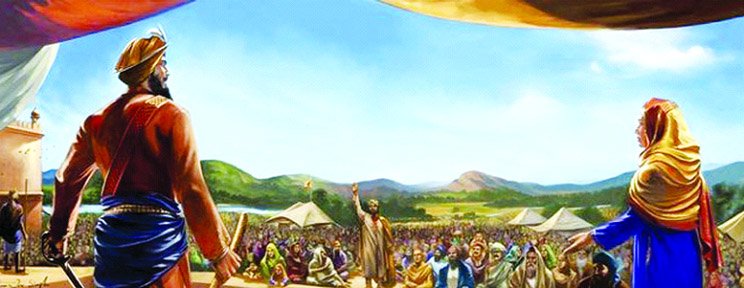
Following Diwali, Vaisakhi has emerged as India’s biggest festival, with its enthusiasm and merry festivities gradually gaining acceptance as a global event. This gave a distinct socio-economic-cultural identity to overseas Punjabis in general and Sikhs. In addition to its religious significance as the birth anniversary of the pure Khalsa, this day is traditionally associated with the beginning of the (wheat) harvest season in North India, during which time the northern farming communities achieved great success. It reflects significant socio-economic progress. Moreover, for many Indian communities, it marks the beginning of a new year.
Major public events such as Vaisakhi memorials with city parades and Nagar Kirtan processions resumed again last year after the coronavirus pandemic subsided. It could not be held in 2021 and 2022. Instead, a special gathering was held at a Sikh temple (gurdwara), following safety protocols of wearing face masks and maintaining physical distancing.
Last year, the ‘Nagar Kirtan Procession’ was replaced by a special congregation held in Toronto on April 24th. Similarly, other major cities in North America also held special ‘Vaisakhi’ celebrations following official guidelines.
On this day in 1699, the 10th Sikh Guru, Shri Guru Gobind Singh, chose the historic town of Shri Anandpur Sahib as the site of his Khalsa. While the main religious festivals are held at Takht Sri Kesgar Sahib (Shri Anandpur Sahib), the Golden Temple (Amritsar), and Takht Sri Damdama Sahib (Talwandi Sabo), Sikhs around the world hold special gatherings at gurdwaras. It is also a venue for the followers of one of the newest modern religions to showcase their progress in the social, political, artistic, cultural, sporting and economic fields worldwide.
Since the origins of Sikhism are in Pakistan, in Nankana Sahib, the birthplace of the first Sikh guru, Shri Guru Nanak Dev, a group of devout believers is also held every year in the second week of April. Visit Sikh temples in Pakistan as part of Vaisakhi celebrations. Almost 230 years after the birth of Guru Nanak Dev, Shri Guru Gobind Singh gave Sikhs a new identity of Khalsa by introducing the concept of holy warrior.
The global importance of Vaisakhi celebrations is such that an ever-increasing number of cosmopolitan cities and metropolises around the world play out the beats of Bhangra and perform the traditional martial art of Gatka as part of their ‘Nagar Kirtan Processions’ or Sikh parades. It can also be measured from the presence ofSikhs are proud to claim they are one of the world’s richest minorities
While Sikhs in India hold Nagar Kirtan processions and special gatherings on Vaisakhi, Punjabis abroad make it special with lavish celebrations. Nagar kirtan processions and Sikh parades are not the only celebrations there. In fact, they are offered as a socio-cultural package consisting of competitions in games, sports and cultural events, in addition to the organization of special religious gatherings that last for weeks together.
Organizing a community kitchen, illuminating the entire route of the procession, and distributing literature on Sikhism in addition to up-to-date copies of telephone directories and business directories became an integral part of the celebration. One recent addition to the event, which has been witnessed in some major cities in North America, is the use of small planes to sprinkle flower petals on the processions.
This year, Vaisakhi celebrations will take on even more significance as India is scheduled to hold parliamentary elections that end in the first week of June. This process has already begun in some parts of the country.
As Sikhs are a growing political minority, leaders of various political parties, both at the state and central levels, have been found in New Delhi, Mumbai, Nanded Sahib, Patna Sahib, Amritsar, Sri Anandpur Sahib, and Sri Talwandi. Sabo and many other places.
Celebrations are held all over the world, including in Europe (UK, Germany, Italy, France, Greece, Netherlands, Sweden), the Americas (USA, Canada), Australia and New Zealand, Africa (Kenya), and Asia (Malaysia). Sikhs are the main focus. , Thailand, Fiji).
Apart from the major Commonwealth countries such as the United Kingdom, Canada, Australia, and New Zealand, several other countries recognize major Sikh festivals in general and Vaisakhi in particular. For example, in 2015, the Malaysian government granted Sikhs a holiday on Vaisakhi.
In 1999, when the whole world celebrated the 300th anniversary of the Khalsa, Canada became the first country outside India to issue a commemorative stamp to commemorate the event. Vaisakhi celebrations are currently held in several provincial parliaments in other Commonwealth countries, as well as within Parliament Hill, including on Parliament Hill in Ottawa. In the United States, Sikh parades are held in almost every major city, including New York, San Francisco, Los Angeles, and Yuba City.
In the United Kingdom, it is organized in several cities besides London, the largest being Birmingham.
Historically, Sikhs have not only had to fight hard to shake off the stigma of “second-class citizens” in many parts of the former Commonwealth, but also to fight for their rights and absorption into the mainstream of their new country of residence. had to fight hard democratically.
In fact, the concept of Nagar Kirtan procession or Sikh parade is very important to the overseas Sikh community, a peaceful and hard-working group who have no qualms about making the country they live in a nation. and has proven to be an effective tool for introducing yourself. their home.
It is this commitment that has helped script an unprecedented success story around the world. Punjabis, called Hindus, began to flow into Canada in the early 1900s, but British Columbians denied them the right to vote from 1907 onwards. They had to wait 40 long years before regaining the right to vote. In 1947, the requirements for being a voter were changed to Canadian citizenship in addition to being a British subject. It was in 1950 that the first Sikh, Naranjan Garewal, was elected to the British Columbia Mission City Council.
The first-ever Sikh parade or Nagar Kirtan procession was organized along Vancouver’s Second Avenue on January 19, 1908. On August 28, 1912, Hardy Al Singh’s Atwal achieved the distinction of being the first Sikh born in Canada.
Each Nagar Kirtan procession consists of an elegantly decorated trailer truck carrying the frightened Guru Granth Sahib in a gold or silver palanquin, five baptized Sikhs (Nishan Sahib) carrying the Kesari flag. , the Gurbani recitation group or “Parbert Feliz” and so on. Besides Bangla players and Gatka players.
The current scale of Nagar Kirtan processions being organized in North America began in 1978 when Sikhs in Canada organized a large-scale Nagar Kirtan procession to commemorate the 500th birth anniversary of Guru Amar Das. . Since then, the Sikh parade has become an annual tradition.
Many historians and social scientists believe that the Nagar Kirtan, or Sikh parade, paved the way for the unification of overseas Sikh communities as a powerful political group, and that it eventually led to the formation of turbaned Sikhs, Gurbax. I agree with the view that Shin Marhi should be elected to the Canadian House of Commons. Six years later, it was he who persuaded the then Liberal Party to hold a grand celebration inside Parliament House to commemorate the 300th anniversary of the Khalsa on Vaisakhi Day. In May 1999, Canada issued a special 49 cent commemorative stamp to commemorate the 300th anniversary of the founding of the Calsa.
Major television channels as well as mainstream media are running features and articles about Sikhs and their significant contribution to the economic growth of their new countries. Success stories of young Sikh boys and girls will also be highlighted to enhance Vaisakhi supplements.
Since then, Vaisakhi celebrations within parliaments and state assemblies have become a regular occurrence not only in Commonwealth countries but also in some countries in Europe and Africa.
The celebrations not only ensured the holding of competitions, tournaments, folk events and religious gatherings, but also as part of the “Know Your Neighborhood Community” program launched by some enterprising overseas Sikh organizations. , you can also invite local residents and organize a lavish banquet. This was needed as a means of defense and awareness to stop the increase in hate violence witnessed in some parts of North America after the 9/11 terrorist attacks.
The people of Tamil Nadu celebrate Vaisakhi as Puthandu, while the festival is known as Vishu in Kerala. In Bengal, this seasonal festival is celebrated as Nava Varsha (New Year). In the neighboring state of Assam, it is called Rongali Bihu.
In Bihar, the celebration is once again associated with the observation of the beginning of a new solar year. In Bihar, it is called Vaishakha in honor of the sun god. In Haryana, as in Punjab, Vaisakhi remains a major religious and socio-economic festival. However, in the hilly region of Himachal Pradesh, people make a pilgrimage to the Jwaraj temple and take a dip in the hot springs there.
Traditionally, religious celebrations consist of performing Nagar Kirtan processions. This usually takes place 1-2 days before the actual Vaisakhi day, but in addition to that, a special religious gathering is held in the gurdwara and the community his kitchen, langars and jalebis become a special attraction. .
Typically, one or more jatas (groups) of Sikhs travel to Pakistan to attend Vaisakhi celebrations at the Gurudwara Sri Janam Asthan in Nankana Sahib, the birthplace of Sikhism, and other historic shrines there. join. Despite political uncertainty, Sikh pilgrim Jathas visited there again this year, albeit on a much smaller scale.
(The author is a senior journalist. He can be contacted at prabhjot416@gmail.com)

