

grand building — “Who wants to read Next Steps to understand what their next job is?” teacher Mary Vander Meer asked the class.
More than a dozen hands went up from around the room, but Brenna McCune took home the honor.
“Add the granulated sugar and mix on high speed for 2 minutes until creamy,” a third grade student read aloud from the recipe displayed at the front of the classroom. “Scrape down the sides and bottom of the bowl if necessary.”

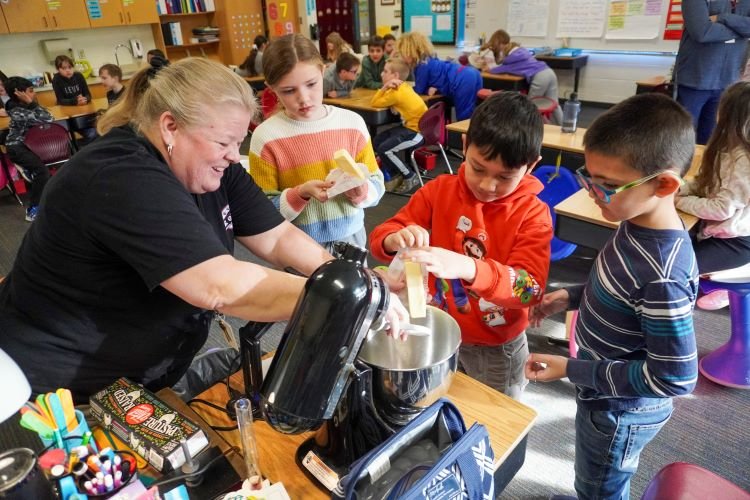
Throughout Grand View Elementary School, the smell of baked goods wafted through the halls, the sound of stand mixers echoed through the classrooms, and each class tackled a unique challenge for National Reading Month. It involved baking an award-winning pound cake by reading and following a book. recipe.
“Children become very good at reading fiction and nonfiction. It’s all part of our classroom activities, but we also understand that reading touches many other aspects of life. We want them to know that,” Vander Meer explained.
Each class took a different approach to making their pound cake stand out from the crowd. Some classes added chocolate chips, others added fruit toppings, and Vander Meer’s class planned a lemon glaze. The cakes were baked by Grand View’s kitchen staff and evaluated for taste, texture and appearance by front office staff, who selected one winner per grade level (just for bragging rights).
But the focus of the competition was reading. In Vander Meer’s classroom, this activity fit well with the study of nonfiction works.
“We talk a lot about nonfiction being written in order. Well, there’s nothing more orderly than recipes,” she said. “I have to follow it exactly in the order it’s written. I know what’s going to happen next, but I don’t want to move on.”
This activity was also connected to the third grade mathematics curriculum. The class had just finished a unit on fractions, so they were able to apply their newfound knowledge to real-life challenges.

Emily Grooms sifts flour as teacher Mary Vander Meer supervises

Third graders Brenna McCune and Braden Cook try their hand at squeezing lemons.
“In baking, you need to understand what something like a half teaspoon is. You need to look at a fraction in a recipe and know what it means,” Vander Meer says. “The combination of fractions and reading strategies here is great for (students) to apply what they’re doing in class and see that they can do what they learned in school every day.”
While Vander Meer named each stage of the baking process, Reihau Eugenio’s name was chosen for one of the most coveted jobs: breaking eggs. However, the third-year student said she was not too nervous to tackle this delicate task with everyone watching, as she had done it before.
In fact, he said he already has a lot of experience reading recipes.
“I learned most of my cooking from my grandmother who lived in Lake Odessa,” Reihau said. “She had an old box full of recipes for cookies and cakes and things, and I read her recipes.”

Although Reihau said she usually cracks eggs to make foods like French toast and scrambled eggs, her reading and math expertise has helped students in her class win the pound cake contest. “I’m pretty confident,” he said. (Spoiler: They did!)
“We’ve already learned how to measure fractions and liquids, which I think is good because we need to measure the ingredients we need fairly accurately,” he said. “I think quite a few (classmates) are pretty good at baking.”
Read more about Granville:
• Ten years later, education is still all about relationships.
• Scrub up, it’s English time
